For most casual movie viewers, character actor Timothy Carey was probably best known for his bit roles in a number of classic films. He was the sharpshooter that gunned down a race horse in Stanley Kubrick's The Killing (1956), the sobbing solider sentenced to death in Paths of Glory (1957), a beer-throwing biker in The Wild One (1953). It's only upon closer inspection that one gets a true sense of the fascinating imprint Carey left on film. Carey may have spent most of his life playing small parts in big movies, but his insistence on taking those moments and making them stand out from the other supporting parts is awe-inspiring. He was larger-than-life, both in appearance and in personality, and once you noticed him in a film he would quickly become hard to forget. He was such a notorious scene-stealer that he often clashed with some of his more famous co-stars.
Stories abound in Hollywood about his famous confrontations on film sets; Kirk Douglas reportedly hated his guts. Carey allegedly got beat up by Richard Widmark on the set of The Last Wagon (1956) and was practically choked to death by Seymour Cassel during the filming of The Killing of a Chinese Bookie (1976). He was kicked in the ribs by Karl Malden and stabbed with a pen by Marlon Brando during the filming of One-Eyed Jacks (1961). On top of this, Carey would simply do anything to secure a role. He dressed up in costume and scaled the walls at 20th-Century-Fox for a part in Prince Valiant (1954). He reportedly knocked on Billy Wilder's trailer door during the filming of Ace in the Hole (1951), causing Wilder to cut himself while shaving, and still had the nerve to ask the famous director for a job (Ace in the Hole was his first official screen credit). Carey himself claimed he was "probably fired more than any other actor in Hollywood."
By the late fifties, Carey had grown tired of making his way through the Hollywood system and longed to make his own picture, one that he could have complete control over, and would showcase his talent in a big way. It wasn't long before Carey began work on what would become his unacknowledged "masterpiece" in 1958 - The World's Greatest Sinner. This would be the ultimate Carey vehicle - a controversial tale that incorporated a variety of polarizing topics, religion, politics, corruption, stardom, rock and roll, life and death; all at a time that was just prior to the great social and cultural upheavals of the 1960's.
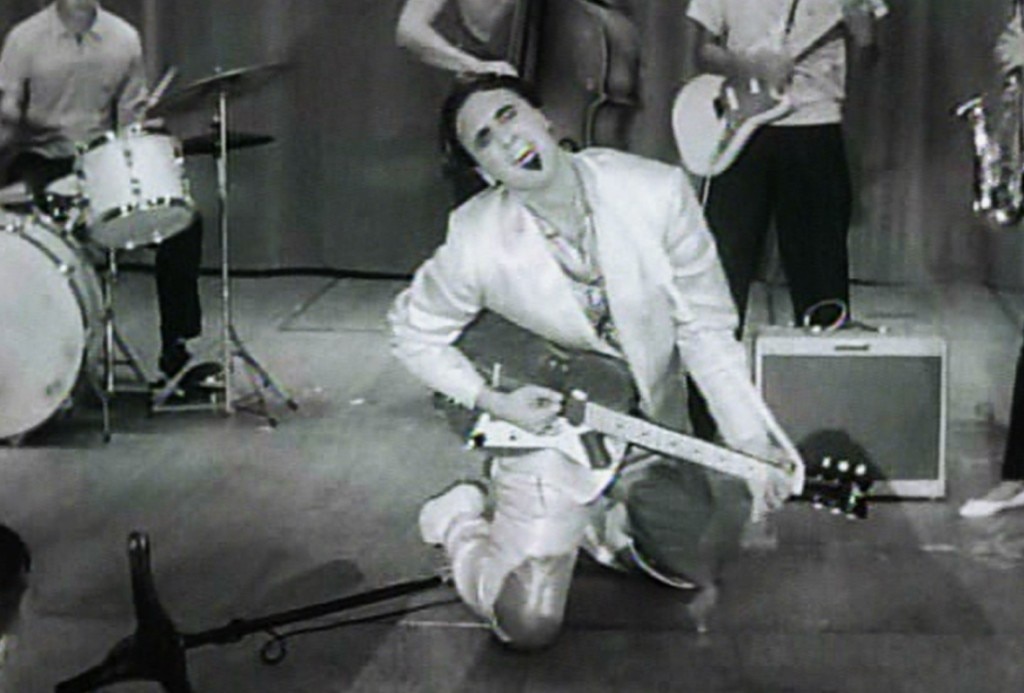
At the center of The World's Greatest Sinner is Clarence Hilliard (Carey), an insurance salesman and family man who has a vision one day and realizes his job is meaningless so he promptly quits. Instead he dedicates himself to spreading his newfound philosophy of life - to live without fear. After watching a rockabilly band perform, he decides to take up guitar with the mission of becoming a rock star. Under the advice of Satan himself (in the form of a snake) and the assistance of his gardener (Gil Barreto), Clarence begins to rally people in the streets, encouraging them to join his newly formed "Eternal Man Party" where he promises they will be become "superhuman beings" and will never die. He seduces elderly women for money, applies a fake goatee to his face, and starts calling himself "God". He begins performing in concert before hundreds of newly acquired fans in a gold lame suit, gyrating and thrashing on stage, as he urges the masses to "Please! Please! Please! Take...my...hand!" His followers begin wearing armbands with the letter "F" written on them (for "follower") and word spreads about the self-made messiah. As "God", he becomes a national phenomenon and is persuaded to run as an independent for President of the United States. By this time, however, "God" has become a power-hungry dictator, having sexual relations with underage girls, and engaging in all kinds of immoral behavior as a direct challenge to the real "God," who soon appears for a final showdown.
The World's Greatest Sinner is a weird, wild, one-of-a-kind film that never really had an official theatrical release. Outside of some initial showings in 1962, the film hasn't been seen in years and has acquired an enormous cult reputation based on the comments of audience members who were lucky enough to have seen it. Carey himself was incredibly proud of the film and if any movie qualifies as a true "underground" film, this is it. From the bizarre camera angles to the jump cuts to the manic performance of Carey as Clarence "God" Hilliard, the actor was involved in every aspect of The World's Greatest Sinner: producing, writing, directing, editing, and of course, casting himself in the lead role. The earnings made from his prior film work as well as his frequent guest appearances on television helped fund the production, and he was able to find additional financing (including an investment of $25,000 from M.A. Ripps, the producer of another Carey film, Bayou , a.k.a. Poor White Trash, 1957). Carey recruited friends and family to help him make The World's Greatest Sinner, and one of those he hired was a young musician by the name of Frank Zappa, who penned the theme song and composed the music score. Legendary cult filmmaker Ray Dennis Steckler (The Incredibly Strange Creatures Who Stopped Living and Became Mixed-Up Zombies!!?, 1964) also served as one of the cinematographers; it was one of his first jobs in Hollywood.
Carey handled the entire distribution of The World's Greatest Sinner himself, bringing the prints to theaters that would dare screen it (his son Romeo carries on the tradition to this day). Although his film never outgrew its underground status, Carey continued to work on The World's Greatest Sinner for the remainder of his life, shooting new scenes and re-editing footage right up to his death in 1994. TCM will be showing Carey's 1965 re-edit of The World's Greatest Sinner which also went by the title of The Cult of the World's Greatest Sinner.
Producer: Timothy Carey
Director: Timothy Carey
Screenplay: Timothy Carey
Cinematography: Frank Grande, Robert Shelfow, Ray Dennis Steckler, Ove H. Sehested
Music: Frank Zappa
Film Editing: Carl Mahakian, Lee Strosnider
Cast: Timothy Carey (Clarence Hilliard), Gil Barreto (Alonzo), Betty Rowland (Edna Hilliard), James Farley (the Devil), Gail Griffin (Betty Hilliard), Grace De Carolis (mother), Gitta Maynard (elderly woman), Gene Pollock (priest), Whitey Jent (guitar player), Carolina Samario (Nate), Victor Floming (Office boss), Ann Josephs (secretary), Jenny Sanches (old lady in church).
BW&C-82m.
by Millie de Chirico
The Gist (The World's Greatest Sinner) - THE GIST
by Millie de Chirico | August 14, 2008
SIGN UP FOR OUR NEWSLETTERS

CONNECT WITH TCM