"The Troubles," Ireland's battle for independence from Britain that
lasted from 1912 to 1922, was recent history in the 1930s. And the
story of assassinated Irish revolutionary Michael Collins was a
dramatic subject for a feature film. The real Collins had been
instrumental in convincing the pro-independence rebels to accept a
compromise that divided Ireland, and die-hard independence advocates
are generally believed to be responsible for his murder. Samuel
Goldwyn's Beloved Enemy (1936) is loosely based on the Collins
story, placing a fictional romance between the revolutionary hero and
an Englishwoman front and center, and giving the lovers credit for
negotiating the compromise.
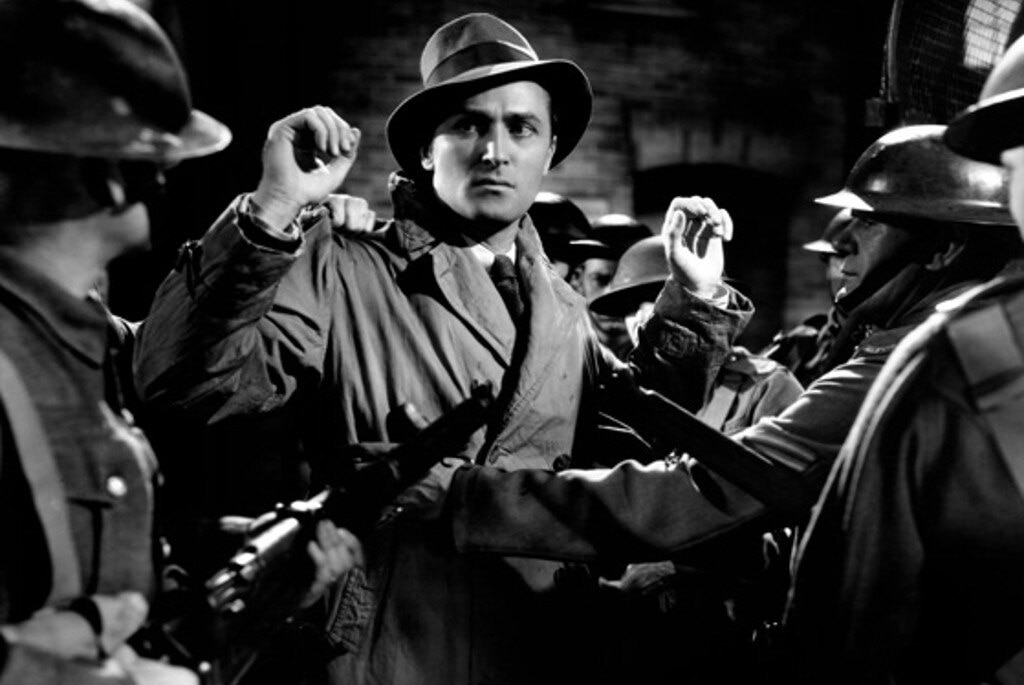
Rebel leader Dennis Riordan (played by English actor Brian Aherne)
meets Helen Drummond (Merle Oberon) when he saves the life of her
father (Henry Stephenson), a British diplomat who's gone to Ireland to
try to negotiate a peaceful solution to the rebel uprising. Riordan
and Helen fall in love, but circumstances are against them, and when
Riordan is nearly captured, the lovers agree to part. They meet again
when Riordan goes to London for negotiations, and Helen convinces him
to agree to a compromise for the sake of peace. After he returns to
Ireland, Riordan becomes a target for Irish separatists unhappy with
the agreement.
Beloved Enemy was the second film Merle Oberon made with Samuel
Goldwyn. Oberon had been discovered in England by producer Alexander
Korda, who put her under contract in the early 1930s. To promote her
career in America, Korda sold part of her contract to Goldwyn, who
starred her in The Dark Angel (1935). The performance earned
Oberon her only Oscar® nomination. Her peak was probably 1939,
when she appeared in Goldwyn's Wuthering Heights. She married
Korda that same year.
Still recovering from gall bladder surgery and an appendectomy,
Goldwyn turned over the supervision of Beloved Enemy to George
Haight, although Haight was only given an Associate Producer credit.
To direct, Goldwyn agreed to Haight's suggestion of hiring his former
Broadway producing partner and Yale classmate H.C. "Hank" Potter.
Goldwyn had employed Potter the previous year at Haight's suggestion,
and Potter had been on the lot for a year with nothing to do.
Beloved Enemy marked Potter's film directing debut. Potter went
on to direct gentle comedies such as The Farmer's Daughter
(1947) and Mr. Blandings Builds His Dream House (1948).
The two neophytes were helped enormously by the work of
cinematographer Gregg Toland, whose best work (Citizen Kane,
1941) lay ahead, but who was already known for his innovative lighting
and camerawork. Praising Beloved Enemy, Frank Nugent wrote in
the New York Times, that "...giving it its final luster is
Gregg Toland's photography which has an almost golden patina."
Two endings were shot for Beloved Enemy, a tragic one and a
happy one. The film was released and reviewed with a tragic ending -
Frank Nugent's New York Times review mentions the "tragically
foredoomed romance," and describes the ending; so does Variety,
which notes that an alternative ending was shot, but adds that "the
tragic note seems consistent with the plot." Apparently, audiences did
not agree. Box office was disappointing, and the ending was changed to
the happy one. Reviews were mixed; Nugent's was among the most
enthusiastic, calling the film "A fine and mature and dignified drama
of the Irish Rebellion of 1921, it has the stamp of quality on each of
its departments."
It took 60 more years for a biographical film, Michael Collins
(1996), to make it to the screen, starring (real) Irish actor Liam
Neeson, with Julia Roberts playing Collins' (real) fiancee Kitty
Kiernan, and not an English sweetheart in sight. The film stuck more
closely to the facts than Beloved Enemy did, but some critics
and historians still deplored Michael Collins's historical
inaccuracies.
Producer: Samuel Goldwyn, George Haight (uncredited)
Director: H.C. Potter
Screenplay: Rose Franken, William Brown Meloney; David Hertz
(additional dialogue); John L. Balderston
(uncredited)
Cinematography: Gregg Toland
Art Direction: Richard Day
Film Editing: Sherman Todd
Cast: Merle Oberon (Helen Drummond), Brian Aherne (Dennis Riordan),
Karen Morley (Cathleen O'Brien), Henry Stephenson (Lord Athleigh),
David Niven (Capt. Gerald Preston), Jerome Cowan (Tim O'Rourke),
Donald Crisp (Liam Burke), Ra Hould (Jerry O'Brien), Granville Bates
(Ryan), P.J. Kelly (Rooney), Leo McCabe (Connor), Pat O'Malley
(Callahan), Jack Mulhall (Casey).
BW-90m.
by Margarita Landazuri
Beloved Enemy
by Margarita Landazuri | August 12, 2008
SIGN UP FOR OUR NEWSLETTERS

CONNECT WITH TCM