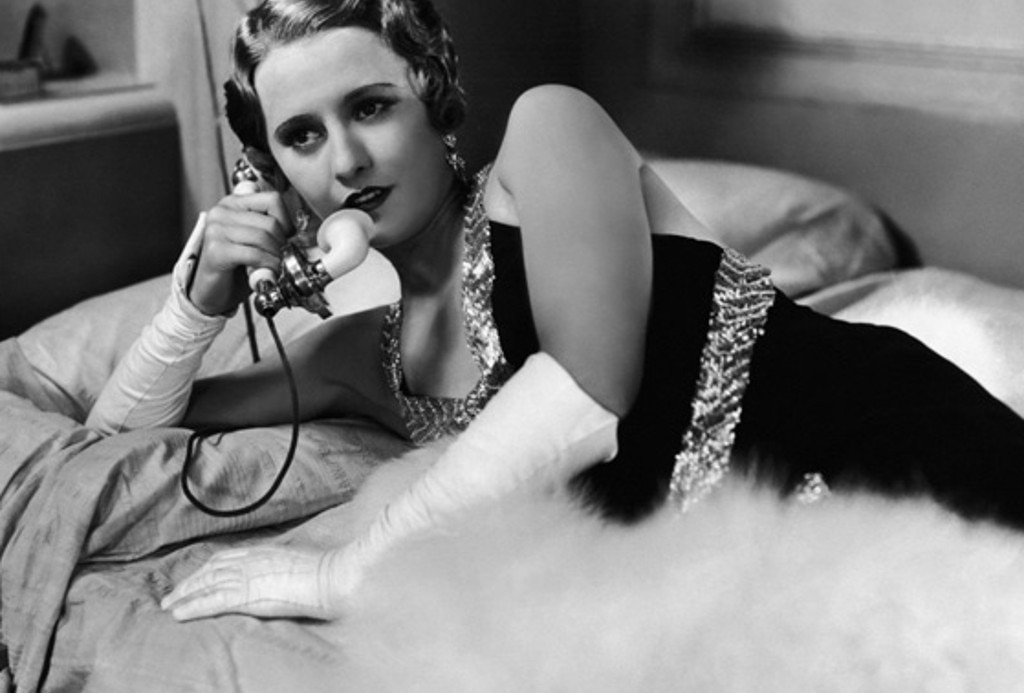
On an ocean voyage, a librarian falls for a married man in the Pre-Code soap opera, Forbidden (1932), starring Barbara Stanwyck and directed by Frank Capra.
In his autobiography, The Name Above the Title, Capra made it clear that he was still
developing as a filmmaker during the period in which he made Forbidden. "Platinum
Blonde recharged my cockiness," he wrote. "The less-than-miraculous Miracle Woman [also
starring Stanwyck] was the only entry in my Columbia "loss" column. I demanded a rematch with
"ideas." But this time, by George, on my terms. I would write my own "idea" film. I fancied I
could write, anyway. So, with a very large assist from Fannie Hurst's Back Street, I wrote an
"original" story, Forbidden...I had yet to learn that drama is not really just actors weeping
and suffering all over the place. It isn't drama unless the audiences are emotionally moved.
Actors' crocodile tears alone can't touch their hearts. But courage, faith, love, and sacrifices for
others will - if believable. In spite of scriptwriter Jo Swerling's valiant efforts to write in some
"bones," Forbidden ended up as two hours of soggy, 99.44% pure soap opera. Some critics
moistened their reviews with tears, most burned them with acid. Forbidden was saved from the
"loss" column by one or two directorial "gems" (sic), and the fine believable performances of
Barbara Stanwyck, Adolphe Menjou, and Ralph Bellamy (one of his earliest films)."
Barbara Stanwyck didn't want to make Forbidden because she felt Columbia studios was not
honoring their contract with her. According to Joseph McBride in Frank Capra: The Catastrophe of
Success, "Forbidden was set to start filming in April 131, shortly after the completion
of The Miracle Woman. But Stanwyck was having a contract dispute with Harry Cohn. She was
obligated to make three more pictures for Columbia on a nonexclusive basis. Following her success in
Ladies of Leisure, she also had made a deal with Warner Bros., but she felt she deserved more
from Columbia now that her name had more box-office allure. Cohn was paying her #2,000 a week, but
only when she was actually making a film (usually about a six-week period). She held out for more,
and on July 17 it was announced to the trade press that she had "failed to put in an appearance at
the Columbia studio for the production of Forbidden...As it stands now, Forbidden has
been laid aside and Miss Stanwyck claims screen retirement."
While Cohn attempted to pressure Stanwyck into making the film, Capra moved on to his next project,
a comedy with the working title of first, The Blonde Lady, and then Gallagher, which
eventually was released as Platinum Blonde. For a while, Columbia fed the press reports that
Helen Hayes was being considered as a replacement for Stanwyck in Forbidden and then Cohn
took Stanwyck to court and won his case. Stanwyck agreed to return to work at Columbia but even
though Cohn had gotten his way, he agreed to raise her salary to $5,000 a week and allow her to make
three films for Warner.
The filming of Forbidden was relatively noneventful except for the occasional appearance of
Frank Fay, Stanwyck's husband, on the set. The couple was going through a difficult time in their
marriage and it may have had to do with Stanwyck's sudden popularity which Fay, also an actor, had a
hard time accepting. He was also extremely possessive and jealous and was usually in a hostile mood
when he visited the Forbidden set. "I can remember vividly how the crew would separate and
make way for him," Ralph Bellamy said (in McBride's biography). "He was a very unpopular guy - and
worked at it." At the same time, Fay didn't seem to be aware that Stanwyck and Capra were having an
affair. They were very discreet and never linked together romantically by the press at the time.
The only other incident that affected the filming of Forbidden occurred in Malibu when
Stanwyck was injured in a horseback-riding scene for the film. "It's a little hard to believe now,"
wrote Ella Smith in her book, Starring Miss Barbara Stanwyck, "but Stanwyck was then afraid
of horses. A double had done the riding, and Capra was preparing for a close-up of Stanwyck on the
animal. He thought he had taken every precaution, but when the reflectors caught the light, they
bounced it into the horse's eyes and scared him. He reared, threw her, and - because his feet were
in wet sand - lost his balance and fell back on her. The soft sand saved her, but not from
injury."
Ralph Bellamy recalled (in The Films of Frank Capra) that "Forbidden was the fourth of
my ninety-six feature pictures to date, and....it's still one of my most pleasant memories. Barbara
Stanwyck had just become a star of magnitude and a dream to work with. And Frank Capra was just
beginning to be recognized as the great director he became. The picture wasn't a classic, but it was
a great part and fun to do."
As Capra had previously stated, Forbidden was not well received by the critics. A typical
opinion was expressed by Mordaunt Hall in The New York Times which called it "a cumbersome
effort at storytelling...It happens invariably when a director tackles his own brainchild that the
result is disappointing." Capra would have much better luck with his next picture, American
Madness (1932), and Stanwyck would follow this with another "women's picture" for Columbia,
Shopworn (1932), which fared much better with critics and audiences alike.
Producer: Harry Cohn
Director: Frank R. Capra
Screenplay: Jo Swerling; Frank Capra (story)
Cinematography: Joseph Walker
Music: Irving Bibo, David Broekman, Alfonso Corelli (all uncredited)
Film Editing: Maurice Wright
Cast: Barbara Stanwyck (Lulu Smith), Adolphe Menjou (Bob Grover), Ralph Bellamy (Al Holland), Dorothy Peterson (Helen Grover), Thomas Jefferson (Wilkinson), Oliver Eckhardt (Briggs), Charlotte Henry (Roberta, age 18, Myrna Fresholt (Roberta as a baby)
BW-85m.
by Jeff Stafford
Forbidden
by Jeff Stafford | July 03, 2008
SIGN UP FOR OUR NEWSLETTERS

CONNECT WITH TCM