As its title indicates, How the West Was
Won takes on a big subject, and the
production was big enough to match it. Running a
generous 162 minutes plus intermission, the movie
had four directors: Henry Hathaway, John Ford,
and George Marshall directed the dramatic
segments, and Richard Thorpe did the transitional
sequences, uncredited. It also has the kind of
luminous cast that only MGM could have assembled
in the early 1960s, when the old studio system
and its iron-clad contracts were vanishing into
the sunset. Most important of all, the movie was
in Cinerama, the most prestigious wide-screen
process of its time, and the ideal format for
sprawling Old West vistas.
How the West Was Won tells five separate
stories involving various members of a pioneer
family, starting in the 1830s and ending fifty
years later. The first episode shows the Prescott
clan rafting west on a river, encountering
tragedy when two members of the family drown, and
finding hope when a friendly mountain man (James
Stewart) falls in love with one of the pretty
daughters (Carroll Baker) and later marries her.
In the second part, the other daughter (Debbie
Reynolds) is a riverboat singer being courted by
two men (Gregory Peck, Robert Preston) with very
different personalities. The third episode
centers on a shaky young Civil War soldier
(George Peppard) who crosses the paths of two
famous generals (John Wayne, Henry [Harry]
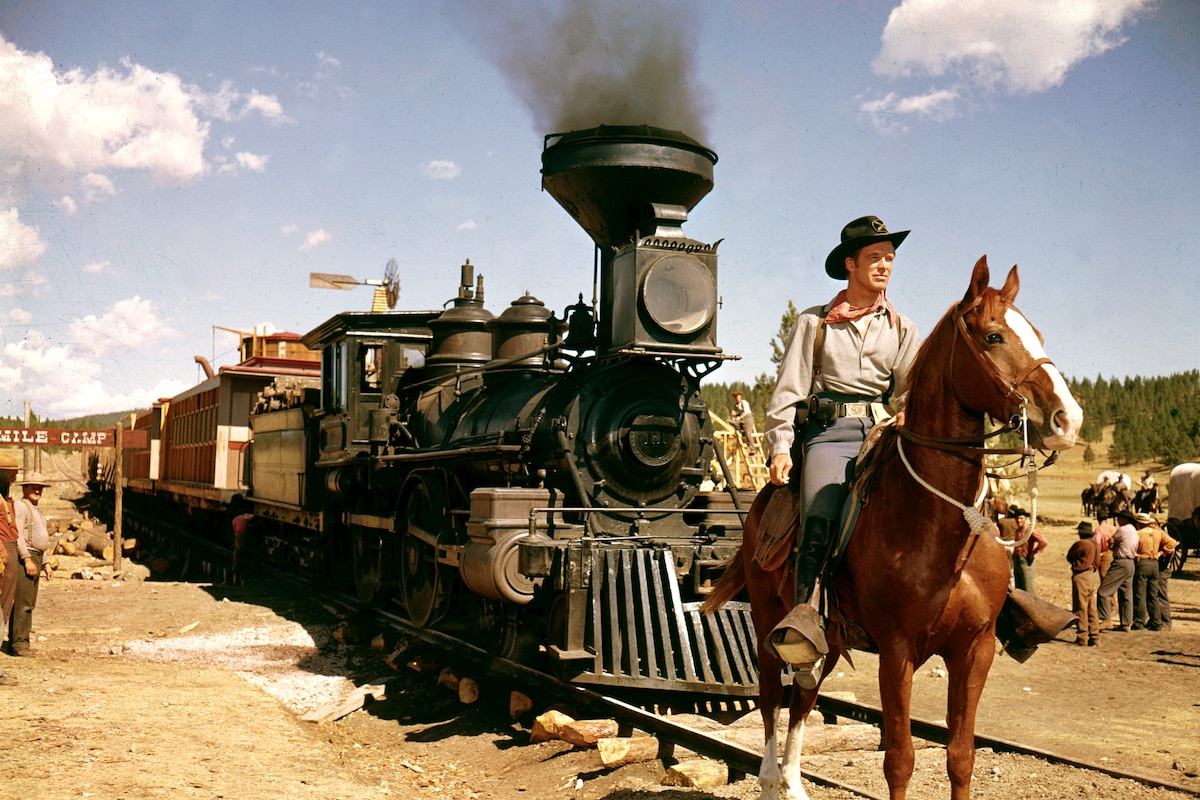
Morgan) and foils an assassination. In the fourth
chapter, two railroad companies have a war that
sets a buffalo hunter (Henry Fonda) against a
greedy capitalist (Richard Widmark) who causes
bloodshed by cheating the Arapahos who live where
he wants to build, and in the last segment a
marshal (Lee J. Cobb) helps to ambush a crazy
outlaw (Eli Wallach) who's setting up a great
train robbery. Suggested by an eponymous series
of Life magazine articles, the picture
earned James R. Webb an Academy Award for best
original screenplay. Out of seven other
nominations, Oscars also went to the film editing
and sound.
Until the premiere of How the West Was Won
in early 1962, documentaries had filled
Cinerama's release slate ever since its 1952
debut attraction, This Is Cinerama, wowed
movie fans with a Spanish bullfight,
water-splashed views of Niagara Falls, and other
imposing sights, including a roller-coaster ride
that had patrons reeling in their seats. After
four more nonfiction films, Cinerama broadened
its horizons by striking a deal with MGM for two
narrative movies that would exploit the special
properties of the curved 146-degree screen and
seven-speaker stereophonic sound; the other MGM
coproduction was The Wonderful World of the
Brothers Grimm, shot simultaneously but
released six months after the western epic. These
were the last two pictures (and the only
narrative films) shot in the classical
three-strip Cinerama process, which was replaced
by 65-mm and 70mm formats for subsequent Cinerama
films ranging from It's a Mad, Mad, Mad, Mad
World in 1963 to 2001: A Space Odyssey
in 1968.
How the West Was Won comes across today as
a distinctly old-fashioned western low in
bloodshed, moderate in action, high in
eye-catching scenery. Knowing that many Cinerama
patrons brought their children along, the
producers kept gunplay to a minimum and
eliminated a subplot about a pregnant woman who
leaves home to be a single mom, even though this
last-minute change meant that part of the
railroad episode, filmed by Marshall on location,
had to be reshot by Hathaway on a soundstage. The
picture's best action sequences are still pretty
exciting, though, and they're extra impressive
when you remember the massive size and weight of
the Cinerama camera, which was really a set of
three synchronized cameras side by side, each
shooting its own strip of film. Among its other
disadvantages, this apparatus gives enormous
depth of field, with everything in focus no
matter how near or far away it is; so if an
intimate outdoor scene takes place without a
visual barrier behind it, acres of background
have to be groomed as carefully as the actors in
the foreground.
Speaking of intimate scenes, Cinerama places
particular demands on dramatic acting. Due to the
camera's unique optical properties, a Cinerama
close-up can't be very close a waist-up view is
the best the format can manage and the device's
fixed lenses mean the whole gizmo has to be moved
every time a new vantage point is needed. On top
of all this, the lenses point in slightly
different directions, so unless the players are
occupying the same segment of the screen, they
have to gaze not at each other but past each
other to look like they're interacting face to
face. This is why Cinerama directors often group
key characters in the center panel of the screen,
leaving the side panels to scenery and extras.
Another common trick is to set up the camera so
that vertical objects (trees, pillars, etc.) are
located on the left and right sides of the center
panel; when the three film strips are projected
from three different booths in the theater, these
objects hide the vertical join-lines where the
three pictures come together on the screen. It's
little wonder that an old Hollywood hand like
Ford quickly lost patience with the ungainly
process. He'd been sitting right next to the
camera for almost fifty years, but if he did it
now he'd block part of a lens and end up in the
shot! The somber Civil War episode of How the
West Was Won marked his first and last
Cinerama experience.
Warner Home Video's edition of How the West
Was Won is packaged with first-rate DVD
extras including the feature-length documentary
Cinerama Adventure, about the history of
the format, and a lively commentary track
featuring film historian Rudy Behlmer and
film-music expert John Burlingame along with
Cinerama chief John Sittig, documentary director
David Strohmaier, and stuntperson Loren James,
who took a daunting number of falls, tumbles, and
spills in the picture without meeting the fate of
his colleague Bob Morgan, who was permanently
maimed when a stunt went wrong during the
train-robbery scene. (Morgan himself talks about
this in Cinerama Adventure, but the
commentary track is inexplicably silent about
it.) In addition to the challenges it posed to
filmmakers and performers, however, Cinerama
presents interesting tests for DVD producers. The
commentary track keeps claiming that high-tech
video processing has erased the join-lines from
the wide-screen image, but they're plain to see
in many parts of the film. And there's no way a
home-video system can reproduce the impact of the
super-huge and ultra-curved Cinerama screen. The
original aspect ratio (about 2.89:1, although
accounts vary) comes out like a ribbon, and even
the most sophisticated flat-screen TV is, well,
flat.
This said, How the West Was Won is a very
colorful ribbon, and while the adventure doesn't
exactly jump from the screen, it offers a fair
amount of traditional western excitement along
with creaky ingredients that have old-Hollywood
charms of their own. IMAX has won the war of the
wide screens, but Cinerama still lingers on the
sidelines, and even the DVD version provides a
hint of what all the excitement was
about.
For more information about How the West Was
Won, visit Warner Video.
To order How the West Was Won, go to
TCM Shopping.
by David Sterritt
How the West Was Won - The Restored Version of HOW THE WEST WAS WON on DVD
by David Sterritt | June 11, 2008
SIGN UP FOR OUR NEWSLETTERS

CONNECT WITH TCM