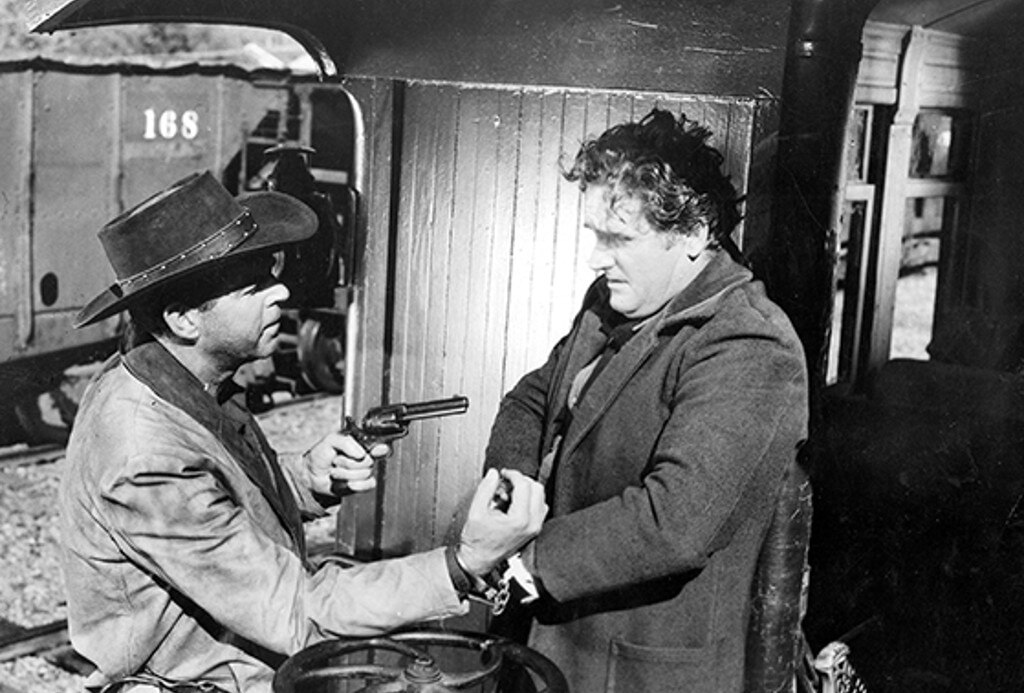
Fred MacMurray is probably best known today as the soft-spoken, avuncular middle-aged star of the long-running TV series My Three Sons and the fantasy-comedies The Shaggy Dog (1959) and The Absent-Minded Professor (1961). Prior to that period, however, there was a darker, more complex side to many of his roles (most notably in the classic film noir Double Indemnity, 1944). Face of a Fugitive (1959) falls more into that category, with MacMurray cast as a morally ambiguous protagonist in one of the last of the minor Westerns that sustained him through the leaner years of the late 1950's, before Disney and TV audiences gave him a whole new career.
Here he plays a bank robber on the lam accused of killing a deputy sheriff. The real killer is his own brother, who dies early on. Changing his name, MacMurray attempts to start over in a new town close to the Mexican border, promptly falling for the deceased deputy's sister and getting involved in a bitter dispute between a corrupt rancher and the town sheriff. In defending the sheriff, MacMurray facilitates his own capture, even as he begins to redeem his criminal past. Perhaps the most notable detail about this downbeat Western is that the action all takes place in the course of a single day, with a chase at the climax providing the story's most exciting action.
This same year, director Paul Wendkos made a far more successful picture, Gidget (1959). He later made the other two Gidget movies (Gidget Goes Hawaiian [1961) with Deborah Walley, Gidget Goes to Rome [1963] starring Cindy Carol), but spent most of his career working in television, although not on the Gidget hit series with Sally Field or any of the made-for-TV movies centered on the character.
Producer Charles H. Schneer's career took in a handful of Westerns and war movies, but he left his real mark in a long association with Ray Harryhausen, the special effects master of his time. Starting in 1955, they made eleven pictures over the next quarter century-plus, including The 7th Voyage of Sinbad (1958), Jason and the Argonauts (1963), and their last (together and separately), Clash of the Titans (1981).
Face of a Fugitive - the original working title was Justice Ends with a Gun - was only the third feature film scored by Jerry Goldsmith, who went on to become one of the most successful film composers of his time. Between 1979 and 1999, he was Oscar®-nominated seventeen times and won once, for The Omen (1976).
Although MacMurray starred as the anti-hero, the real bad guy in this movie is James Coburn, who is particularly nasty in his second feature film appearance. After Face of a Fugitive, he went back to television guest spots, often in Western series, until his breakthrough roles in The Magnificent Seven (1960) and The Great Escape (1963). Late in his career, he won a Best Supporting Actor Academy Award for Affliction (1997).
Director: Paul Wendkos
Producer: Charles H. Schneer
Screenplay: David T. Chantler, Daniel B. Ullman, story by Peter Dawson
Cinematography: Wilfred M. Cline
Editing: Jerome Thoms
Art Direction: Robert Peterson
Original Music: Jerry Goldsmith
Cast: Fred MacMurray (Jim Larsen), Lin McCarthy (Sheriff Mark Riley), Dorothy Green (Ellen Bailey), Alan Baxter (Reed Williams), James Coburn (Purdy).
C-80m.
by Rob Nixon
Face of a Fugitive
by Rob Nixon | May 27, 2008
SIGN UP FOR OUR NEWSLETTERS

CONNECT WITH TCM