Of the five titles in Fox Home Entertainment's new Carmen
Miranda Collection, The Gang's All Here (1943) is the
most newsworthy. Released just over a year ago in Fox's Alice
Faye Collection, the movie looked murky and faded - a real
tragedy, for The Gang's All Here is famous for the dazzling
leaps it made with three-strip Technicolor. Happily, Fox has taken
the widespread criticism to heart and remastered the picture, with
a result that pops. (Even the movie's DVD case looks brighter than
before!)
It's ironic that this movie has been released on DVD in two
different collections in such a short time frame, for it's best
characterized not as an Alice Faye or a Carmen Miranda movie, but
as a Busby Berkeley movie. It is far and away dominated by
Berkeley's consistent visual inventiveness, be it his kaleidoscopic
and geometric overhead shots, his knockout color schemes, his
special effects, or just by the props and objects that he places in
the frame.
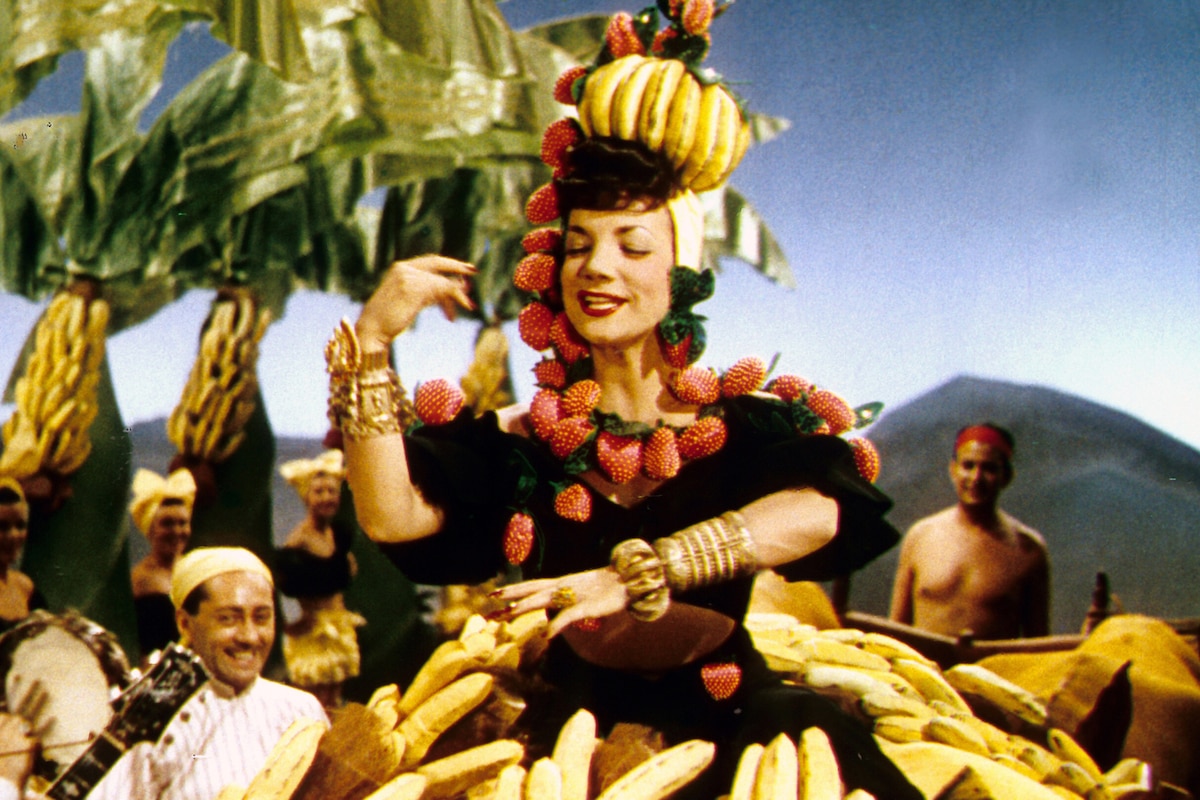
For example, before shooting Carmen Miranda's unforgettable number
"The Lady in the Tutti-Frutti Hat," Berkeley must have told the
studio brass something like the following: "I'll need half a dozen
small monkeys, two oxen, 40 giant prop bananas, and, oh, about 2000
small ones." A statement like that signifies either utter madness
or utter genius. Luckily, Fox chief Darryl Zanuck had been at
Warner Brothers in the 1930s when Berkeley choreographed Gold
Diggers of 1933 (1933) and Footlight Parade (1933), and
therefore was unfazed by any level of wackiness this time around.
He simply gave Berkeley what he needed (including a high budget and
a long shooting schedule), and for that we can all be
thankful.
The picture shows right off the bat that it's not going to be
presenting itself in the usual musical way; the first image is of a
disembodied head singing in the upper left corner of a black
screen. When the final number comes to an end 103 minutes later,
the last thing we see is a frame filled with singing disembodied
heads! It's safe to say that if Busby Berkeley had never been
born, no filmmaker would ever have thought of doing this. It's but
one of countless images here that manage to be bizarre, funny,
surreal and wonderful in one big mishmash.
For all the craziness of the numbers, The Gang's All Here is
pure WWII-era escapism that speaks to the girls left behind by
war-bound American soldiers. It also gives us the male fantasy of
a serviceman sweeping Alice Faye off her feet. James Ellison is
about to leave for the Pacific, but before he goes he falls for the
seemingly untouchable showgirl Faye, and after some resistance, she
falls, too. He goes to war and returns a hero, but his longtime
sweetie (Sheila Ryan) expects to marry him. She's become friends
with Faye, who doesn't know about Ellison's two-timing. Carmen
Miranda plays another singer who basically tries to keep the peace,
but the plot isn't nearly as important as this synopsis makes it
sound. It's boy meets, loses, and gets girl, set to the luscious
music of Benny Goodman and His Orchestra (they're in the film and
Benny has a speaking role) and the unique imagery of
Berkeley.
Alice Faye performed in this film right after Hello Frisco,
Hello (1943), and she was soon to make her last movie
(Fallen Angel, 1945) before leaving Hollywood and her
career. She looks especially beautiful here and sings a few songs
including the superb "No Love, No Nothin'" and "A Journey to a
Star." Faye's biographer Jane Lenz Elder has written, "More than
any other actor in The Gang's All Here, Alice emerges as a
three-dimensional human being rather than a caricature... Berkeley
uses Alice to anchor the rest of the film's action, which critics
and audiences noted with approval."
Carmen Miranda, on the other hand, was at her peak in this film.
It was her sixth American movie and the most prominent role she had
yet played. She helps carry this picture, and not just with her
singing and dancing; she gets quite a few acting scenes as well,
including a hilarious sequence with Edward Everett Horton in which
her kisses almost turn him into a proverbial jungle cat! Born in
Portugal, raised in Brazil, Miranda had become a singing star and
made a few Brazilian films before coming to America to star in
musical revues on Broadway. It was only a matter of time before Fox
came calling and put her in the Betty Grable/Don Ameche feature
film Down Argentine Way (1940). She was a sensation in her
jaw-dropping costumes and hats and with her endless energy. Film
historian Jeanine Basinger writes in her book The Star
Machine that to filmgoers in the 1940s, Miranda "was an
exaggeration and a welcome one." Carmen Miranda and Maria Montez,
Basinger says, "were stars of the moment in an era that needed
their humor, their color, and their considerable pizzazz... They
remind us that people can have fun during dark times. They sent
things up with a deadly seriousness that is only to be
admired."
Also in the cast is Eugene Pallette, pairing comically with Horton
and even, yes, singing a lyric of the closing song. Look for Adele
Jergens as a chorus girl, June Haver as a hat check girl near the
opening, and Jeanne Crain as a girl in a bathing suit who asks
Charlotte Greenwood if she's going oor a dip in the pool. These
were Crain's first words on film.
Fox Home Entertainment has included all the extras that were on the
original DVD release: an audio commentary by Drew Casper, a deleted
scene (nothing special but worth a look), a well-produced
featurette on Berkeley, a short promotional film Alice Faye made
for Pfizer in 1985, which has her reminiscing on her career between
clips of her work, two episodes of Faye and husband Phil Harris'
1940s radio show, a trailer and various still galleries.
Also in this box set are four more Carmen Miranda pictures:
Greenwich Village (1944), Something For the Boys
(1944), Doll Face (1946) and If I'm Lucky (1946). The
various extras include a deleted scene from Doll Face, two
isolated score tracks, trailers and stills, and a new 83-minute
documentary entitled Carmen Miranda: The Girl From Rio which
is quite detailed and informative. (It's on the Something for
the Boys disc.) Fox has also thrown in a colorful 10-page
booklet with printed info on each film. Picture and sound quality
are excellent, especially on Doll Face, which looks
breathtakingly sharp. Each title comes in its own slim case, and
the artwork on all the packaging is beautiful, colorful and fun.
Carmen Miranda, whose glamorous face adorns the box cover, would
wholeheartedly approve!
For more information about The Gang's All Here, visit Fox Home Entertainment. To order
The Gang's All Here, go to
TCM Shopping
by Jeremy Arnold
The Gang's All Here - Busby Berkeley's First Technicolor Musical - THE GANG'S ALL HERE on DVD
by Jeremy Arnold | May 20, 2008
SIGN UP FOR OUR NEWSLETTERS

CONNECT WITH TCM