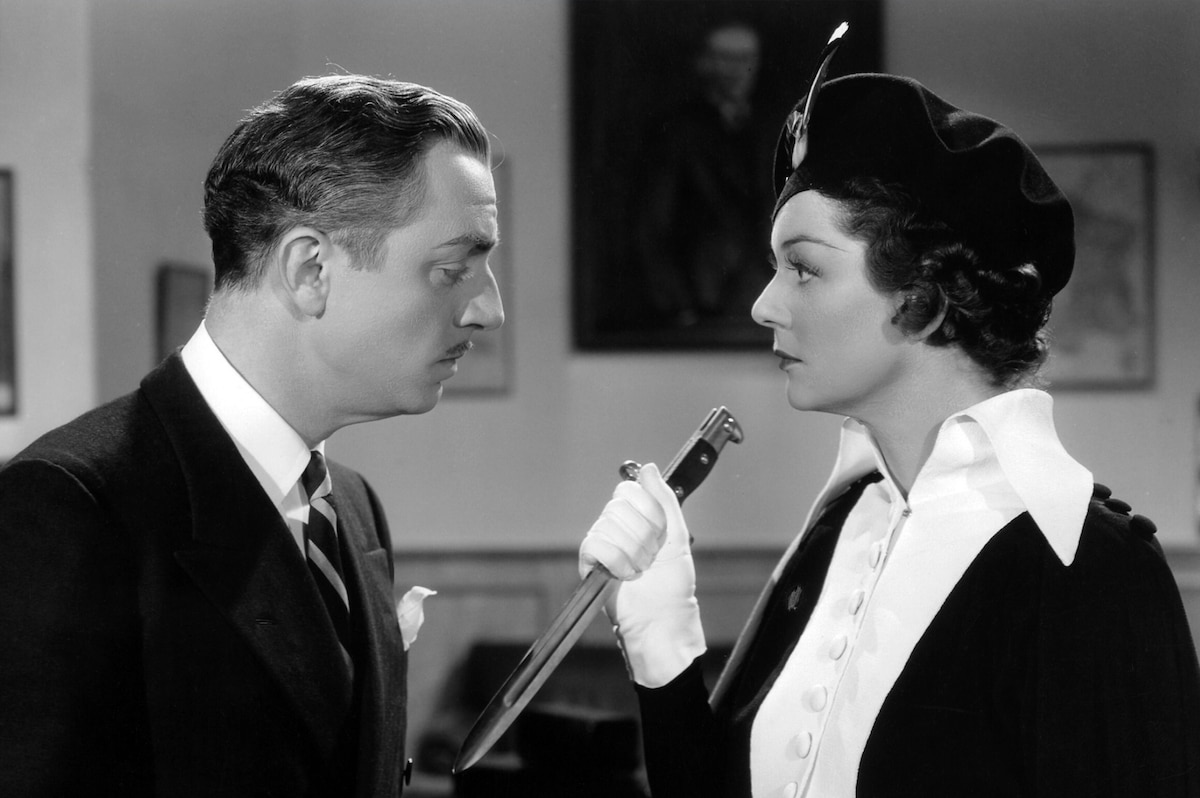
Rosalind Russell was still fresh off the Broadway stage when she was starred opposite William Powell in Rendezvous (1935) and she owed her good fortune to Myrna Loy. Loy and Powell had made the tremendously successful comedy-mystery The Thin Man the year before and Loy felt that she was entitled to more money than MGM was willing to pay so she went out on strike. Russell had made only one film - Evelyn Prentiss (1934) (coincidentally with Powell and Loy) - but she found herself in a starring role for Rendezvous. As she remembered later in her autobiography Life Is a Banquet, " [...] I was put into a movie called Rendezvous with Bill [Powell]. I felt self-conscious. Powell and Loy had been a hit in The Thin Man, they were an unbeatable team, so my first day on Rendezvous, I tried to apologize. "I know you don't want me, you'd rather have Myrna " Powell denied it. "I love Myrna, but I think this is good for you, and I'm glad we're doing it together." He was not only a dear, he was cool. If an actor thought he could get any place by having tantrums, watching Bill Powell would have altered his opinion. I remember a story conference during which he objected to a scene that he felt wasn't right for him. He was at once imperious and lucid. "It's beyond my histrionic ability to do this," he said. I thought that was delicious."
Rendezvous was based on a non-fiction book called The American Black Chamber by Major Herbert O. Yardley (head of the United States Secret Service during World War I) about code-breakers during WWI. Bella and Samuel Spewack adapted Yardley's book into a film with additional assistance from screenwriters P. J. Wolfson and George Oppenheimer. Powell plays a cryptographer who falls in love with a socialite (Russell). Russell tries to get Powell a safe desk job by pulling strings and meddles (as socialites often did in 1930s films) into everyone's business. There was something for everyone in Rendezvous: drama, espionage, romance and comedy to boot.
Production was a quick five weeks, from June 24th July 29th 1935. The Hollywood Reporter wrote that co-star Binnie Barnes' appendicitis delayed shooting briefly, but there were other problems. Director William K. Howard fended off rumors in the press that the film wasn't working and needed extensive reshoots by printing a letter in the Reporter saying the studio "was trying to decide on a very effective last act for the picture...which will exploit the talents of Miss Rosalind Russell." He did say that "the production never had a satisfactory ending" and, as is common in Hollywood, the producers were waiting for preview audience's reactions before deciding on retakes. At the same time Howard had to leave the production as he was obligated to start work on another film and Sam Wood took over. Howard Emmett Rogers and Herman Mankiewicz worked on the new script. Cameraman William Daniels (Garbo's favorite cameraman and who later shot I Love Lucy) was also pulled off Rendezvous to start on another picture so James Wong Howe did the reshoots, which took place September 6th 26th 1935.
The results must have been worth the hassle. When Rendezvous was released on October 25th critics were pleased though Russell suffered from comparisons to Myrna Loy. New York Times critic Andre Sennwald wrote "William Powell dashes urbanely in pursuit of the German espionage ring in the humorous and rousing spy melodrama called Rendezvous. With sleek banter and that blend of bored nonchalance and razored shrewdness that make him one of our most attractive performers, he introduces us to the counter-espionage maneuvers described by Major Herbert O. Yardley in The American Black Chamber. Assisted by Miss Rosalind Russell, Metro-Goldwyn-Mayer's second-string Myrna Loy, and a fascinating web of secret codes, he keeps the entertainment consistently vigorous even when it threatens to collapse into conventional spy patterns. Although the criticism is probably knavish, I must confess to a suspicion that the comedy relief assigned to Miss Russell in the role of a lady who refuses to be serious about the machinations of the enemy agents might have seemed considerably less kittenish if Miss Loy had been in the part. Occasionally the game becomes so bewildering as it approaches the solution that you are reminded of the hilarious hide-and-seek activities of Ben Turpin several years ago in Million Dollar Legs (1932). Under the able management of William K. Howard, the film preserves its sense of humor without disturbing its omnipresent air of mystery. There are effective performances by Mr. [Cesar] Romero as the wily German operative, Lionel Atwill as the helpless American chief and the charming Miss Barnes as the agent who holds the key to the enigma. With Mr. Powell at his debonair best, Rendezvous emerges as a lively and amusing melodrama."
Producers: William K. Howard, Lawrence Weingarten
Directors: William K. Howard, Sam Wood (uncredited)
Screenplay: P.J. Wolfson, George Oppenheimer; Bella Spewack, Samuel Spewack (adaptation); Herbert O. Yardley (book "American Black Chamber")
Cinematography: William Daniels, James Wong Howe (uncredited)
Art Direction: Cedric Gibbons
Music: Dr. William Axt
Film Editing: Hugh Wynn
Cast: William Powell (Lt. William 'Bill' Gordon/Anson Meridan), Rosalind Russell (Joel Carter), Binnie Barnes (Olivia Karloff), Lionel Atwill (Maj. William Brennan), Cesar Romero (Capt. Nicholas 'Nikki' Nieterstein), Samuel S. Hinds (John Carter, Asst. Secretary of War), Henry Stephenson (Russian Ambassador Gregory), Frank Reicher (Dr. R.A. Jackson)
BW-95m. Closed captioning
by Lorraine LoBianco
SOURCES:
Life Is a Banquet by Rosalind Russell and Chris Chase
The New York Times: Rendezvous: a Spy Melodrama Now at the Capitol Theatre by Andre Sennwald, October 26, 1935
The AFI Film Guide
The Internet Movie Database
Rendezvous
by Lorraine LoBianco | April 16, 2008
SIGN UP FOR OUR NEWSLETTERS

CONNECT WITH TCM