In the 1940s, as psychiatry became more accepted in the U.S., plays and
films using psychiatry as a key plot element became popular, from
psychological musicals like Lady in the Dark (1941) and its film
version in 1944, to psychological thrillers like Alfred Hitchcock's
Spellbound (1945), and High Wall (1947). The Guilt of
Janet Ames (1947) offered another twist on the genre, the
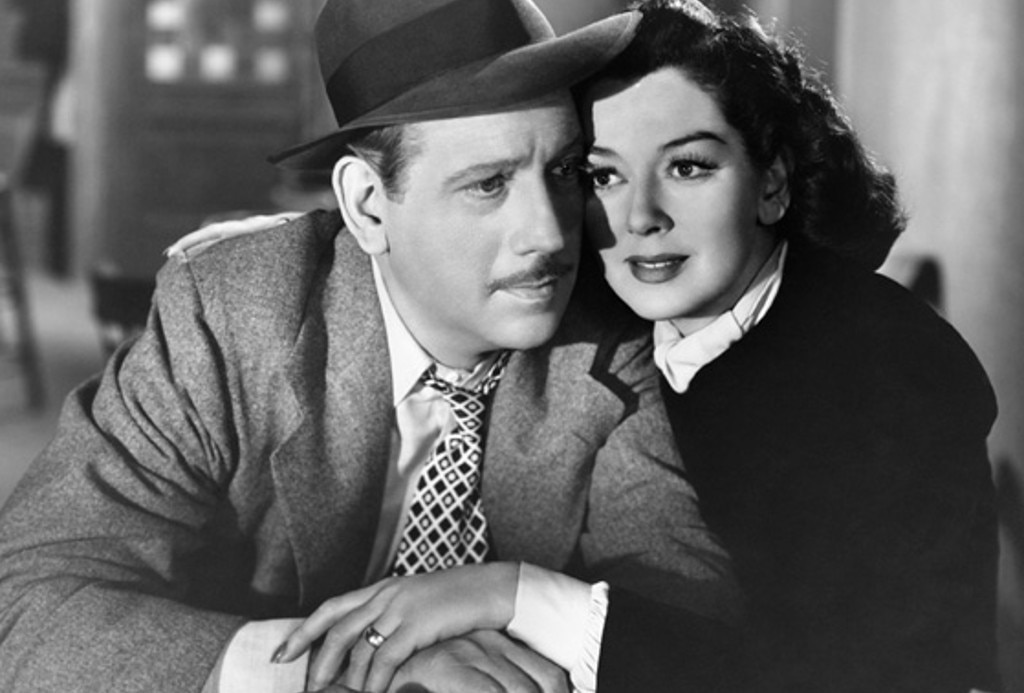
psychological melodrama. Janet Ames (Rosalind Russell) is a war widow
whose husband died heroically, throwing himself on a grenade to save four
fellow soldiers. Janet sets out to find those four survivors, but is
injured in what may have been a suicide attempt. The incident leaves her
unable to walk, although doctors can't find any physical reason for her
paralysis. Circumstances bring her together with one of the survivors, an
alcoholic journalist (Melvyn Douglas), who paints vivid "word pictures" of
the productive lives the survivors are living. Janet's imagination sees
these vignettes in dreamlike images, with expressionistic sets and
dramatic camera angles clearly inspired by Salvador Dali's innovative
dream sequences in Spellbound. Eventually, the reason for Janet's
quest to find the survivors, and for her guilty feelings, becomes clear.
Russell had been playing mostly comedy roles since her rollicking
performance as the catty Sylvia in MGM's The Women (1939). When her
contract with MGM ended in 1941, Russell wanted more varied roles and
decided to freelance. She worked for various studios, but she was still
being offered mostly roles in comedies, usually playing a glamorous career
woman tamed by love. Only Roughly Speaking (1945) at Warner Bros.
gave her a well-rounded character to play, including both drama and
comedy. At RKO, her dramatic performance as the Australian nurse who
devised a treatment for polio in Sister Kenny (1946) earned her an
Oscar® nomination. The Guilt of Janet Ames, her first drama at
Columbia after several comedies, also seemed to offer a dramatic
challenge. It would re-unite Russell with Melvyn Douglas, who would be
making his first film since returning from serving in World War II, and
with whom she had co-starred in the sparkling romantic comedy This
Thing Called Love (1940). However, The Guilt of Janet Ames
turned out to be a troubled production that did nothing for either of
their careers.
The original director assigned to The Guilt of Janet Ames was
Charles Vidor. But he and producer Virginia Van Upp (with whom he had just
finished making Gilda, 1946) disagreed about the script. Vidor was
also suing Columbia to terminate his contract. Van Upp collapsed from the
stress, and production closed down for two weeks while a replacement for
Van Upp was selected and script changes were made. Vidor refused to work
with Van Upp's replacement, Helen Deutsch. Deutsch also asked to be taken
off the picture, but Columbia boss Harry Cohn refused, and issued a
statement supporting her (Neither Deutsch nor Van Upp has an onscreen
credit). Henry Levin eventually received credit for directing the film,
and Vidor lost his suit against Columbia, which in turn sued him. Vidor
eventually bought out his contract in 1948.
In her book A Woman's View (1993), film historian Jeanine Basinger
provides a feminist analysis of The Guilt of Janet Ames as a case
study in attitudes towards women in the films of the 1940s. Basinger
believes that the film "is not meant to be subversive, but to reaffirm a
woman's traditional role. That it appeared in 1947, just as women who had
worked during World War II were being asked to settle back down in their
roles at home, may be significant."
That kind of analysis, of course, was decades away. Contemporary critics
found The Guilt of Janet Ames dull, in spite of its stylish dream
sequences. According to the New York Times, what it "lacks in large
doses is dramatic interest, and there isn't much the principals, Rosalind
Russell and Melvyn Douglas, can do about that. The producer and director
should have spotted the weakness in the script and sent it back for
rewriting." The Times critic, did, however, have kind words for a
young newcomer: "A lunatic note of comedy is attained when the
elastic-faced Sid Caesar appears doing an energetic burlesque of
psychiatrists and psychoanalysis. A very funny man, this Mr. Caesar."
The Guilt of Janet Ames was the 25-year old Caesar's second film.
His first was Tars and Spars (1946), a film version of a musical
military revue. Caesar, a talented saxophonist, had a musical role in the
show until producer Max Liebman noticed him improvising comedy routines,
and gave him a spot doing comedy. Caesar had grown up working in his
immigrant father's New York diner, and had picked up accents from the
immigrants who frequented it. The pseudo-Viennese accent he uses in his
routine in The Guilt of Janet Ames was just one of the many accents
that he would use throughout his career. Caesar left Hollywood for New
York soon after making The Guilt of Janet Ames, and a few years
later, his Tars and Spars producer Max Liebman would star him in
the television variety show, Your Show of Shows. Caesar became one
of television's top stars, and would not appear in another film until
1963's It's A Mad, Mad, Mad, Mad World.
Two other newcomers made their film debuts in The Guilt of Janet
Ames. Betsy Blair, who plays the girlfriend of the bouncer in the
first dream sequence, had been a Broadway actress before going to
Hollywood as the bride of Gene Kelly in the early 1940s. She spent several
years raising their daughter before returning to acting. Her best role
would be as the gentle love interest in Marty (1955). Future film
and television character actor Denver Pyle made his screen bow in a small
but pivotal role. Watch for him as a man who tries to pick up Janet in the
first scene of the film, as she waits to cross the street. He's not listed
in the onscreen credits, but printed credits refer to his character as
"Masher."
Director: Henry Levin
Screenplay: Devery Freeman, Louella MacFarlane, Allen Rivkin; Lenore J.
Coffee (story)
Cinematography: Joseph Walker
Art Direction: Stephen Goosson, Walter Holscher
Music: George Duning
Film Editing: Charles Nelson
Cast: Rosalind Russell (Janet Ames), Melvyn Douglas (Smithfield Cobb), Sid
Caesar (Sammy Weaver), Betsy Blair (Katie), Nina Foch (Susie Pearson),
Charles Cane (Walker), Harry von Zell (Carter), Bruce Harper (Junior),
Richard Benedict (Joe Burton).
BW-83m.
by Margarita Landazuri
The Guilt of Janet Ames
by Margarita Landazuri | April 16, 2008
SIGN UP FOR OUR NEWSLETTERS

CONNECT WITH TCM