Peter Lorre got his own night of B noirs over the weekend in wonderful 35mm prints, but before they unspooled, noir fans got a look at a new short film by noir historian and author Eddie Muller. The entire festival is basically Muller's brainchild, and in the years since he started it with the programmers at the American Cinematheque, he has formed the Film Noir Foundation, which does good work to keep these pictures alive and available. His 20-minute short The Grand Inquisitor (2008), based on his own published short story, stars 90-year-old Marsha Hunt, who knows a thing or two about classic noir: among her dozens of credits stretching back to 1935 is Anthony Mann's masterful Raw Deal (1948). Here, she plays a mysterious woman who opens the door of her San Francisco home one day to find a young woman (Leah Dashe) with some questions about her past. Dashe has acquired some old textbooks with cipher markings scrawled on many of the pages which seem to match those of the notorious Zodiac Killer of the 1960s; she has traced the books to Hunt's dead husband and hopes that Hunt can shed some light on this mystery and basically answer the question: was her husband Zodiac?
Hunt initially protests the claims as ludicrous, but slowly we realize that perhaps Dashe is onto something. Since the story is inspired by the world of noir, things inevitably turn darker and more ominous, and soon it's clear that Dashe was foolish not to tell anyone where she was going this day. Hunt looks marvelous at 90 and gives the part her all, right through the disturbing and shocking finale. Hunt was at the screening and took part in a lively Q&A afterward with Muller.
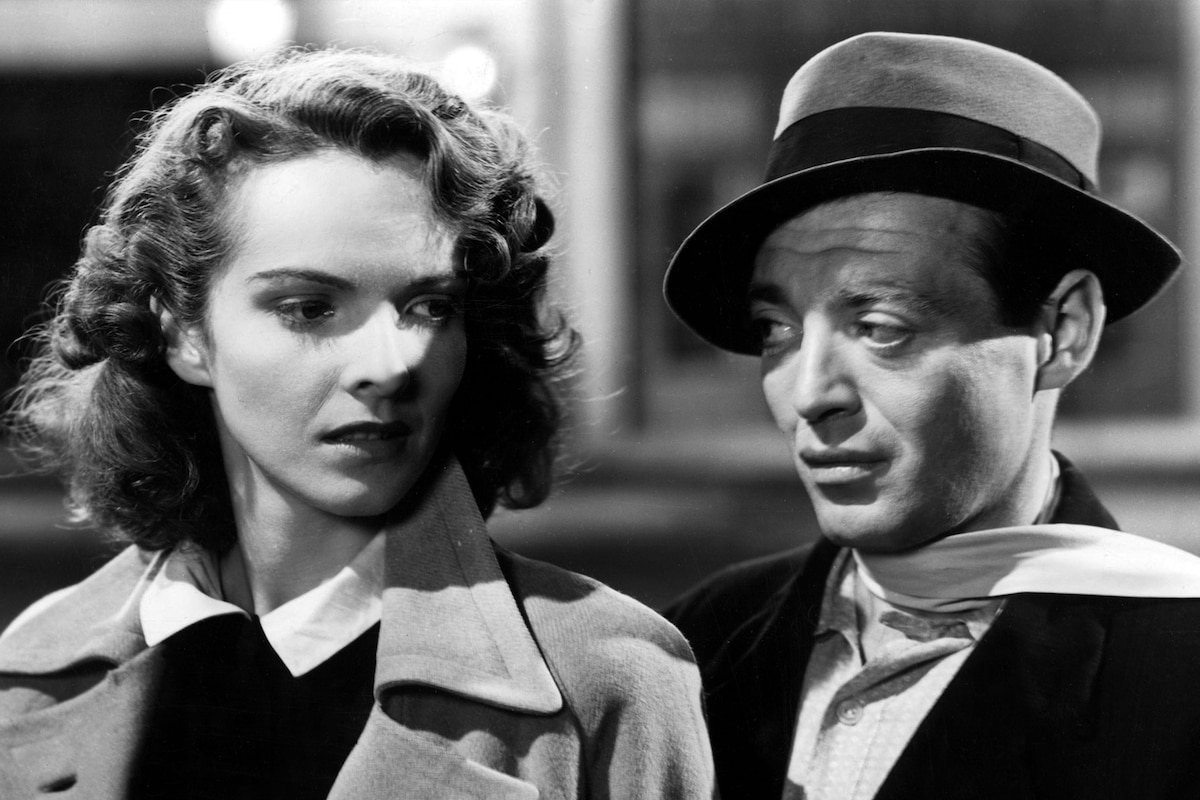
The evening then moved on to the two Peter Lorre movies. Stranger on the Third Floor (1940) is not as rare as it once was; it pops up on TCM from time to time. Many consider it the first true film noir, and a programming article I previously wrote on its production can be found elsewhere on tcm.com. Seeing it again in such a nice print with a sizable audience was a pleasure. Van Nest Polgase's imaginative production design has great impact on the big screen; the nightmare sequence remains a stunning piece of expressionism which not only visualizes a character's (John McGuire's) paranoia but also makes serious comments on America's imperfect justice system. There are few better-realized dream sequences out there. As a whole, it's an amazing movie considering it runs 64 minutes and was so, so cheaply made.
Peter Lorre made The Face Behind the Mask (1941) soon after Stranger on the Third Floor, and it gives him a full leading-man, romantic role. It's worth remembering that while Lorre tends to be remembered fondly for his character parts in films like Casablanca and The Maltese Falcon, he was by 1940 totally established. Not only had he been a full-fledged star in over a dozen German films, most famously M (1931), he had been top-lining American movies like Mad Love (1935) and the Mr. Moto series since arriving in Hollywood.
He's awfully sympathetic in The Face Behind the Mask as a Hungarian immigrant newly arrived in New York. His character is armed with an appealing mixture of naivete and total enthusiasm for America and the opportunities it provides those willing to work. And Lorre is willing to work. Experienced in both watchmaking and aircraft maintenance, his upbeat personality wins him friends easily, and he takes a job as a dishwasher in the cheap boarding house he moves into. A fire breaks out one night, however, and Lorre is left with a horrendously disfigured face - shown to us a few brief but effective times.
Lorre now can't get work; his face is too horrible for anyone to bear. Desperate for money for plastic surgery, he turns to a life of crime. He is very successful at it and eventually is rolling in dough. His face is too far gone for reconstructive surgery, however, and he must settle for a mask, built by a doctor working from Lorre's passport photo. He continues to conduct robberies until he meets a blind woman (Evelyn Keyes) with whom he falls in love. But when his cohorts kill her (with a bomb meant for Lorre), he gets his revenge in a bizarre finale that finds everyone crash landing in the middle of the Arizona desert and dying painful deaths. Lorre's death is essentially suicide, though he takes the bad guys down with him.
There are other pulpy scenes of violence in this film, including a brutal torture sequence, and Lorre builds much sympathy as we see the world refusing to give him a chance no matter how hard he tries. His journey from optimism to alienation is a bleak and very "noir" one, and the ending is certainly true to what has been established. Lorre spends quite a bit of time before he gets his mask with his back to the camera, or in shadow, his face hidden from us, and as a result his dialogue sounds like voiceover. This has an interesting effect of building subjectivity; the de facto voiceover allows us to enter his psyche in a more direct way, and our sympathy deepens because of it.
Lorre describes his situation at one point as "a horrible nightmare from which I can never awake. " He doesn't.
By Jeremy Arnold
Noir City 2008 Report, Part 3 - The Grand Inquisitor, Stranger on the Third Floor, & The Face Behind the Mask Unveiled at NOIR CITY 2008 in Los Angeles
by Jeremy Arnold | April 16, 2008
SIGN UP FOR OUR NEWSLETTERS

CONNECT WITH TCM