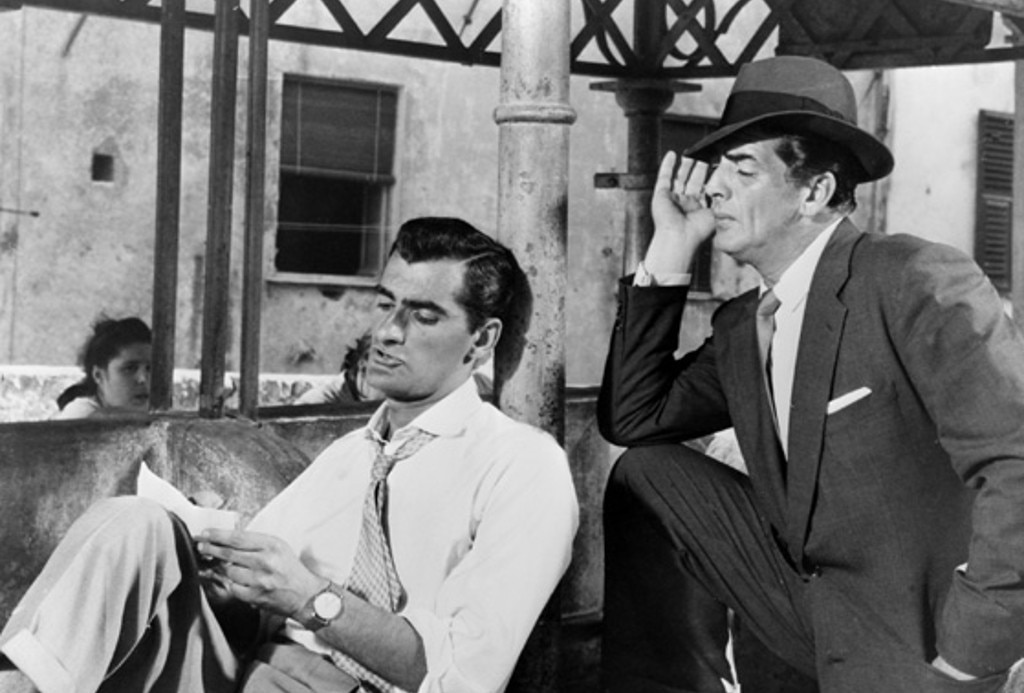
"This is a picture about DOPE!," proclaimed the posters for Pickup Alley (1957), an international crime drama starring Victor Mature as an American FBI agent on the trail of the shadowy head of a European drug smuggling operation flooding New York with heroine. It's personal for Mature--his sister was an undercover operative murdered by the cartel--and he hopscotches all over Europe tailing the gang's beautiful courier (Anita Ekberg) to find the enigmatic Frank McNally, a cartel king so mysterious that Interpol doesn't even know what he looks like. It's based on the novel "Interpol" by A.J. Forrest and it was released in Europe under that name.
It was produced by Warwick Films, a British studio created by Albert R. Broccoli and Irving Allen, with co-financing by Columbia Pictures in Hollywood, and it was shot at Elstree Studios in London and on location in Rome and Genoa in Italy; Athens, Greece; Lisbon, Portugal; and Paris, France. Mature was a veteran of previous Warwick productions and the name star needed for the American market. Swedish-born Ekberg was a Hollywood contract player who was more famous for her voluptuous looks and tabloid romances than for her performances. It was Federico Fellini who made her an international sensation when he sent her splashing through Rome's Revi Fountain with Marcello Mastroianni in La Dolce Vita (1960). Trevor Howard provides the British contribution to the film's star power as the psychopathic drug kingpin McNally, a cocky criminal mastermind with a smirking confidence, witty manner, and cold-blooded soul. The performance recalls the cool, cagey Calloway from The Third Man (1949) and the cynical, conniving Willems of Outcast of the Islands (1951).
Warwick assigned director John Gilling, a veteran of low-budget productions like Mother Riley Meets the Vampire (1952) before he making Odongo (1956) for Warwick, and Gilling's regular cinematographer Ted Moore, who came with Gilling from the trenches of British B movies. Curiously, it is their studio work that stands out from the finished film, where Moore's lighting and Gilling's widescreen compositions and staging bring noir style to the continental investigation. Gilling went on to direct a handful of pictures for Hammer Films, including Plague of the Zombies (1966) and The Reptile (1966), and Moore went even bigger, shooting the first three James Bond films for producer Broccoli and winning an Academy Award as director of photography for A Man for All Seasons (1966).
By Sean Axmaker
Sources:
AFI Catalog of Feature Films
IMDb
Pickup Alley
by Sean Axmaker | March 21, 2008
SIGN UP FOR OUR NEWSLETTERS

CONNECT WITH TCM