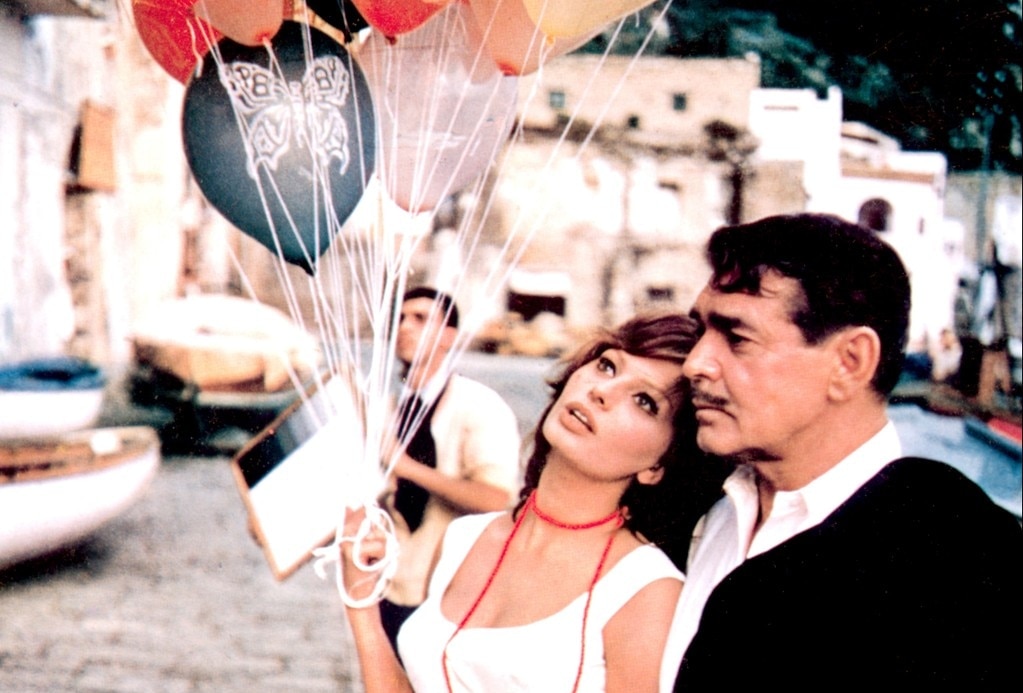
Sophia Loren biographer Warren Harris wrote that after Clark Gable first met Loren on the set of It Started in Naples (1960), he turned to a crew member and said, "Jesus, is that all mine for the duration? That girl makes you think - all the wrong thoughts!"
The picture, a comedy-drama, casts Gable as a tough, shrewd Philadelphia lawyer who arrives in Naples to settle the affairs of his recently-deceased brother. Unbeknownst to Gable, his brother has left behind an 8-year-old son, Nando, who is living alone with his aunt (Loren) on Capri. Loren is a nightclub performer who dreams of a movie career. Gable is horrified to see that Nando drinks, smokes, and picks pockets, and a custody battle ensues; inevitably, Gable starts to succumb to Loren's beauty and charms.
The two stars were at very different places in their careers and lives. For Gable, 57, this would be his next-to-last picture. He was married to his fifth wife, Kay Williams, who was with him in Italy during production, and he was still drinking and smoking heavily despite having recently suffered a mild heart attack. His looks were clearly fading because of all the excess. Twenty-four-year-old Sophia Loren, on the other hand, was approaching the peak of her beauty and success, and had recently (and scandalously) married Italian producer Carlo Ponti.
For this production, Gable's contract stipulated that he would work from 9-5 and not a moment longer. Loren later remembered, "We were in the middle of a love scene when a piercing buzz erupted from the vicinity of his wrist. Clark immediately released me, gave me a pat and a see-you-tomorrow, and disappeared. That's how it was with Gable. A thorough professional. He came on time, knew his lines and left the instant his wristwatch buzzed at five o'clock."
It Started in Naples opened on Aug. 7, 1960. Three months later Gable died of a heart attack. He had completed one final film, The Misfits, which would be released in February 1961. When Loren heard the news of Gable's death, she was in the middle of filming Two Women (a 1961 U.S. release), and she was so distraught that production was shut down for the rest of the day. She would, however, end up winning an Oscar® for that performance in early 1962.
During production of It Started in Naples, Loren was going through quite a bit of personal drama. She had recently married Carlo Ponti by proxy, while she was in Hollywood and he was in Mexico divorcing his first wife, but divorce was illegal and unrecognized in Italy and therefore he faced bigamy charges there. In the end, his marriage to Loren was annulled, he and his first wife became French citizens and were re-divorced in France, and he and Loren then remarried and had two children. They were still married when he died in 2007.
The movie also represented something of a bittersweet homecoming for Sophia Loren. Having grown up in poverty in Naples, she was making her first return to the area as a big Hollywood star and a central figure in a bigamy case. According to biographer Warren Harris, "In the same streets where she nearly starved during the war, people hung out of windows and shouted at her with love or damnation."
A third major star of the movie was Italy itself. Filmed in Naples, Rome and Capri, with interiors at Cinecitta Studios, It Started in Naples was shot by top-drawer cameraman Robert Surtees, who had just completed Ben-Hur (1959) and had won Oscars® for King Solomon's Mines (1950) and The Bad and the Beautiful (1952). Here he was working in VistaVision and Technicolor, and the results were brilliant. If the critics were lukewarm in their praise for the film, they did all agree on the gorgeous look of it, and of voluptuous Sophia Loren herself. "The major thing to look at is Miss Loren," panted The New York Times. The movie received a sole Oscar nomination, for Best Color Art Direction. (It lost to Spartacus.)
Appearing in It Started in Naples as a local lawyer hired by Gable is renowned Italian filmmaker Vittorio De Sica. The producers had sought his help to incorporate a genuine Neopolitan atmosphere into the story, and De Sica in turn steered them to the writer Suso Cecchi d'Amico, who had written De Sica's The Bicycle Thief (1948). D'Amico polished the Naples script by Melville Shavelson and Jack Rose, deepening Loren's character and added bits of business throughout. As thanks, De Sica was given his acting role, and he took the opportunity to help guide Loren's performance a little bit, too. He had already directed her in one Italian feature and would do so seven more times, including Two Women, the movie for which she would soon win her Best Actress Oscar®.
Producer: Jack Rose
Director: Melville Shavelson
Screenplay: Suso Cecchi d'Amico, Melville Shavelson, Jack Rose; Michael Pertwee, Jack Davies (story)
Cinematography: Robert L. Surtees
Art Direction: Roland Anderson, Hal Pereira
Music: Alessandro Cicognini, Carlo Savina
Film Editing: Frank Bracht
Cast: Clark Gable (Michael Hamilton), Sophia Loren (Lucia Curcio), Vittorio De Sica (Mario Vitale), Marietto (Nando Hamilton), Paolo Carlini (Renzo), Giovanni Filidoro (Gennariello), Claudio Ermelli (Luigi).
C-101m.
by Jeremy Arnold
It Started in Naples
by Jeremy Arnold | March 20, 2008
SIGN UP FOR OUR NEWSLETTERS

CONNECT WITH TCM