Anyone with a smattering of film history - or American history, for
that matter - will watch closely when The Bitter Tea of General
Yen (1933) moves toward its big love moment, which happens in a
dream sequence. Hollywood star Barbara Stanwyck plays the woman,
Megan Davis, an American missionary who's recently landed in China,
and Swedish star Nils Asther plays the man, General Yen, a Chinese
warlord who's been holding Megan as a semi-willing captive while
civil war rages outside his palace. They speak in romantic tones,
they gaze into each other's eyes, they move their faces slowly,
slowly together. Then their lips meet, and you know this moment must
have brewed some extremely bitter tea back in 1933, when interracial
on-screen smooching was strictly taboo.
Sure enough, Columbia Pictures and director Frank Capra found
themselves in hot water. "Seeing a Chinaman attempting to romance
with a pretty and supposedly decent young American white woman,"
predicted Variety reviewer Sam Shain, "is bound to provoke
adverse reaction." How true. Capra claimed in his memoir, The
Name Above the Title, that the picture lost money because it
"was banned in Great Britain and in British Commonwealth countries
due to the shocking implications of a love affair between a yellow
man and a white woman." While that isn't true - the Commonwealth
censors passed the picture, as did the British censors after a few
cuts - The Bitter Tea of General Yen definitely lost money,
despite Columbia's energetic publicity campaign for the
million-dollar production, its most expensive to date, and according
to a Variety report, the "nucleus" around which the studio's
entire 1933 slate would be marketed. "Drawn together by fate," the
ads trumpeted with an uneasy blend of candor and sensationalism, "a
man of the East...a woman of the West...their forbidden love wrecked
an empire."
Another loser was Radio City Music Hall, the largest movie theater
in the West or East, where Capra's melodrama had its New York
premiere on January 11, 1933, the same day it debuted in other large
cities. The ritzy and enormous Music Hall had opened for business
just two weeks earlier as a vaudeville house, then quickly
introduced a policy of film showings with tickets cheap enough for
Depression audiences to afford. The Bitter Tea of General Yen
was the first movie to play there; it was scheduled for a minimum
two-week run, but the theater yanked it after eight days and $80,000
in grosses, despite the certainty of a $20,000 loss on its $100,000
rental fee. In his memoir, Capra proudly recalls that "it was
chosen as the film to open Radio City Music Hall," omitting its
less-than-glorious performance on the occasion. He certainly
considered the movie to be big and bold enough for the world's
biggest and boldest movie house; in his book American Vision: The
Films of Frank Capra, critic Raymond Carney makes the
fascinating point that Yen's palace actually resembles one of the
great '30s picture palaces, which tried to "create a world of
cinematic consciousness that could stand as an alternative to the
world outside the film."
Based on a story by Grace Zaring Stone, which Capra called a
"strangely poetic romance," The Bitter Tea of General Yen
begins in war-torn Shanghai, where an aptly named missionary, the
Rev. Dr. Bob Strife, is taking an afternoon off from saving souls to
marry Megan, his childhood sweetheart. But duty calls - several
children are stranded in an imperiled orphanage, and Bob rushes off
to save them before the ceremony starts, taking Megan along for the
ride. The situation is more chaotic than he bargained for, and when
he's knocked unconscious by a rioting mob, Megan gets rescued by
General Yen, who spirits her away, puts her up in his summer palace,
and does what he can to woo and win her. Megan is initially charmed
by the tall, handsome officer, who speaks all sorts of languages and
carries himself the way she imagines an emperor would. We know
better, since the screenplay has informed us of his ruthless and
cold-blooded side, and Megan wises up when she realizes he's about
to kill Mah-Li, his Chinese mistress, for cheating on him with
Captain Li, his aide. It turns out the mistress is more heartless
than the general, though, and when Yen selflessly decides to let her
live, Megan starts falling for him. The climax arrives when she's
forced to acknowledge her un-Christian hypocrisy in benefiting from
his generosity and protection while staving off the warmth and
affection he's held out to her. She agrees to stay by his side, but
realizing that she'll never love him of her own free will, Yen
prepares to drink a cup of poisoned tea. This doesn't happen in the
novel, where Yen's enemies kill him as he helps Megan get to safety.
In the original draft of the screenplay, according to critic Joseph
McBride, he tosses the tea away when Megan yields to him. Capra
devised the film's actual ending, wherein Yen drinks the tea and
dies as Megan looks innocently on. This is followed by a brief coda,
which shows Megan heading back to Bob but clearly daydreaming,
wordlessly and tenderly, about the remarkable general she's left
behind.
The Bitter Tea of General Yen was the fourth picture in four
years directed by Capra with Stanwyck as the star; she teamed with
him again for Meet John Doe in 1941, but this was her last
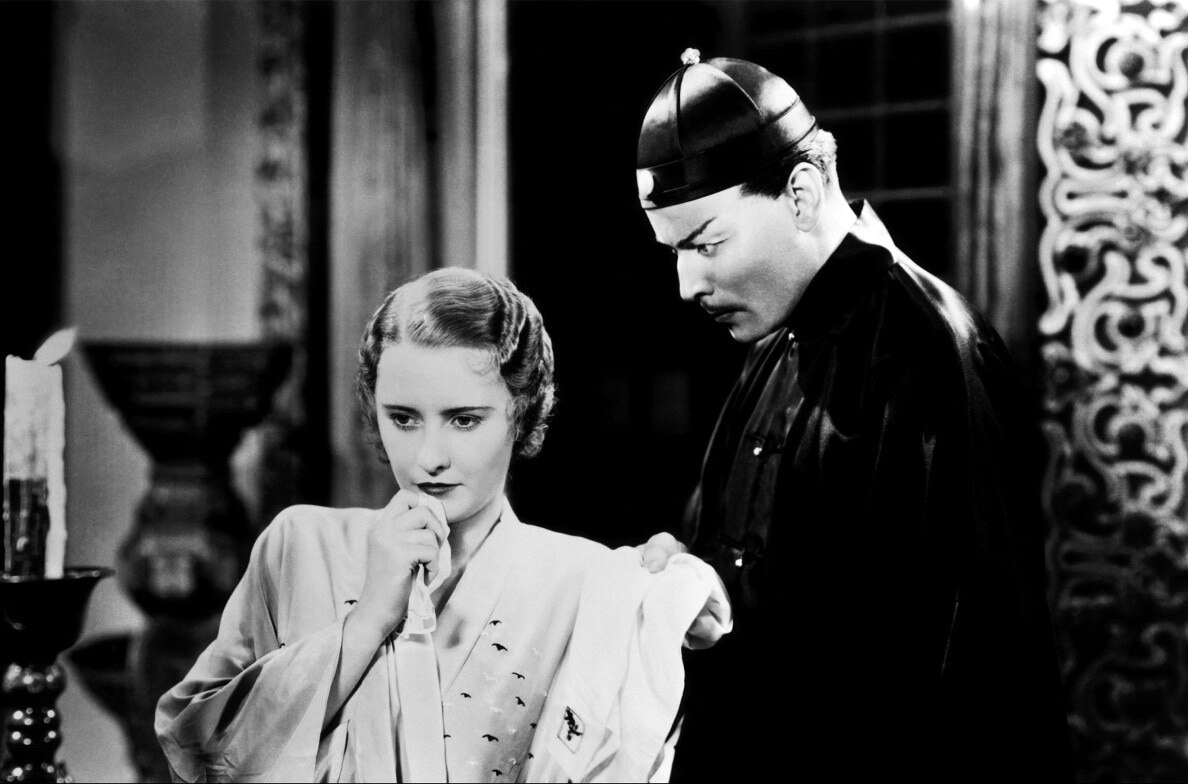
Columbia film. She handles her role with skill, gracefulness, and a
lot of glamour, thanks partly to cinematographer Joseph Walker, who
appreciated the movie's "pictorial possibilities" and spiced it up
with portrait lenses and a diffusion device of his own design. As
the other main character, Capra didn't want "a well-known star made
up as an Oriental," but he had no problem with "a not-too-well-known
Swedish actor" made up as one. Asther had the "impassive face" and
"slightly pedantic" accent that Capra was looking for, so the
make-up artist covered his upper eyelids with "skins" and clipped
his eyelashes to a third of their normal length, and the wardrobe
department decked him out in sumptuous Mandarin robes and a tall
black skullcap. The result of these labors, not surprisingly, is a
Hollywood stereotype: "On the screen," Capra enthuses in his memoir,
"he looked strange - unfathomable." But it's visually stunning
nonetheless, making Yen one of Capra's most memorable
characters.
Like others connected with the picture, Stanwyck blamed its poor
box-office showing on racist backlash. McBride quotes her as saying,
"The women's clubs came out very strongly against it....I was so
shocked. [Such a reaction] never occurred to me, and I don't think
it occurred to Mr. Capra when we were doing it." Maybe not, but
Capra was cruising for an Oscar® at this point in his career,
and he saw the project as "Art with a capital A," risky and
offbeat enough to convince the Academy that it was an act of culture
as well as commerce. Although it suffered a shut-out from the
Oscar® race, Capra kept up his faith in it, saying a few years
later that it "has more real movie in it than any other I
did." He was right. For all its racial stereotyping and insensitive
dialogue, The Bitter Tea of General Yen endows Yen with an
outward charisma and inward dignity that never quit, and his final
exit from the story is as emotionally rich as anything Capra ever
crafted. Stanwyck also shines in what one commentator calls, with
some exaggeration, "the only art film" she ever made. The movie and
its compelling lead performances deserve a far wider audience than
they've received.
Producer: Walter Wanger
Director: Frank R. Capra
Screenplay: Edward E. Paramore, Jr.; based on a story by Grace
Zaring Stone
Cinematographer: Joseph Walker
Film Editing: Edward Curtiss
Music: W. Franke Harling
With: Barbara Stanwyck (Megan), Nils Asther (General Yen), Toshia
Mori (Mah-Li), Walter Connolly (Jones), Gavin Gordon (Bob), Lucien
Littlefield (Mr. Jacobson), Richard Loo (Captain Li), Helen Jerome
Eddy (Miss Reed), Emmett Corrigan (Bishop Harkness).
BW-87m.
by David Sterritt
SOURCES:
Starring Miss Barbara Stanwyck by Ella Smith (Crown Publishers)
Frank Capra: The Catastrophe of Success by Joseph McBride (Simon &
Schuster)
The Films of Barbara Stanwyck by Homer Dickens (Citadel Press)
The Name Above the Title by Frank Capra (Random House)
The Bitter Tea of General Yen
by David Sterritt | March 20, 2008
SIGN UP FOR OUR NEWSLETTERS

CONNECT WITH TCM