Has there ever been a western as snow-drenched as Day of the Outlaw
(1959)? A few other snowy westerns come to mind - Track of the Cat
(1954), The Tall Men (1955), Will Penny (1968), McCabe and Mrs.
Miller (1971) - but really only Track of the Cat even approaches the
snowbound feel of this film. And like Track of the Cat, which is really
an abstract, metaphorical drama of a dysfunctional family set in the old west,
Day of the Outlaw isn't exactly a traditional western. The snow, which
isolates the characters from the outside world - and the movie from the "outside
genre" - takes on a great deal of emotional weight, very much affecting the
audience's experience of the story and characters.
"Emotional weight" seems to be the key difference between the two movies.
Track of the Cat is fascinating but works a little better on an
intellectual rather than emotional level; Day of the Outlaw is truly
outstanding because it works so well on both. Its characters and story are
intense, its atmosphere and setting are utterly believable, and its emotional
effect is palpable and raw. Watching it, one feels one is up there in the
screen, and it's a scary, riveting feeling.
The movie is smartly constructed. Rancher Robert Ryan lives on the outskirts of
a tiny Wyoming town, and he is angry that his cattle drives are being impeded by
a neighbor's new barbed-wire fence. He also has a romantic history with the
neighbor's wife (Tina Louise), and his anger may in fact actually be an
expression of the bitterness and loneliness he feels because he can't have her.
In any event, he rides into town with his foreman (Nehemiah Persoff, excellent)
one winter's day, and the few other townspeople immediately sense Ryan's anger
about to explode. With the whole town on edge, things come to a head when Ryan
challenges his neighbor and two other men to a gunfight in a saloon.
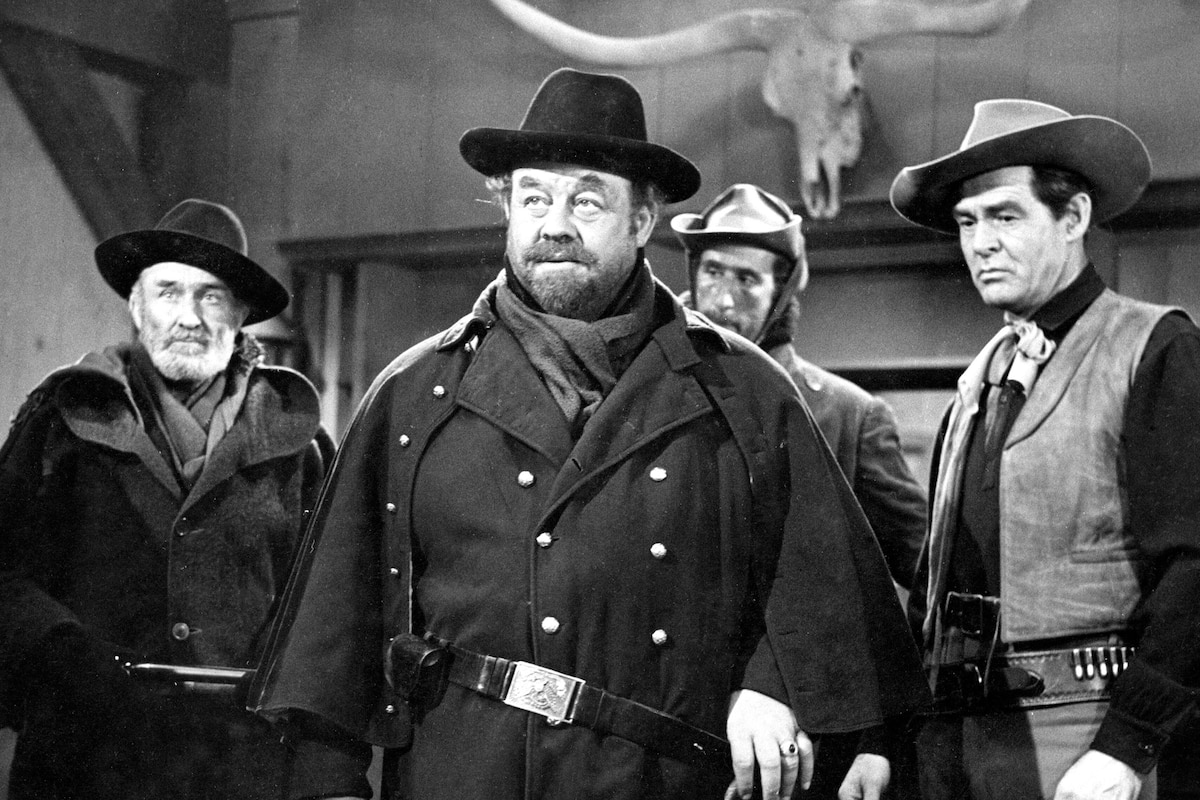
And right at that moment, Burl Ives makes one hell of an entrance! He and his
band of outlaws storm into the saloon and immediately take the town hostage; for
the rest of the film, the drama centers around whether the townspeople can
survive the invasion. Ives is a renegade Union army captain who is on the run
with his men, and a meaner, scarier, more psychotic bunch you couldn't imagine.
These guys are just aching to rape all the women and loot the town, and it is
only Ives' control of them that prevents this. But Ives has been wounded by a
gunshot, and his survival is tenuous. The only doctor in town is a horse doctor,
and he tries his best to keep Ives alive (which includes a terrifying operation)
so that Ryan can buy time to figure out what to do.
Meanwhile, one of Ives' men, played by David Nelson, wants out of the gang but
still feels loyalty to his boss. (The real-life son of Ozzie and Harriet
Nelson, he bears a striking resemblance to his brother Ricky Nelson.) Nelson's
character is at heart a decent guy, and he forms a mutual attraction with the
innkeeper's daughter played by Venetia Stevenson (in real life a knockout
British model and the daughter of Anna Lee). In the extraordinary, drawn-out
ending to this film, the knee-deep snow seems to have the last word, and its
blinding presence both stifles the fury of some characters and offers a clean
slate for others.
The richness of the characters make the picture very rewarding. Everyone seems
to be on edge in one way or another, but in the key players there is a deeper
complexity. What has turned Burl Ives' captain into the leader of such a bunch
of hooligans? What amount of loss does Robert Ryan feel every day? Moments in
the film make us ponder these questions. At one point, Ryan tells Tina Louise
about her husband, "I can't feel sorry for someone I hate." Coming from Ryan,
that statement reveals an inner torment that perhaps this actor expressed better
than any other. It's a complex line that seems to also say he wishes he
could feel sorry for him, which in turn perhaps means that he actually
does feel sorry for him a little bit, though he could never say so
outright. Robert Ryan delivered this kind of complexity to role upon role,
whenever the writing allowed it, and Day of the Outlaw does allow it: the
screenplay is by Philip Yordan, veteran of many Anthony Mann westerns and
epics.
The directing is by Andre De Toth, still one of the great underknown American
film directors of the studio era. With De Toth at the helm, the visuals help
create and reinforce the emotions of this film. De Toth puts across the feeling
that any of these characters could snap, and explode into violence, at any
moment. It's much like Clint Eastwood's later Unforgiven (1992), in fact,
and there is one sequence here that surely influenced that later film: when Ives
orders his men to brutally beat and kick Robert Ryan in the middle of the street
as everyone watches in horror, one is reminded of Gene Hackman doing the same to
Richard Harris in a very similarly-staged sequence.
Also like Unforgiven, Day of the Outlaw has an intricately
constructed town. It feels spatially alive somehow. De Toth knew how important
the town set would be, and he went to great pains to make it look right. He had
the town built in Oregon several months before filming so that the structures
would be naturally weathered by rain and snow, not artificially dressed by
crewmen. When De Toth learned that the workers had neglected to follow his
compass headings for the layouts of the streets, he had them rebuild it!
"Shooting it as it was built would've added additional weeks to the shooting,"
De Toth reasoned, much to the consternation of his producers.
In a book-length interview with Anthony Slide, De Toth also recalled his
attraction to this story: "Is it worse being the jailer instead of the prisoner?
Is it worse being incarcerated by white snow in white silence, or by the
blankness of black silence? With that frame of mind, I wanted to explore the
bizarre situation of a group of outlaws on a getaway, terrorizing a small
western village, and then, by a quirk of nature, becoming equally the prisoners
of a white silence in the middle of nowhere."
Perhaps inevitably, Day of the Outlaw has been quietly slipped onto DVD
without any fanfare from its distributor, Fox Home Entertainment, which now
handles these MGM catalogue titles. There are no extras, no liner notes, no
commentary - which is too bad, because Tina Louise, David Nelson and Nehemiah
Persoff are still with us and could have provided some interesting backstory.
But at least it's available, in a good-quality print (despite occasional minor
wear) and at a reasonable price. Another western masterpiece of the era, Man
of the West (1958), has also just been given a bare-bones release. That
sophisticated film is one of Anthony Mann's finest, and both of these are
essential viewing. I can't recommend them more strongly.
For more information about The Day of the Outlaw, visit MGM Home Entertainment. To order
The Day of the Outlaw, go to
TCM Shopping.
by Jeremy Arnold
Day of the Outlaw - Robert Ryan in the 1959 Western DAY OF THE OUTLAW on DVD
by Jeremy Arnold | March 18, 2008
SIGN UP FOR OUR NEWSLETTERS

CONNECT WITH TCM