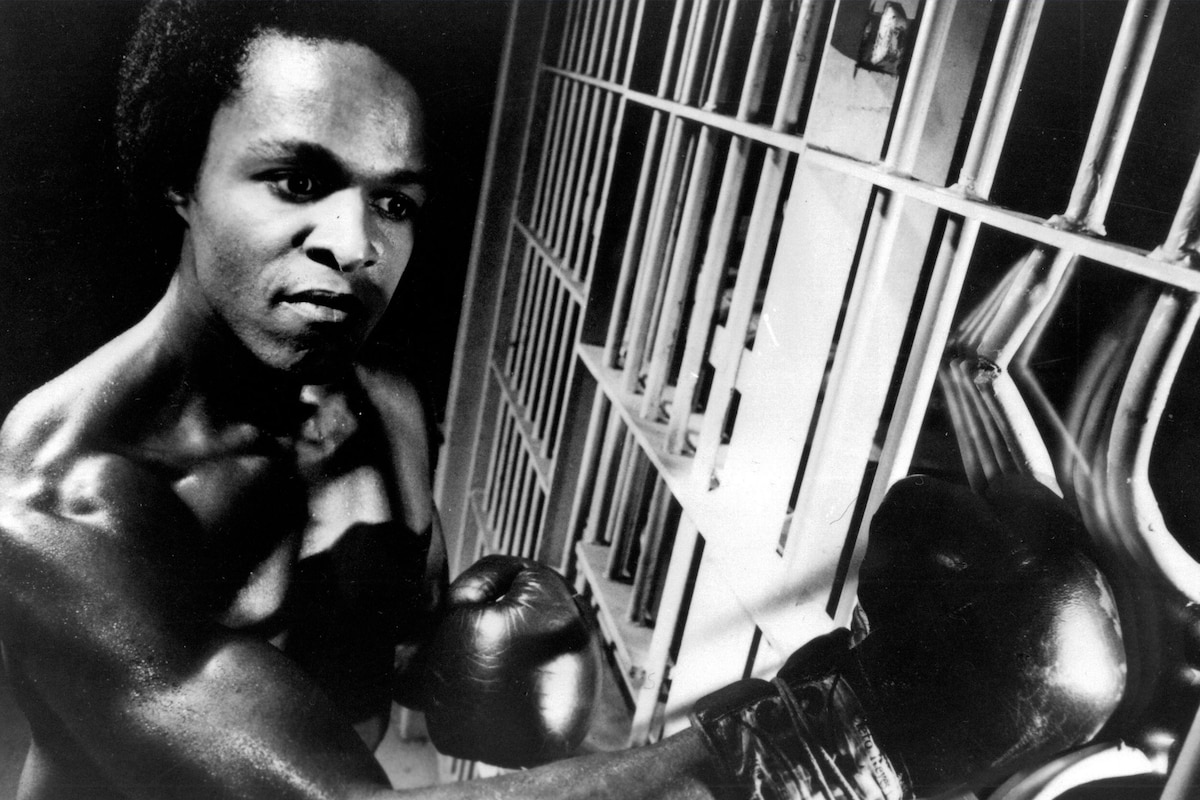
Forgive the pun, but there's no shortage of arresting imagery on hand in Jamaa Fanaka's Penitentiary (1979), from the sight of a bugged-out prison inmate strutting along the cellblock with a lit cigarette stuck in his ear to a boxer standing triumphant above his opponent in a curly wig and black bra; perhaps the strangest image in the entire film is that of black actor Leon Isaac Kennedy standing up from a makeshift lean-to in the wide open space of the Southern California desert. Even thirty years later, moviegoers are unaccustomed to seeing black actors, whom Hollywood has coded for urban environments, in a setting reminiscent of John Ford, particularly The Grapes of Wrath (1940). As drifter Martel "Too Sweet" Cordone, Kennedy certainly has the lean and hungry look of Tom Joad and does find himself in a Joadian pickle when he defends a roadside prostitute (Hazel Spears) against the bullying of a pair of motorcyclists and is thrown into prison for his gallantry. While the setup is familiar to the point of being over-familiar (Robert Aldrich's The Longest Yard [1974] comes immediately to mind), Fanaka's mostly all-black cast makes the material feel fresh and immediate. By the end of the 1970s, the racial demographic of the US prison system found black inmates outnumbering Caucasians but prison movies continued to center around white inmates (Tom Gries' excellent 1972 made-for-TV movie The Glass House) or surround their black star with a supporting cast comprised for the most part of white actors (Buzz Kulik's 1969 Riot). Penitentiary flipped that script.
Born Walter Gordon in Jackson, Mississippi, in 1942, the future filmmaker changed his name to Jamaa Fanaka (Swahili words meaning "togetherness" and "success") while a student at UCLA so that moviegoers would know he was black. Despite obvious pride in his African heritage, Fanaka was then and remains to this day a fan of classic Hollywood films. Two of Fanaka's favorite movies are the original King Kong (1933) and William Wyler's remake of Ben-Hur (1959), and the shadow of both films can be seen to touch Penitentiary. The film marked the end of Fanaka's UCLA academic curricula, following the experimental-style Welcome Home Brother Charles (1975) and the more naturalistic Emma Mae (1976). Fanaka showed drafts of his script to prisoners on Terminal Island, a low security corrections facility off the coast of Los Angeles. For the boxing scenes, he drew from his experiences in the United States Air Force, where time in the ring allowed enlisted men to escape the grind of kitchen patrol.
Fanaka had written the role of the wronged and righteous Martel "Too Sweet" Cordone for Glynn Turman, the rising star of Michael Schultz's Cooley High (1975), but was forced to reconsider when Turman eloped with singer Aretha Franklin close to the start of principal photography. Already signed onto the project as an associate producer, Leon Isaac Kennedy threw his own hat into the ring via a videotape of himself acting the Too Sweet role (with his sportscaster wife, Jayne Kennedy, reading lines opposite him off-camera). Suitably impressed, Fanaka gave the first-time actor a shot.
Filming of Penitentiary took place in Los Angeles County's dusty Antelope Valley and (for the prison scenes) in the long-shuttered Lincoln Heights Jail. (Built in 1931 and closed shortly after the Watts Riots in 1965, the facility remains a popular filming location, whose boiler room was used as Freddy Kruger's lair in Wes Craven's A Nightmare on Elm Street, 1984.) Even supplemented with government funding and a hefty chunk of Fanaka's parents' savings, the budget ran thin near the end of production, leaving the writer-director unable to feed his large cast and dozens of extras. Taking the initiative, bit player Wilbur "Hi-Fi" White (cast as the gap-toothed
cross-dressing Sweet Pea) collected food stamps from cast and crew and became the production's official caterer, feeding over one hundred actors and technical staffers for the final week of shooting.
Made marketable by the success of Rocky (1976) and Rocky II (1979), Penitentiary wound up being the most successful independent feature of 1980. Two sequels followed, both contriving to bring Leon Isaac Kennedy back to prison and into the ring for more abuse. The sequels notwithstanding, it's tempting to remember Too Sweet as he is during Penitentiary's final frames: paroled and headed down a long stretch of desert highway pointed towards blue sky, snowcapped mountains and the unfinished business of claiming his share of the American dream.
Producer: Jamaa Fanaka
Director: Jamaa Fanaka
Screenplay: Jamaa Fanaka
Cinematography: Marty Ollstein
Art Direction: Adel Mazen
Music: Frankie Gaye
Film Editing: Betsy Blankett
Cast: Leon Isaac Kennedy (Martel 'Too Sweet' Cordone), Thommy Pollard (Eugene T. Lawson), Hazel Spear (Linda), Donovan Womack (Jesse Amos), Floyd 'Wildcat' Chatman (Seldon Seen Jackson), Gloria Delaney (Peaches), Ian Foxx (Pretty Red), Badja Djola ("Half-Dead" Johnson).
C-99m. Letterboxed.
by Richard Harland Smith
Sources:
Interview with Jamaa Fanaka by Millie De Chirico, www.tcm.com
Interview with Jamaa Fanaka by Suzanne Donahue, www.associatedcontent.com
Interview with Jamaa Fanaka by Michael Guillen, http://theeveningclass.blogspot.com
Penitentiary
by Richard Harland Smith | January 14, 2008
SIGN UP FOR OUR NEWSLETTERS

CONNECT WITH TCM