There have been more than 30 film versions of Shakespeare's Romeo and Juliet - silent versions,
sound versions, versions in foreign languages, and in modern dress. M-G-M's 1936 adaptation, directed
by George Cukor was sumptuous and glossy, but Norma Shearer, age 34, and Leslie Howard, 43, were
improbable teenagers. William Shakespeare's Romeo + Juliet (1996) had lovers close to the right
age in Leonardo DiCaprio and Claire Danes. But director Baz Luhrmann's frenetic MTV-style editing and
graffiti and hip-hop setting was jarring, and Shakespeare's language sounded silly coming from Southern
California gangbangers. For many people, the definitive version is Italian director Franco Zeffirelli's
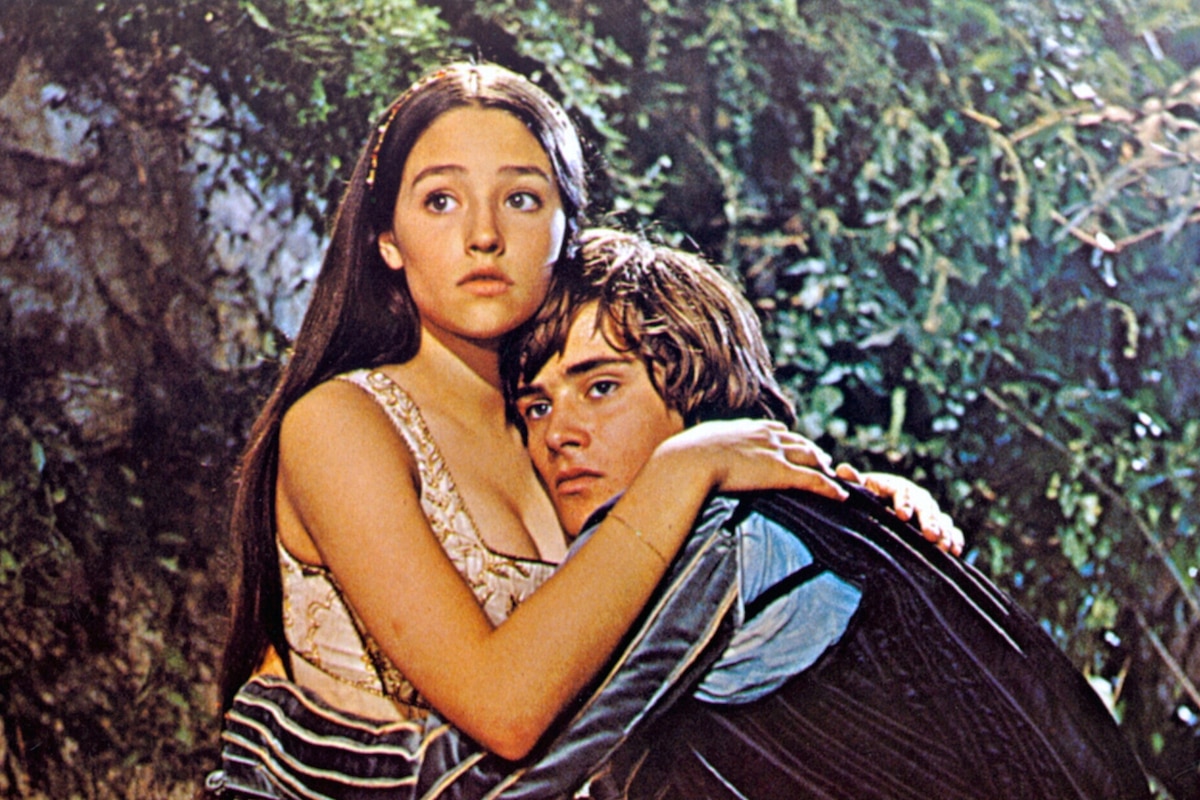
groundbreaking Romeo and Juliet (1968). It was a worldwide phenomenon. Zeffirelli's brilliant
innovations included casting actual teenagers as the doomed lovers, shooting the film on location in
Tuscany, and giving it the look and feel of robust Renaissance vitality instead of wan romanticism.
Zeffirelli, who had worked as an assistant to film director Luchino Visconti, had been a stage and opera
designer and director. He had directed several Shakespeare plays, including a version of Romeo and
Juliet at the Old Vic in 1960. While working on his feature film directing debut, The Taming of the
Shrew (1967), starring Richard Burton and Elizabeth Taylor, he began discussing the possibility of
making a film of Romeo and Juliet with a youthful cast, an idea enthusiastically supported by
Burton, an experienced Shaakespearean actor. It was the era of youthful rebellion, and studio executives
were looking for films that would attract young audiences. The Taming of the Shrew was a
success, and Paramount agreed to take a chance on Romeo and Juliet, if Zeffirelli would agree
to a low-budget production of $800,000.
Zeffirelli embarked on a worldwide search for unknown teenage actors who were beautiful and talented.
(Some accounts say that he offered Romeo or another role in the film to Beatle Paul McCartney, but
Zeffirelli doesn't mention it in his autobiography, and it seems unlikely, since McCartney was not an actor
and was 25 at the time.) He finally chose 17-year old Leonard Whiting, and 15-year old Olivia Hussey. To
compensate for their inexperience, Zeffirelli trimmed long speeches, used reaction shots, and gave them
lots of movement. Michael York, who had made his film debut in Zeffirelli's The Taming of the
Shrew, plays Tybalt.
During production of Romeo and Juliet at Rome's Cinecitta Studios, Laurence Olivier was filming
The Shoes of the Fisherman at the studio. One of the greatest interpreters of the Bard, Oliver had
a proprietary interest in anything Shakespeare. He dropped by the Romeo and Juliet set and
watched filming, and asked if there was anything he could do in the film. Zeffirelli asked him to read the
prologue, and Olivier agreed, but wanted to do more. So he dubbed Lord Montague, who was being
played by Antonio Pierfederici in heavily Italian-accented English. Olivier was having so much fun that
Zeffirelli recalled, he "insisted on dubbing all sorts of small parts and crowd noises in a hilarious variety of
assumed voices."
Because of Romeo and Juliet's limited budget, Zeffirelli couldn't build elaborate sets at Cinecitta,
as he had done for The Taming of the Shrew, but that turned out to be a blessing in disguise.
Interiors were shot on modest sets in the studio, but exteriors were shot in the Renaissance towns of
Pieza, Gubbio, and Artena in central Italy. Nevertheless, the production quickly ran out of money. Zeffirelli
appealed to Charles Bludhorn, head of Paramount's parent company, Gulf and Western. Bludhorn arrived
at a screening of completed sections of Romeo and Juliet, trailing an entourage. He talked
nonstop to his aides or on the phone, ignoring the film. Finally, Bludhorn's teenage son yelled, "Shut up,
Daddy!" Startled at his son's reaction, Bludhorn asked him if he liked the film, and if he understood it. The
boy said he did. That was all Bludhorn needed to hear. Additional funds were granted, and the finished
film cost $1.5 million. Young people around the world loved it as much as young Bludhorn had, and it
grossed $50 million.
Not all the teens that wanted to see Romeo and Juliet were allowed to do so, since the film
included a controversial nude scene between the lovers, and was given a PG rating. And some
Shakespearean purists were displeased with Zeffirelli's cuts in the play's text. But in general, the critics
were as enthusiastic as the audiences. Roger Ebert of the Chicago Sun-Times called it "the most
exciting film of Shakespeare ever made....it has the passion, the sweat, the violence, the poetry, the love
and the tragedy in the most immediate terms I can imagine." Renata Adler of the New York Times
added, "It is the sweetest, most contemporary romance on film this year." Nino Rota's score was also a
big hit, and the film's soundtrack album was the fourth-best selling album of the year. Henry Mancini's
instrumental version of the film's love theme was a top single. Romeo and Juliet was nominated
for four Academy Awards, including best picture and best director. It won two Oscars®, for
Pasqualino DeSantis' cinematography and Danilo Donati's costume design.
Romeo and Juliet has remained popular over the years, and there are rumors that Paramount
may re-release it theatrically. At a sold-out 40th anniversary screening on Valentine's Day in San
Francisco, audiences broke into spontaneous applause after the balcony scene. Olivia Hussey, who
attended the screening, told the audience that she still gets e-mails from 12-year olds who love the film.
"Even today, the film still appeals. To see the way young people still react to it is inspiring."
Producers: John Brabourne, Anthony Havelock-Allan
Director: Franco Zeffirelli
Screenplay: Franco Brusati, Masolino D'Amico, Franco Zeffirelli; William Shakespeare (play)
Cinematography: Pasqualino De Santis
Art Direction: Emilio Carcano, Luciano Puccini
Music: Nino Rota
Film Editing: Reginald Mills
Cast: Leonard Whiting (Romeo), Olivia Hussey (Juliet), John McEnery (Mercutio), Milo O'Shea (Friar Laurence), Pat Heywood (the Nurse), Robert Stephens (the Prince), Michael York (Tybalt), Bruce Robinson (Benvolio), Paul Hardwick (Lord Capulet), Natasha Parry (Lady Capulet), Antonio Pierfederici (Lord Montague), Esmerelda Ruspoli (Lady Montague), Roberto Bisacco (Paris)
C-138m. Letterboxed.
by Margarita Landazuri
Romeo and Juliet (1968)
by Margarita Landazuri | January 11, 2008
SIGN UP FOR OUR NEWSLETTERS

CONNECT WITH TCM