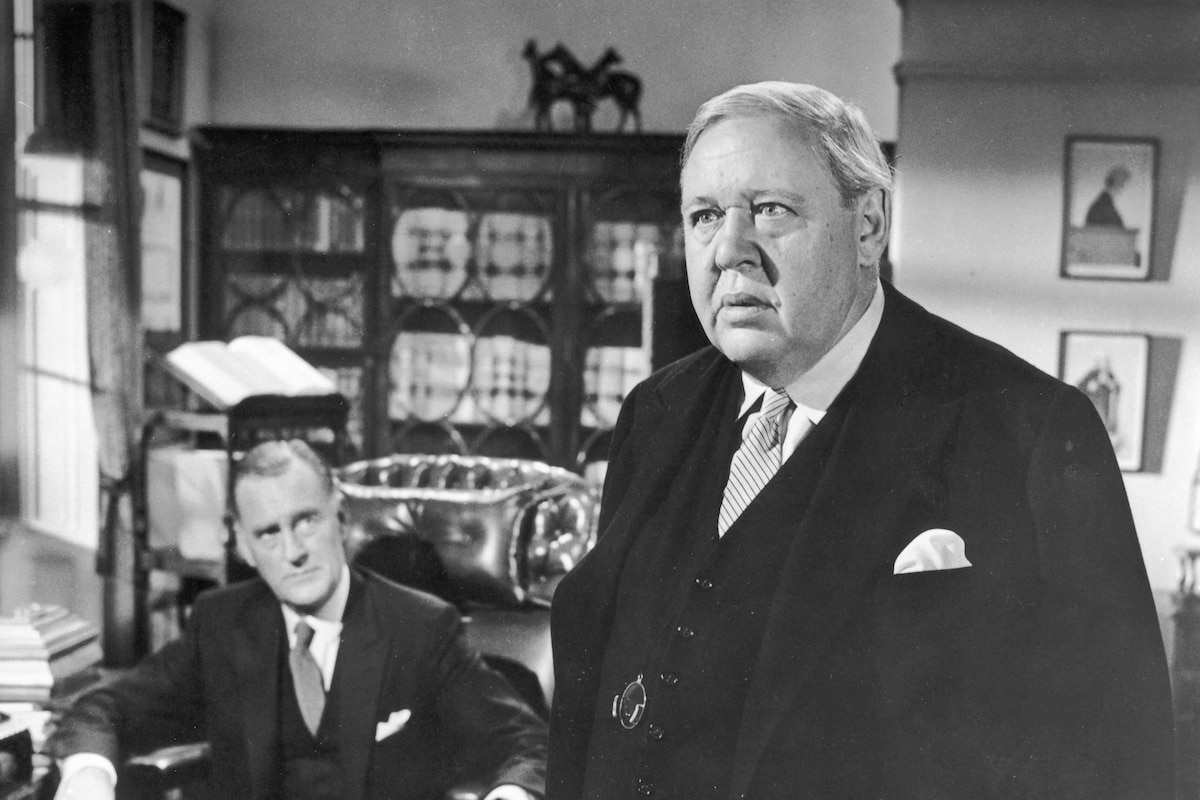
Production began on Witness for the Prosecution before the leads were even cast. But once they were, Wilder only allowed the cast and crew to view an abridged version; it was missing the final ten pages. Likely that was more of a public relations ploy than anything else, an attempt to create a heightened air of mystery and suspense around the story and its surprise ending. If asked by reporters, the actors could say even they were not let in on the ending. The producers pushed that further by stationing guards at the doors to the soundstages, according to Variety. It was also said that at a command performance in London, Hornblow had managed to get the royal family to sign pledges that they would not divulge the film's surprise ending to their subjects.
Co-screenwriter Harry Kurnitz, who much preferred being a fashionable boulevardier to a hard-working writer, found Wilder an exhausting collaborator. He once described the director at work as "actually two people Mr. Hyde and Mr. Hyde."
Kurnitz never worked with Wilder again after this and explained why in 1964, saying the typical Wilder collaborators "have a hunted look, shuffle nervously, and have been known to break into tears if a door slams anywhere in the same building. ... (Wilder) is a fiend at work."
The cast found Wilder much more simpatico than Kurnitz and this contributed to a positive atmosphere on the set. Laughton, who could be moody and difficult, was apparently a dream to work with on this project as well, throwing himself into the role with dedication and delight. Wilder later recalled a day that was set aside just for shooting reaction shots of the jury and courtroom crowd (composed of extras hired only for the day). Normally, the assistant director would read the actors' lines and the extras would react. However, Laughton, who was fascinated with the whole process of filmmaking, begged to help. So he came in on his day off and read all of the off-camera speeches for the jury members. He read not only his part, but also the judge's, the prosecutor's and even Marlene Dietrich's. According to biographer Maurice Zolotow in his book Billy Wilder in Hollywood, the author said, "it was an exhibition of craftsmanship such as Wilder had never seen. He believes that Charles Laughton had the greatest technical range and power of any actor, man or woman, whom he has known."
Marlene Dietrich and Billy Wilder enjoyed a long-running mutual admiration society. She praised him repeatedly as both an artist and a human being, calling him the kindest, sweetest man she had ever known. And he once said of her, "If we had to invent someone to be the ideal woman...we would have to invent Dietrich." She threw herself into the part with gritty determination, approaching it, Wilder said, "as if she thought her career depended on it." Dietrich later said Christine Vole was the only role she ever felt emotionally connected to because "she's not only brave, but she loves her man unconditionally."
SPOILER ALERT
Where Dietrich really demonstrated her acting chops was in the relatively short but key scenes where Christine disguises herself as a disfigured Cockney woman in order to give Sir Wilfrid some "evidence" that will allow him to prove the vindictive Christine a liar on the stand, thereby clearing Vole of all charges. "Marlene was forever up at our house, trying on scarves, shawls, and various wigs, and taking lessons in Cockney from Charles," Lanchester later said. "She was obsessed with this impersonation. I never saw anyone work so hard." Dietrich's old friend Orson Welles, who usually created fake profiles for himself in every role, helped her create a fake nose and scar for the Cockney. The original costume was rejected because it made her look too much like a man. So her appearance was softened somewhat, but still far enough removed from Dietrich so that audiences failed to recognize her on screen. To this day, some people still insist another actress stepped in for the part and that Dietrich's lines were dubbed. But there is no evidence to support this. The actress, in fact, worked extremely hard on the accent, too. Besides Laughton, she received coaching from playwright Noel Coward, who noted in his diary, "It is not easy to teach Cockney to a German glamour-puss who can't pronounce her Rs, but she did astonishingly well."
SPOILER ALERT
It was up to Billy Wilder whether or not to cue the audience in to the deception. He decided to go with the element of surprise rather than reveal the ploy. But the deceptive cameo is believed to have cost Dietrich an Oscar nomination, because the producers didn't want to campaign on behalf of her performance in a dual role. In her memoirs, she said not being nominated for Witness for the Prosecution meant nothing to her. But Wilder said she was extremely disappointed, an opinion borne out by a story that she had called columnist Radie Harris before final voting and asked him to state in print that she deserved to win. It was also said she had recorded an intro to her Las Vegas act for the day nominations were announced, urging the audience to welcome Academy Award nominee Marlene Dietrich. When she learned she didn't get the nod, the intro had to be re-recorded.
Even Dietrich's well-known vanities and foibles worked in her favor in Witness for the Prosecution. Elsa Lanchester used to delight in broadcasting Marlene's secrets. Although Dietrich was never secretive about her famous "tape lifts," Lanchester detailed their use to anyone who would listen (One of the most avid listeners was Laughton, who urged a make-up man to steal one so he could try it). The lifts were stuck to the side of Dietrich's head where she wanted skin to be lifted. Then the long threads hanging from them were woven into hair at the back of her head, forcing the tabs to pull the skin very tight. A wig then covered the network of tabs and threads. Lanchester joked that Dietrich wouldn't dare to pull or twist her face for fear of loosening a lift. In the film, one can see how Dietrich rarely breaks the cold passiveness of her expression and moves her whole body rather than her head. The effect, however, is not one of pathetic vanity but of the actions of a woman of steely single-mindedness and willful deception.
Dietrich's characterization of a woman desperately in love was also enhanced by her real-life crush on Tyrone Power during shooting. According to his biographer, the actor was embarrassed by her advances, but to be fair, it should be noted that Wilder said Laughton (who was homosexual) also had a crush on Power.
By Rob Nixon
