Agatha Christie's mystery play was a big hit in London in 1954 and an equal success during its Broadway run, which began in late 1954. Several studios were competing for the film rights when the show's producer wisely acquired them for $400,000, a rather staggering sum for a theater piece at that time. The wisdom of the deal was apparent shortly after, however, when independent film producer Edward Small bought them for $435,000. Small saw the box office potential of Christie's ingenious story and approached Arthur Hornblow, Jr. about signing onto the project. Hornblow had been a successful studio producer for many years, notable at Paramount in the 1940s, where he guided the production of Billy Wilder's first American directorial effort, The Major and the Minor (1942). Hornblow had already made his mark as an independent with the epic musical, Oklahoma! (1955) and was eager to enhance his reputation further with Witness for the Prosecution.
Courtroom dramas have long been a staple of the stage, where audiences can get intensely involved with the action and almost assume the roles of judge and jury. On screen, however, such scenes can be deadly if there is too much verbal exposition. When Billy Wilder finally agreed to direct Witness for the Prosecution, he made sure to fashion a script that avoided the inherent pitfalls. For a collaborator he DID NOT chose his former partner Charles Brackett, with whom he had written classic scripts for Ninotchka (1939), Ball of Fire (1941), and several of Wilder's best-known films of the 1940s. He also overlooked his current collaborator, I.A.L. Diamond, co-scripter of Love in the Afternoon (1957) and with whom Wilder would create the remaining eleven films of his career. For this one film alone, he chose Harry Kurnitz, an Anglophile and experienced mystery author.
The two quickly realized what the story needed was some humor, achieved by creating a new character, Nurse Plimsoll, and giving the aged barrister Sir Wilfrid a heart condition for her to cluck over. Wilder also knew you couldn't cast Marlene Dietrich in a picture without including one of her trademark musical numbers or giving audiences a glimpse of those justifiably famous legs. He accomplished this with a flashback to postwar Germany, where Dietrich's character sings for her supper in a seedy dive frequented by the kind of toughs who wouldn't hesitate to tear her trouser leg off in a fit of fanatic adulation. The flashbacks also served to break up the courtroom action and provide background into Vole's relationship with both his wife and other women.
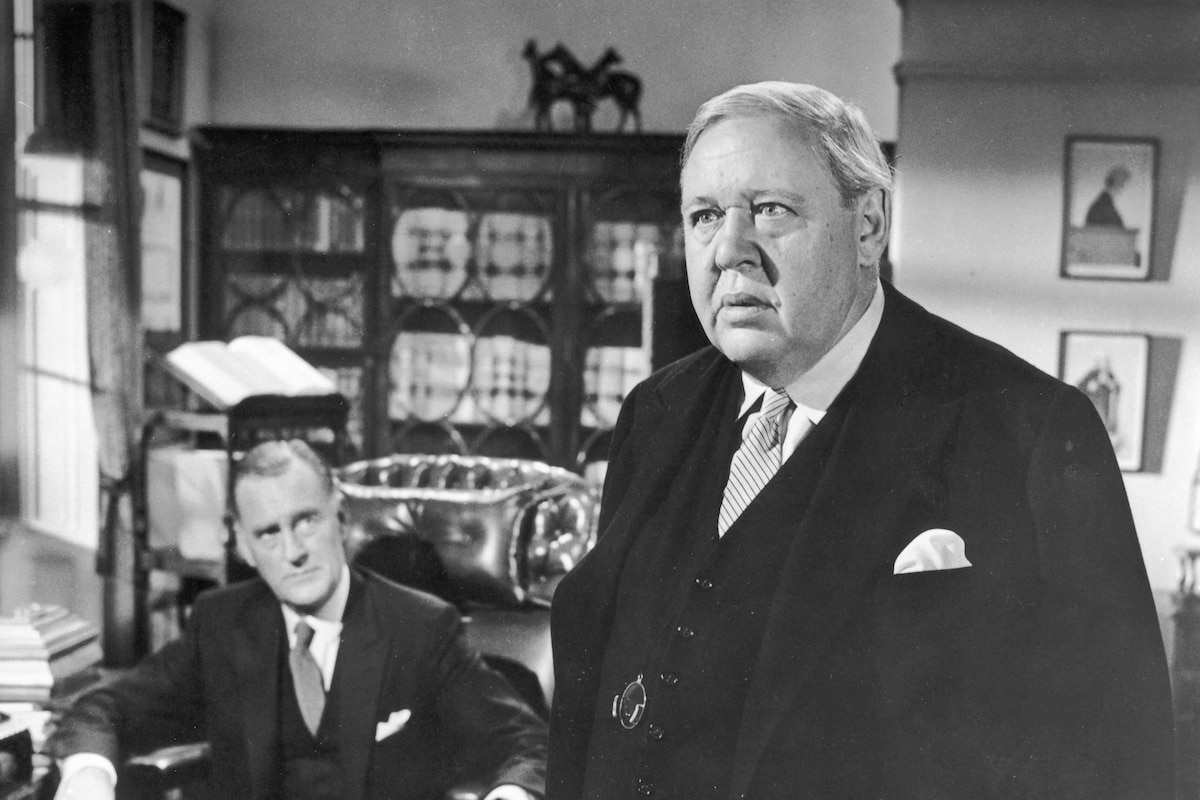
Wilder and Kurnitz also wisely chose to emphasize character as strongly as the mystery plot. "In our film it is Laughton who pulls the whole thing together," Wilder said. "He is much more important than (his character) was in the play. The puzzle is good, but it is still a gimmick. Laughton is a person, a man."
By Rob Nixon
