The lyricist of Swing Time (1936), Dorothy Fields, had a 48-year-long career during which she co-wrote more than 400 songs for both stage and film. She worked on 15 Broadway musicals, and co-wrote numerous hits ranging from "On the Sunny Side of the Street" in 1930 to "If My Friends Could See Me Now" in 1965. Her stage work included such shows as Annie Get Your Gun and Sweet Charity. Her major stint in Hollywood spanned the decade of the 1930s. With Jimmy McHugh, Fields wrote such film songs as "I'm in the Mood for Love" and "Dinner at Eight." Teaming with Jerome Kern, she worked on the films Roberta (1935), I Dream Too Much (1935), Joy of Living (1938), and of course Swing Time. The classic "I Can't Give You Anything But Love, Baby", written with McHugh, has been heard in a long string of movies - from the 1931 Mickey Mouse cartoon "The Birthday Party" to the features Street Scene (1931), Bringing Up Baby (1938), So This Is Paris (1955), Nixon (1995), The Green Mile (1999), and Catch Me If You Can (2002).
Jerome Kern was one of the Broadway greats and will be forever remembered for the immortal 1927 production Show Boat and the classic "Ol' Man River," written with Oscar Hammerstein II. After his great success with the show Roberta in 1933, Kern went to Hollywood and seldom looked back. His first task was to add additional music to his Roberta score for the 1935 RKO movie version. He enlisted lyricist Dorothy Fields, and the results included the classic "Lovely To Look At." Kern moved on to original songs for the movies. Aside from Swing Time, Kern wrote music for such films as Reckless (1935), I Dream Too Much, When You're in Love (1937), One Night in the Tropics (1940), Lady Be Good (1941), You Were Never Lovelier (1942), and Cover Girl (1944). Kern died in 1945 and an MGM biopic followed: 1946's Till the Clouds Roll By. In that film the Swing Time score was represented by a rendition of "A Fine Romance" by Virginia O'Brien.
Swing Time was adapted for Broadway in 2003 as Never Gonna Dance. Following the basic plot of the film, the show served as a Jerome Kern revue as it featured additional Kern classics in addition to those from the film. The Never Gonna Dance book was by Jeffrey Hatcher. The show ran for 84 performances and was directed by Michael Greif and choreographed by Jerry Mitchell.
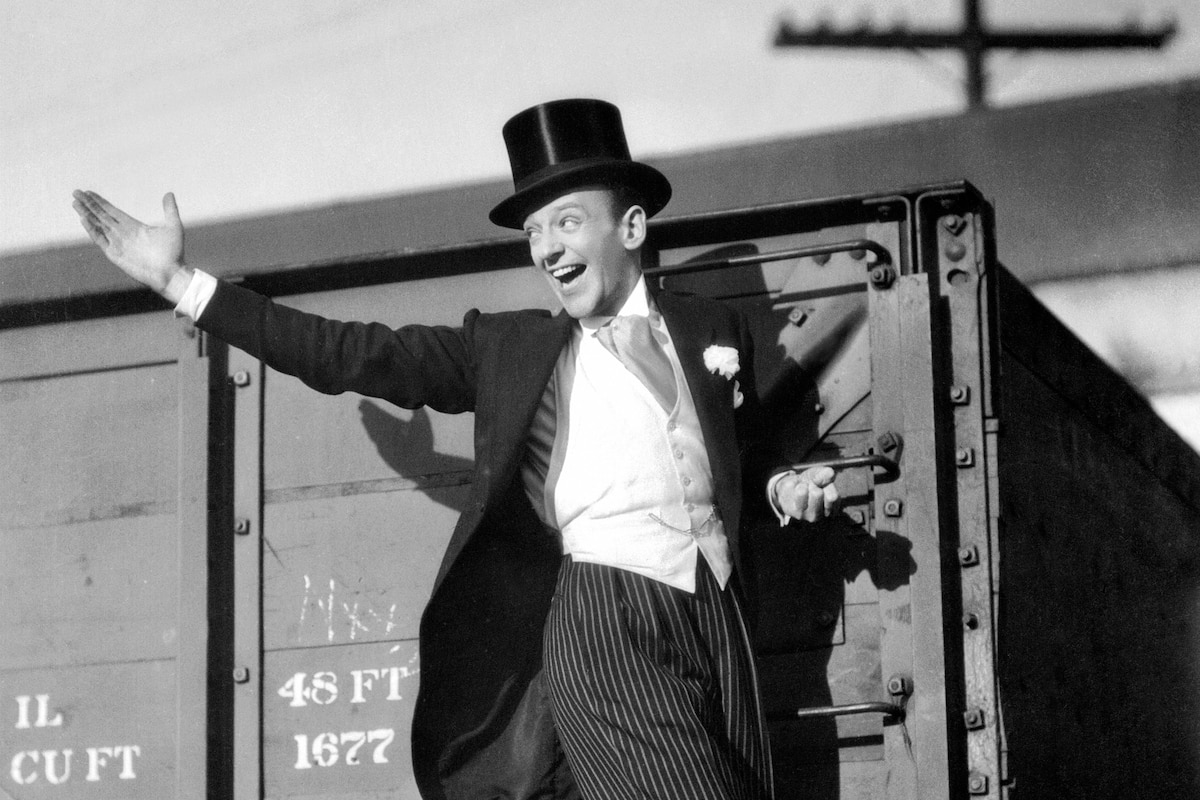
Dorothy Fields usually avoided topical references in her lyrics (unlike, say, Cole Porter), but several creep into songs in Swing Time. In "Never Gonna Dance" there is a reference to Major Edward Bowes, who hosted a popular radio Amateur Hour; and to the Marx Brothers, as Fred Astaire sings:
And to Groucho Marx I give my cravat.
To Harpo goes my shiny silk hat.
"A Fine Romance" contains the line, You don't have half the thrills that 'The March of Time' has. The March of Time, an offshoot of Henry Luce's Time Magazine empire, was the most popular newsreel series shown in movie theaters in the late 1930s. At the time of this mention in song, the series was brand new, having been started by producer Louis de Rochemont in 1935. The series could be seen in theaters until 1951, but it reached its popular peak in the years leading up to WWII. The March of Time was known for being more sensationalistic than other studios' newsreel series, and was parodied (as "News On the March") at the beginning of Citizen Kane (1941). No surprise here, but The March of Time newsreels were distributed by RKO Pictures, the maker of Swing Time. Coincidence? More likely, this was an early example of Corporate Synergy!
Fred Astaire's erstwhile fiancée in Swing Time is played by RKO contract player Betty Furness. Furness came to movies from a New York modeling career and went on beyond Hollywood to an amazing set of careers in the following 50 years: early television, advertising, politics, consumer activism, TV journalism and more. She began at age fourteen as a model for the famed Powers agency in New York, in 1930. She was signed by RKO in 1932 and went on to make over 30 Hollywood films, moving back to New York after her contract was up. She hoped for a theater career but found herself working in the mid-1940s in the then-primitive television industry. She appeared on fashion shows and live dramas, and during an episode of Studio One she stepped in to host a commercial for the show's sponsor, Westinghouse. The appliance company executives were impressed and hired Furness to be their exclusive spokeswoman. Soon Furness was getting more fan mail for pitching kitchen appliances than were the stars appearing on the sponsored shows. Furness was with Westinghouse for an amazing 12 years and became a household name. She also hosted programs and appeared on many quiz shows as a panelist. In the 1960s Furness took a job as Special Assistant for Consumer Affairs during the Johnson administration. This led directly to her starting a new field of broadcast journalism the consumer reporter. For eighteen years she campaigned against consumer fraud and did reports on local New York television as well as on NBC for The Today Show. Following a bout with cancer, Furness died in 1994.
Woody Allen certainly must admire the Swing Time song score "The Way You Look Tonight" is the song used in Carrie Fisher's audition scene in Hannah and Her Sisters (1986), and the song also turns up in the Allen films Alice (1990), Deconstructing Harry (1997), and Anything Else (2003). In addition, the Swing Time song "A Fine Romance" is heard in Allen's Another Woman (1988).
by John Miller
Pop Culture 101 - Swing Time
by John Miller | January 08, 2008
SIGN UP FOR OUR NEWSLETTERS

CONNECT WITH TCM