Fred Astaire was a stage dancer with his sister Adele and wowed the 1920s crowds in London and New York. When Adele married and retired, Astaire found himself partnerless at age 34, and tried his luck in Hollywood. After a tentative start at MGM, he found himself in 1933 at RKO Pictures. It was there that his screen persona emerged full-blown in a dance routine with established starlet Ginger Rogers. The picture was the Delores del Rio vehicle Flying Down To Rio where the dancers were fourth and fifth billed. The pair was a sensation and received top billing in eight more pictures at RKO - movies that did nothing less than define the musical genre for the decade of the 1930s: high gloss, good humor, breezy sophistication, brilliant dance, and zero references to the real world outside the movie theatre. These pictures were an Art Deco dream scored with a matchless songbook of immortal music from the likes of Irving Berlin, Jerome Kern, Cole Porter and George Gershwin.
Swing Time (1936) appeared in the middle of the Astaire-Rogers series and came at a time when the films were being produced at the steady clip of two a year. Roberta and Top Hat had been released in 1935, and Follow the Fleet had already been released in early 1936. Even so, the major players were ready to turn on the steam and work even harder on the series. Astaire was extremely precise and exhaustive with his rehearsals and routines - the effortlessness that he achieved on film came about only after a great deal of effort. He had always prided himself on filming routines full figure, without close-ups or cutaways, to emphasize the movement of his entire body, and to give the viewer the feeling of seeing a perfected version of a stage routine. By the arrival of Swing Time, he was ready to push the limits of what he had done before.
Meanwhile, Ginger Rogers faced different challenges before filming Swing Time. She was in the middle of negotiating a new contract with RKO. She was tired of the long hours and low pay, but the primary issue to her was the enforced servitude required in playing any part that RKO assigned her. She wanted more freedom to pick her roles and was tired of the lightheaded, snappy blonde stereotypes she was playing. On the advice of her agent Leland Hayward, Rogers refused to show up for rehearsals for Swing Time. Realizing the great loss Rogers' absence would be to the series, RKO agreed to the contract demands.
If Rogers was looking for more of a challenge in the acting department, she must have been thrilled to learn that George Stevens was set to direct Swing Time. Taking over from Mark Sandrich, director of three of the previous films in the series, Stevens was a slow and meticulous director. He was fond of multiple takes, so Rogers could take advantage of the opportunity and fine-tune her performance.
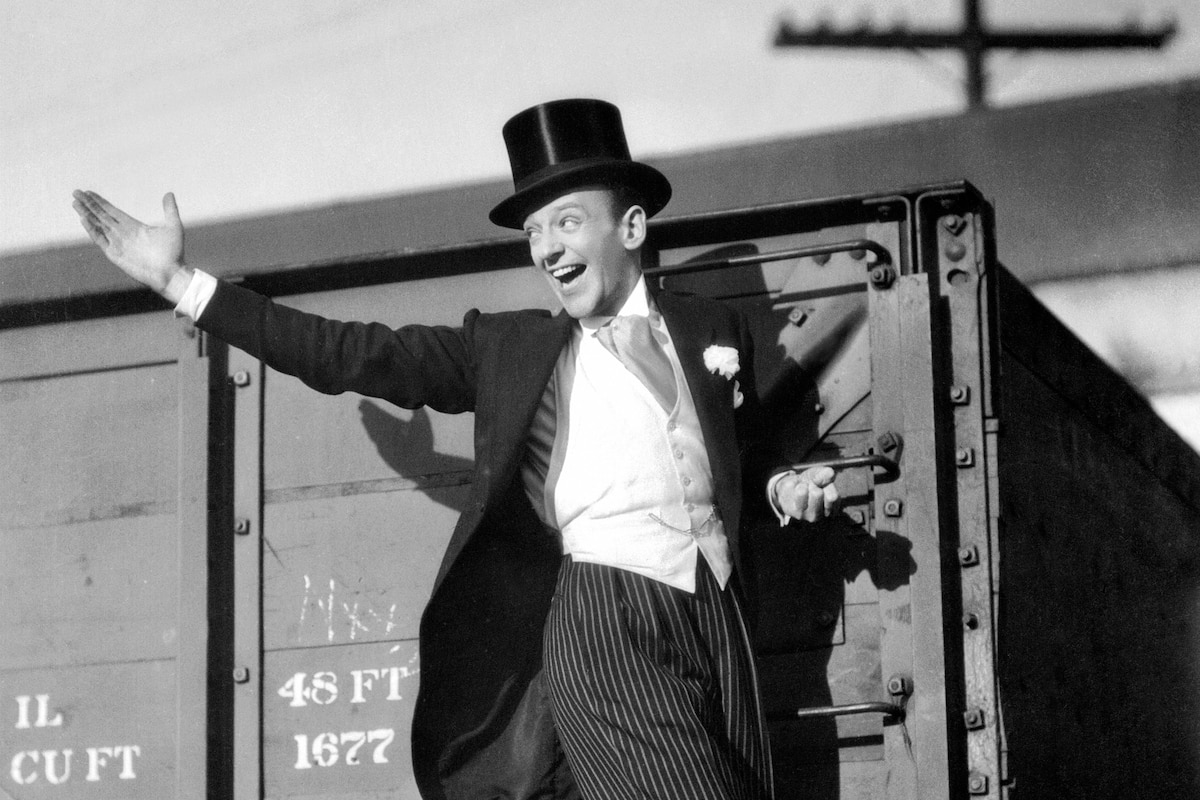
The plot in such films as Swing Time is never much more than the vehicle for musical interludes and provides the standard formula for uniting the two protagonists, dividing them due to circumstances and misunderstanding, then reuniting them again. Erwin Gelsey provided the necessary elements for Swing Time in his story "Portrait of John Garnett," which scriptwriter Howard Lindsay fleshed out in script form. The Astaire-Rogers scripts have a reputation for totally ignoring the Great Depression, labor strife and political debates that existed outside the studio doors and for good reason, audiences wanted escapism, not realism. Unique among the films in the series, Swing Time contains a few oblique nods to these issues. Near the beginning of the story we see Lucky, in top hat and tuxedo, hop a freight train, a preferred mode of transportation for those looking for work in the Depression. Later we hear Penny refer to a policeman as a "Cossack," and then there is the scene with Lucky and Pop picketing outside Penny's apartment, protesting her "unfair" practices. It is unknown which of the writers provided this slight hint of social commentary; Lindsay's draft was apparently reworked from top to bottom by another writer, Allan Scott. The script was still unfinished as shooting began, which may explain the finale, in which all of the character's inconsistencies and the holes in the plot are literally laughed away. Following rehearsals, shooting on Swing Time began in May of 1936.
Some of the songs for Swing Time were written to order for the plot, and lyricist Dorothy Fields had to write these without the benefit of first hearing the melody. For the early scene in which Fred Astaire pretends to have two left feet on the dance floor, Fields wrote wonderfully bouncy words of encouragement:
Nothing's impossible, I have found.
For when my chin is on the ground,
I pick myself up, dust myself off,
Start all over again.
Don't lose your confidence if you slip.
Be grateful for a pleasant trip,
And pick yourself up; dust yourself off;
Start all over again.
For two of the classic songs in Swing Time, Dorothy Fields composed lyrics first, which were then set to music by Kern. For "Pick Yourself Up," the script demanded a song in a scene where Rogers is encouraging Astaire, who is pretending to be a stumblebum on the dance floor. "A Fine Romance" is a sarcastic love ballad, required in a scene where Astaire and Rogers are taking turns avoiding the advances of the other, as demanded by the plot. The words are playful and still affectionate; they were sung memorably in the film in a snow-covered romantic setting:
A fine romance, with no kisses.
A fine romance, my friend, this is.
We should be like a couple of hot tomatoes.
But you're as cold as yesterday's mashed potatoes.
Apparently these were the only two songs in Fields' long career which were written without first having the melody, and it is a testament to the high quality of Swing Time's songs that these two plot-driven tunes have remained standards in their own right.
Astaire wanted at least a couple of the numbers in the film to actually "swing," which put him at odds with the musically conservative Kern. When a number in Swing Time does reflect swingin' sensibilities, it is largely thanks to arranger Robert Russell Bennett. As the title of the song implies, the "Waltz in Swing Time" sequence is the most obvious example of his work - Kern provided the lilting tune, but Bennett gave the stars something to dance to. During rehearsals, Astaire's pianist Hal Borne also contributed many musical ideas and ways to adapt the Kern material for dance time.
by John Miller
The Big Idea - Swing Time
by John Miller | January 08, 2008
SIGN UP FOR OUR NEWSLETTERS

CONNECT WITH TCM