AWARDS AND HONORS
In 1989, Modern Times was chosen by the National Film Preservation Board to be one of the films preserved in the National Film Registry of the Library of Congress.
In 1974, on the basis of Modern Times and The Great Dictator (1940), Charles Chaplin was awarded Best Foreign Filmmaker in the Jussi Awards, the national film award of Finland. Modern Times had been re-released in that country the previous year.
In 2004, "The Charlie Chaplin Collection," which included Modern Times, The Great Dictator, The Gold Rush (1925), and Limelight (1952), was nominated as Best Classic DVD Release by the International Press Academy Golden Satellite Awards.
Critics Corner: MODERN TIMES
"Went to see Charlie's picture last night. The part about the factory was very interesting and charming, but the rest just repeats Chaplin's old material."
novelist and activist Upton Sinclair in a letter, February 1936, echoing the sentiment of many who passed initial judgment on the picture as too reminiscent of his earlier shorts and little more than just a collection of gags
"Modern Times has still the same old Charlie, the lovable little fellow whose hands and feet and prankish eyebrows can beat an irresistible tattoo upon an audience's funnybone or hold it still, taut beneath the spell of human tragedy. A flick of his cane, a quirk of a brow, an impish lift of his toe and the mood is off; a droop of his mouth, a sag of his shoulder, a quick blink of his eye and you are his again, a companion in suffering. Or do you have to be reminded that Chaplin is a master of pantomime? Time has not changed his genius. ... Sociological concept? Maybe. But a rousing, rib-tickling, gag-bestrewn jest for all that and in the best Chaplin manner. ... So it goes, and mighty pleasantly, too, with Charlie keeping faith with his old public by bringing back the tricks he used so well when the cinema was very young, and by extending his following among the moderns by employing devices new to the clown dynasty. If you need more encouragement than this, be informed then that Miss Goddard is a winsome waif and a fitting recipient of the great Charlot's championship...."
Frank S. Nugent, New York Times, February 2, 1936
"The picture is grand fun and sound entertainment, though silent. It's the old Chaplin at his best, looking at his bestyoung, pathetic and a very funny guy. He remains the world's No. 1 pantomimist, and the greatest panto artist since the Frenchman Severin. Whatever sociological meanings some will elect to read into Modern Times, there's no denying that as a cinematic entertainment it's wholesomely funny. Every whimsy, every humorous turn, every comicality is born of a legitimate situation."
Abel Green, Variety, February 12, 1936
"The cinema's First Immortal returns to us after an absence of almost five years in a comedy for fun-lovers, egalitarians, and philosophers."
Richard Watts, Jr., New York Herald Tribune, 1936
"Charlie Chaplin's work, like that of Moliere, to which it is akin, will never die because his genius enabled him to draw universal conclusions from his observations of the human environment."
Jean Benoit-Levy, The Art of the Motion Picture (Coward-McCann, 1946)
"To see Charlie grappling with the problems and frustrations of the modern world which were so real to millions of people was a new experience, and Chaplin grew accordingly in stature and popular affection. Modern Times was the last film of Charlie the tramp, but it was a foretaste of the later masterpieces. ... With these films humour became harnessed to a wider satirical aim directed no longer merely at particular individual situations but at the major evils of our times."
Louis Marks, Films and Filming, October 1954
"Chaplin himself is not dated, never will be; he is a reservoir of humor, master of an infinite array of dodges, agile in both mind and body; he is not only a character but a complex character, with the perfect ability to make evident all the shades of his odd and charming feelings; not only a touching character, but a first-class buffoon and I guess the master of our time in dumb show. ... The general reaction to [Modern Times] anyway is the wonder that these primitive formulas can be so genuinely comic and endearing."
Otis Ferguson, The Film Criticism of Otis Ferguson (Temple University Press, 1971)
"[Chaplin] had proven his greatness in every possible way; but then at 81 he decided to put some of his films back on the market and see how they fared. They are faring very well, you might say. Here in Chicago, they're booked in the Carnegie Theater, where the staff hardly knows what hit it. Modern Times (1936), the first of seven Chaplin programs, was SRO all weekend, and when I saw it on Sunday afternoon, the audience was just about beside itself with delight. I go to a lot of movies, and I can't remember the last time I heard a paying audience actually applaud at the end of a film. But this one did. And the talk afterward in the aisles, in the lobby, and in line at the parking garage was genuinely excited; maybe a lot of these people hadn't seen much Chaplin before, or were simply very happy to find that the passage of time have [sic] not diminished the man's special genius."
Roger Ebert, Chicago Sun-Times, January 25, 1972
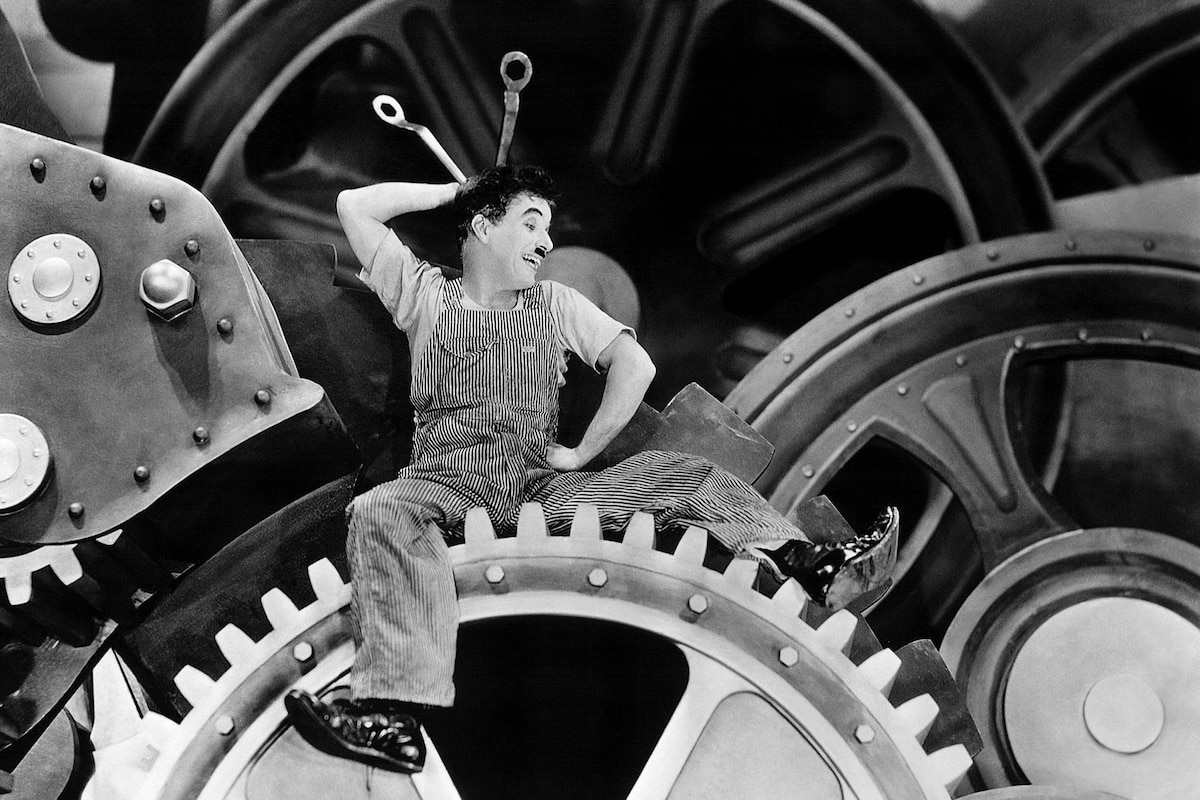
"Modern Times was seemingly made under the twin influences of Walt Disney (the cartoon-like use of sound effects) and Fritz Lang (the vast art deco factory that initially employs the Little Tramp). More than any previous Chaplin film, albeit setting the precedent for all subsequent ones, Modern Times was a statement-Chaplin's conscious, if sentimental, attempt to locate his alter ego in the context of class struggle. ... Modern Times' music hall celebration of the 'little guy' looks forward to Italian neorealism-there are intimations of De Sica and especially Fellini. ... [It] remains Chaplin's most sustained burlesque of authority."
J. Hoberman, Village Voice, December 23, 2003
"Every time the Castro shows Modern Times, someone sees a Charlie Chaplin feature for the first timeand a door opens on something wonderful. ... For all its comedy, Modern Times is a film born of serious concerns. Chaplin had a horror of automation, which he saw as symptomatic of a trend in modern life to turn people into machines, with machine lives and thoughts. At the time this movie was being made, the rich and powerful were organizing, either through totalitarian ideologies or through control of goods and technology. The sweetness of life was becoming lost, and Modern Times was Chaplin's comic response. ... Modern Times is an ungainly masterpiece, but Chaplin's ungainliness is something one can grow fond of. He was a thinker, but he was too emotional to think straight, and, at this stage, too much of a performer to let ideas get in the way of a great gag. ... Some reactionaries accused the film of being 'communistic,' but that was absurd: The film's hero and heroine wouldn't have lasted 15 minutes under a Stalinist regime. If anything, Chaplin was an individualist."
Mick LaSalle, San Francisco Chronicle, December 26, 2003
"The last appearance of the Chaplin tramp, before Hitler, Monsieur Verdoux and other personae took over. Antics and situations from the earliest shorts are revived in a narrative framework designed to portray 'humanity crusading in the pursuit of happiness', as the opening title puts it; the tramp faces the perils of factory machinery, poverty, starvation and Depression unrestand just about survives. Chaplin's political and philosophical naivety now seems as remarkable as his gift for pantomime."
Geoff Brown, Time Out Film Guide (Penguin Books, 2007)
by Rob Nixon
Critics' Corner - Modern Times
by Rob Nixon | January 08, 2008
SIGN UP FOR OUR NEWSLETTERS

CONNECT WITH TCM