By the end of the 1920s talking pictures were all the rage and the careers of most of the great silent clowns were either beginning to fade or were already over, yet Charles Chaplin boldly made City Lights (1931), his first film in three years, as a silent. While considered something of a novelty, the picture was received favorably enough by critics and audiences to convince Chaplin he could succeed on his own terms, defying trends and technological advances while seeking ways to explore the newly aural medium. He quickly learned he could even comment on and play with its emerging conventions and restrictions from the perspective of a silent filmmaker.
Following City Lights, Chaplin embarked on an extended world tour to promote his film globally. He was convinced by the editor of Women's Home Companion to document his journey in a five-part article for the magazine entitled "A Comedian Sees the World." In this article he related many of his experiences and impressions such as his thoughts on the condition of humanity and observations of the devastating effects of the Depression in Europe. He also addressed the political and economic crises erupting across the world, and his meetings with politicians, artists and such great thinkers as Einstein and Gandhi. Chaplin's own social and artistic circle had become more progressive and leftist, and all these factors brought about a shift in his views and the themes he wanted to explore in his work. He felt urged on by a growing sense that he was not simply a comic but an influential world artist. All of these factors were early inspiration for Modern Times.
Chaplin heard and read stories, at home and abroad, about young men who had suffered breakdowns after financial necessity forced them to leave behind rural life for grindingly repetitive and impersonal factory work.
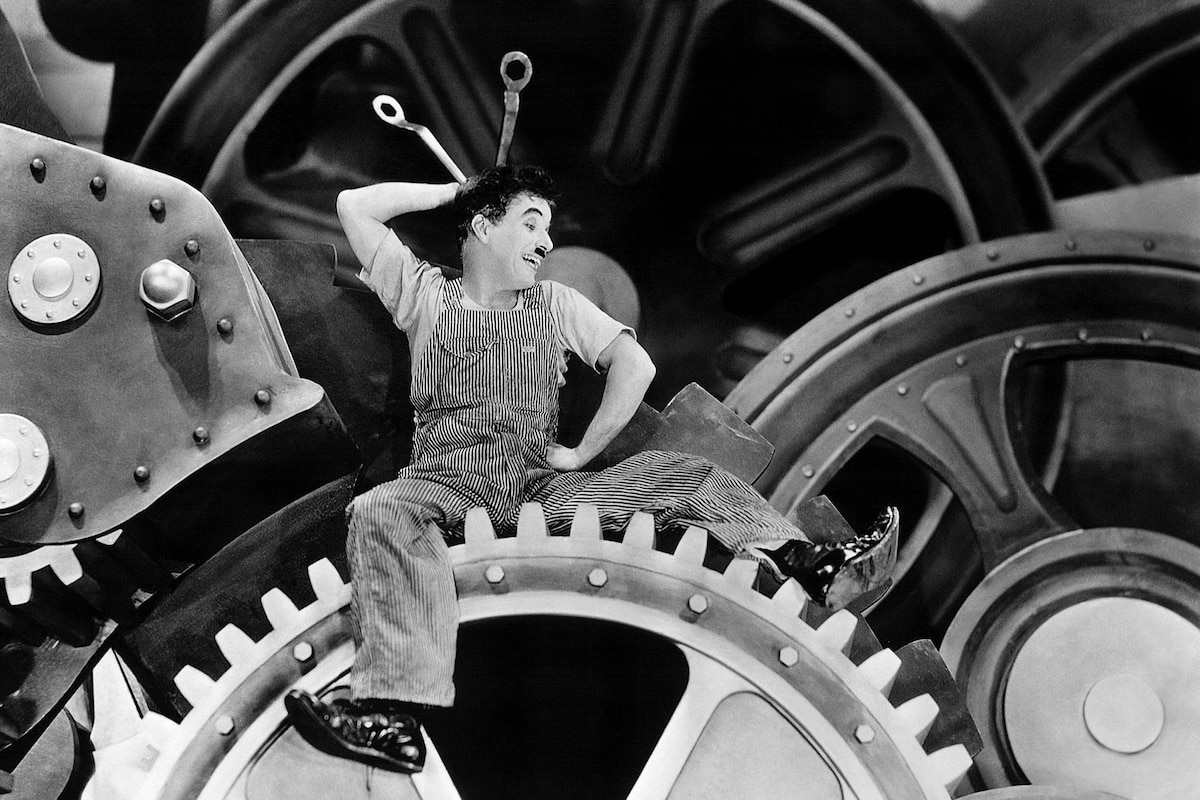
Another influence on Chaplin's ideas for Modern Times was René Clair's satire À nous la liberté (1931), set in a mechanized factory where workers are reduced to mere automatons. (The inspiration was strong enough to cause the French distributors to sue Chaplin years later.)
In an interview shortly after the release of Modern Times, Chaplin described an incident that he said inspired the theme and title: "I was riding in my car one day and saw a mass of people coming out of a factory, punching time clocks, and was overwhelmed with the knowledge that the theme note of modern times is mass production. I wondered what would happen to the progress of the mechanical age if one person decided to act like a bull in a china shop."
Various other inspirations have been credited for Modern Times, among them Chaplin's apprenticeship as a printer's devil at the age of 12, dwarfed by an enormous printing press; awareness of the increasingly mechanized and regimented automotive assembly lines in Detroit; and a huge conveyor-driven dishwashing machine he saw in a Los Angeles restaurant.
Upon his return from his world trip, Chaplin toyed with several film ideas for Modern Times, including a documentary on the Balinese dancing he had seen in Indonesia and the revival of an old idea about a Napoleon and Josephine story, which he pursued seriously enough to hire a young British journalist and aspiring playwright, Alistair Cooke, to help him develop. At the same time, he was also working with another assistant, the former vaudevillian Carter de Haven, on a satire about the factory system with his Little Tramp character causing chaos on an assembly line. His initial notes called for an opening shot of smoke billowing from the chimney of the "Electrical Metal Corporation" factory where the manager exhorts his workers to speed up production via a closed-circuit television.
It has been said that Chaplin experienced a burst of creative and emotional energy after meeting a young starlet on movie mogul Joseph Schenck's yacht. Her name was Paulette Goddard, and she had appeared only in bits and as one of the Goldwyn Girls chorus. She would become his constant companion, eventually his wife, and his leading lady in Modern Times. It has also been said that Goddard made story idea contributions to Modern Times as well as suggestions about her Gamin character.
In his early notes for his new movie, Chaplin briefly considered a story involving rebellious factory workers, "a drama of communism and everybody getting two cars."
During this period, Chaplin and Alistair Cooke were at Chaplin's house playing piano duets, including a risqué cabaret song called "Titine," which would find its way into Modern Times, albeit transformed into a nonsense song for the film debut of Chaplin's voice. During the number, Chaplin reportedly turned to Cooke and announced that he no longer wanted to pursue the Napoleon and Josephine project.
The factory project was called simply "Production No. 5" at first; later it was referred to under the title "The Masses."
At some point in the development stage of Modern Times, Chaplin began creating a story, which he related to a reporter at the time, about his Tramp character picking up a fallen red danger flag from a truck. He begins running after the vehicle waving the flag with the intention of getting the driver's attention and returning it, only to be mistakenly arrested as a political agitator. The film would then build to a climactic rally at which the character would accidentally become a symbol, and perhaps leader, of the masses. At this point, the ending he envisioned was similar to the inspirational one he would later use in The Great Dictator (1940). Soon after, however, he backed away from the overtly political theme and title ("The Masses").
The original script of Modern Times called for substantial bits of dialogue, confirming Chaplin's early plans to make a sound film. Some analysts have also noted that the dialogue script indicated a shift in his working methods from extensive improvisation to a more scripted and efficient style; in the past Chaplin's films often experienced delays due to blocking problems and reshoots.
by Rob Nixon
The Big Idea - Modern Times
by Rob Nixon | January 08, 2008
SIGN UP FOR OUR NEWSLETTERS

CONNECT WITH TCM