SYNOPSIS
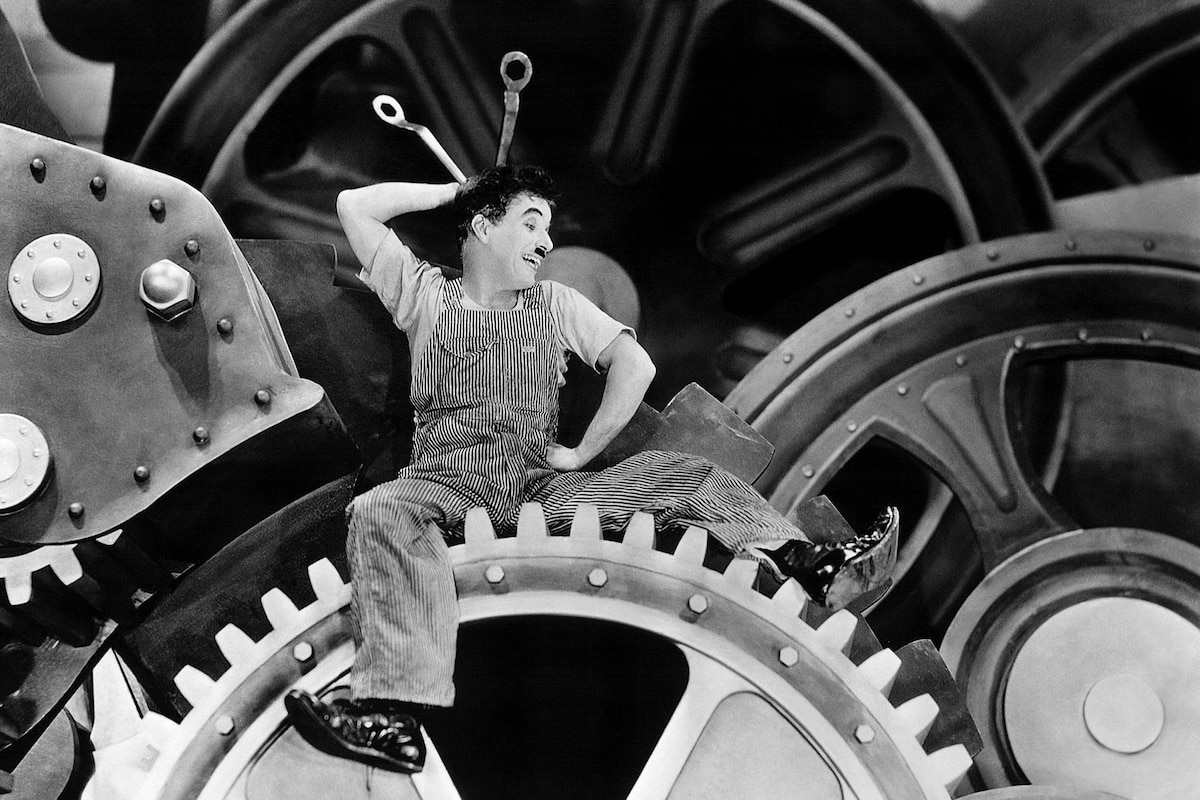
Charlie is a worker in a factory whose demanding boss monitors and gives orders to his employees over an extensive closed-circuit TV system. Charlie's inability to keep up with the work causes moments of chaos in the plant, and the monotonously repetitive tasks finally cause him to crack, putting him in a mental hospital and out of a job. On his release, he encounters the turmoil of the Depression in labor strikes, political rallies, and shantytowns. He also befriends a feisty young girl, the Gamin, who lives by her wits on the streets and steals bread to survive. Helping her avoid the juvenile authorities who take her younger sisters away after their unemployed father dies, Charlie vows to get them a real home. But their adventures together prove they're not suited or destined for a normal settled life.
Director: Charles Chaplin
Producer: Charles Chaplin
Screenplay: Charles Chaplin
Cinematography: Ira Morgan, Rollie Totheroh
Editing: Willard Nico
Art Direction: J. Russell Spencer
Original Music: Charles Chaplin
Cast: Charlie Chaplin (A Factory Worker), Paulette Goddard (A Gamin), Henry Bergman (Café Proprietor), Tiny Sandford (Big Bill), Chester Conklin (Mechanic), Hank Mann (Burglar).
BW-87m.
Why MODERN TIMES is Essential
Years after sound took over the motion picture industry and public taste, Charles Chaplin released an essentially silent film - Modern Times. It was the last true silent ever made (not counting parodies and experimental pieces). When the careers of his fellow comedians of cinema's early years had begun to decline or already faded, Chaplin limned the comic possibilities of the Depression era and the dehumanizing effects of the Machine Age through the character he had created and sustained for two decades, the Little Tramp. Against all wisdom, he had a success with the movie, delighting audiences and garnering reviews that, although mixed in their assessment, agreed that Chaplin's genius for filmmaking was undeniable.
Chaplin actually intended to make Modern Times an all-talking picture but abandoned the idea. Although dialogue is mostly relegated to title cards and the story conveyed primarily through visuals and pantomime in the movie, speech is heard, but on Chaplin's terms. Rather than "live," it's electronically reproduced on giant video monitors and pre-recorded phonograph records; it's mechanized beyond the purely human, like the automatic feeding machine that Charlie is strapped into by management as an experiment. In the café sequence that climaxes the story, singers, audience, and background noises are heard while the Tramp and Gamin carry on a scene in silence. Also, when at last we hear Charlie's voice, for the first time on film, it is singing gibberish, leaving us still dependent on his pantomime to understand the meaning.
Modern Times represents more than a refusal to move into talkies for the film actually comments on sound and plays with the conventions of both silent and talking pictures. In exploring this new technology, the form of the film becomes part of the content and the story itself becomes a reflection of the cinematic "modern times," an observation on the increasingly mechanized, factory-like production of movies, something far removed from the improvisational and leisurely way Chaplin was accustomed to working.
Ultimately, however, what audiences have responded to for years in Modern Times is not so much the formal qualities of the movie as the human, comic aspects of the story. It is almost a catalogue of Chaplin's greatest bits. He had created the Little Tramp in the early days of cinema and, in dozens of films over two decades, combining comedy and pathos to depict a person at odds with the world around him. His screen alter ego was always a misfit who usually finds a way to fit in and gain the home and companionship he craves, only to fail, time after time, walking off down the road alone. The character he created became the most universally recognized fictional figure in screen history, and in Modern Times Chaplin at last gives him a final gesture of hope and warmth in an increasingly hostile world, by sending him off down the road with a companion.
There are other considerable factors that mark Modern Times as a milestone, not least the artist's shift to the broader social and political satire he would explore further in the handful of films that followed. But all else aside, Modern Times would still be immortal if only for that final shot. Although they may not have known it at the time, it was the last time cinema audiences would ever see the Little Tramp.
by Rob Nixon
The Essentials - Modern Times
by Rob Nixon | January 08, 2008
SIGN UP FOR OUR NEWSLETTERS

CONNECT WITH TCM