You Can't Take It with You began as a play penned by the acclaimed writing team of George S. Kaufman and Moss Hart. It was wildly successful, running on Broadway for two years and winning the Pulitzer Prize for Drama.
While the play of You Can't Take It with You was enjoying its success on the stage, director Frank Capra was also riding a wave of success making films for Columbia Pictures in Hollywood. Having already won two Academy Awards® for directing It Happened One Night (1934) and Mr. Deeds Goes to Town (1936), Capra was the jewel in the Columbia crown. Like many people, however, Capra butted heads with the studio's temperamental mogul, Harry Cohn. A dispute between the two in 1937 had escalated to Capra's eventual year-long suspension from the studio, which would later play a part in bringing You Can't Take It with You to the big screen.
Frank Capra first got the idea to make a movie of the Kaufman-Hart play when he was in New York for the opening of his film Lost Horizon (1937). On a whim he went to the Booth Theater to see the play You Can't Take It with You and he absolutely loved it. "Its witchery was so entrancing," Capra recalls in his 1971 autobiography The Name Above the Title, "wild horses couldn't have dragged me away before final curtain." Things were still tense between Capra and Harry Cohn, but there was no denying that when they worked together, the result was great films. "You Can't Take It with You had to be my next film," said Capra. "But-producer Sam Harris' asking price was staggering: two hundred thousand dollars! Harry Cohn's squeal blew out the phone fuses." According to Capra, Cohn's response was, "I wouldn't shell out two hundred G's for the second coming!" In the end, however, Cohn made the record purchase on Capra's behalf partly because he knew that by giving him You Can't Take It with You it would help to make peace between them. It also didn't hurt that Cohn managed to secure the rights to it before his rival Louis B. Mayer did.
Writer and frequent Capra collaborator Robert Riskin was hired to adapt the play for the screen. Capra and Riskin worked closely on the script, making some changes from the stage version here and there, including beefing up the part of Tony Kirby and adding some new peripheral characters such as Mr. Poppins.
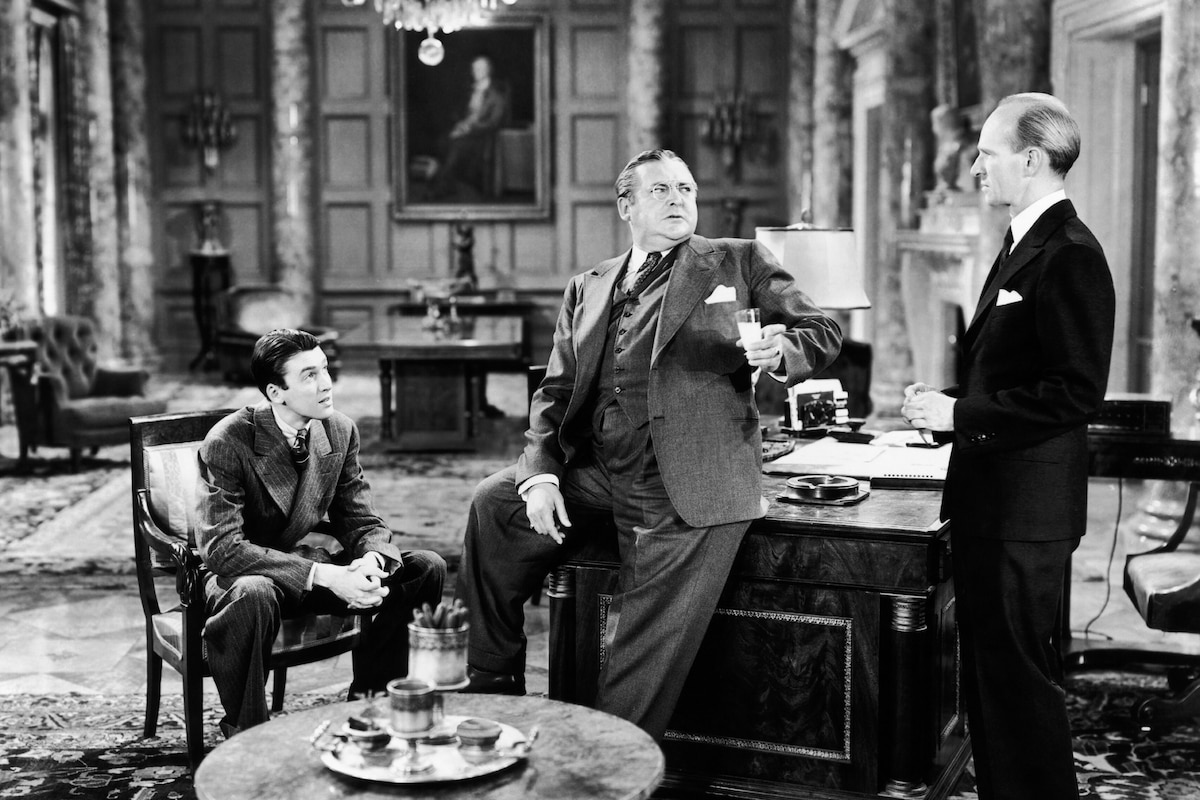
One of the reasons that Riskin and Capra beefed up Tony Kirby's part was because of James Stewart. Frank Capra had first noticed the gangly young actor in MGM's Navy Blue and Gold (1937) and was impressed. "I sensed the character and rock-ribbed honesty of a Gary Cooper," recalled Capra in his autobiography, "plus the breeding and intelligence of an ivy league idealist." He was sure that Stewart had what it took to be a major star. In order to get James Stewart for You Can't Take It with You, Capra had to make arrangements to borrow him from MGM, where Stewart was under contract at the time. MGM was happy to loan Stewart out since the film was based on a Pulitzer Prize-winning play and promised to be a prestigious film. It could only be a good thing, they thought, to have one of their stars associated with a top-notch picture, even if it didn't come from MGM.
For the key role of Grandpa Vanderhof, Capra settled on Lionel Barrymore, whom he later referred to as "the humblest, most cooperative actor I've ever known." Despite suffering from a variety of physical ailments, Barrymore was game to be in such a distinguished film. "When I interviewed him for the Grandpa Vanderhof part," recalled Capra, "he was crippled with arthritis. His hands, elbows, feet and knees were as stiff and knobby as old oak roots. He couldn't walk or pick up a spoon; needed hourly shots to ease the killing pain. His body was a mess. But not his verve. 'I'll play the part on crutches,' [Barrymore] said with a laugh. 'Just put a cast on my foot to alibi them. That'll do it.'" Since Barrymore was perfect for the part, that is exactly what they did.
From the beginning, Capra wanted actress Jean Arthur for the part of Alice Sycamore. He had used her before in Mr. Deeds Goes to Town and was a big fan, calling her "the finest actress of the day." Arthur was thrilled to take on the part.
Casting the role of Penny, the would-be novelist, proved to be more of a challenge for Capra. His first choice was actress Fay Bainter, but she was unavailable. Serendipitously, actress Spring Byington was suggested for the part, and she turned out to be perfect for Penny, making Capra happy with the choice.
Ann Miller, who was just getting started in Hollywood, had long been fibbing about her age in order to work. Tall and shapely, Miller looked like a mature woman and could get away with playing the married character of Essie in You Can't Take It with You. She was only 15 years old, however, and in awe of her big chance to be among such talented people. "Although I was young," she writes in her 1972 autobiography Miller's High Life, "I had sense enough to realize what a great opportunity it was for me to work with movie people of such magnitude." Miller was one of many who had auditioned for the role of Essie, an aspiring ballerina. It was crucial that whoever played Essie be able to do ballet toe work. Miller had received ballet training, but never in toe shoes. Eager for the part, Miller fibbed again and said that she could handle the toe work. When she was handed a pair of toe shoes and asked to demonstrate her skills at the audition, Miller wasn't sure how to properly wear them. She didn't understand that you were supposed to wrap the accompanying lamb's wool around her toes for protection and pad the toe area of the shoes. "But since I'd never handled toe shoes before," she said, "when they gave me this wad of stuff, I thought it was something you put in your hair...and I tossed it aside. I went out there and did the test standing on my toes, won the part, and then worked throughout that picture without the lamb's wool in my shoes because nobody told me to stick it in there."
To portray Essie's xylophone playing husband, Ed, Frank Capra was interviewing men who could actually play the instrument. One of the people who showed up to audition was Dub Taylor, who played the song "Dinah" on the xylophone for Capra. "His southern accent dripped hominy grits," said Capra in his autobiography. Taylor was perfect and made Capra laugh. He was cast on the spot. The small but memorable role would mark Dub Taylor's first ever appearance in a film.
Armed with a terrific script and cast, cameras were ready to roll on You Can't Take It with You in the spring of 1938. It was a film that Capra was extremely excited to make. "Why this mania to film Kaufman and Hart's play? Because it was a laugh riot? A Pulitzer Prize play? Of course," said Capra. "But I also saw something deeper, something greater. Hidden in You Can't Take It with You was a golden opportunity to dramatize Love Thy Neighbor in living drama. What the world's churches were preaching to apathetic congregations, my universal language of film might say more entertainingly to movie audiences."
by Andrea Passafiume
The Big Idea - You Can't Take It With You
by Andrea Passafiume | January 08, 2008
SIGN UP FOR OUR NEWSLETTERS

CONNECT WITH TCM