The Postman Always Rings Twice was James M. Cain's first crime novel. It was rejected by 13 publishers, mainly because of its sexual content, but when Alfred A. Knopf's wife convinced him to pick it up, it became a bestseller.
Prior to publication, MGM offered Cain $5,000 for the screen rights, but he decided to hold out to see how the book sold first. The choice proved a wise one.
Before the book came out, RKO executive Merian C. Cooper sent the manuscript to the Production Code Administration to see if it was suitable for screen adaptation. The PCA notified him that the story was probably unfilmable and he gave the same response to executives from Columbia and Warner Bros.
MGM picked up the film rights for $25,000 in 1934 without consulting the PCA. After several memos from new PCA head Joseph Breen, they decided not to proceed with plans for a film version. In particular, Breen objected to the implications that Frank and Cora shared a sado-masochistic relationship. He also noted the detailed depiction of their plot to kill Cora's husband and the depiction of the dishonest lawyers and insurance investigators involved in the murder case.
Hoping to soften up the PCA, MGM financed a stage adaptation of Postman by Cain in 1936. The production starred Mary Phillips as Cora and former film star Richard Barthelmess as Frank. The young Joseph Cotten played a police officer. The production lasted just 72 performances and was never revived.
A French film adaptation of Postman appeared in 1939 under the title, Le Derniere Tournant, "The Last Turn." It starred Fernand Gravey as Frank, Corinne Luchaire as Cora and Michel Simon as her husband. Pierre Chenal directed. The film was a commercial failure and has never played in the U.S.
In l943, Italian director Luchino Visconti directed and co-wrote an unauthorized adaptation under the title Ossessione. Massimo Girotti and Clara Calamai starred as the illicit lovers. Although critically acclaimed as one of the first "Neorealist" films, it was barred from distribution in the U.S. by the Cain estate and MGM until it was screened at the New York Film Festival in 1976, prior to a limited release here in 1977.
In 1940, MGM sent the PCA a story treatment prepared partly by Gustav Machaty, director of the notorious Czech film Extasé (1933). The new version omitted the sado-masochistic affair and had Cora's husband die by accident. Breen still considered it too sordid for the screen and production plans were dropped once again.
Paramount considered taking the story off MGM's hands in 1943 until they looked at the formidable correspondence file with Breen's comments.
When Billy Wilder passed the censors and scored a hit with Cain's previously unfilmable Double Indemnity (1944), Hollywood started looking for other properties to bring to the screen. Jerry Wald at Warner Bros. put Mildred Pierce (1945) into production, and Casey Wilson at MGM, who had produced several of the family-oriented Andy Hardy films, started working on The Postman Always Rings Twice.
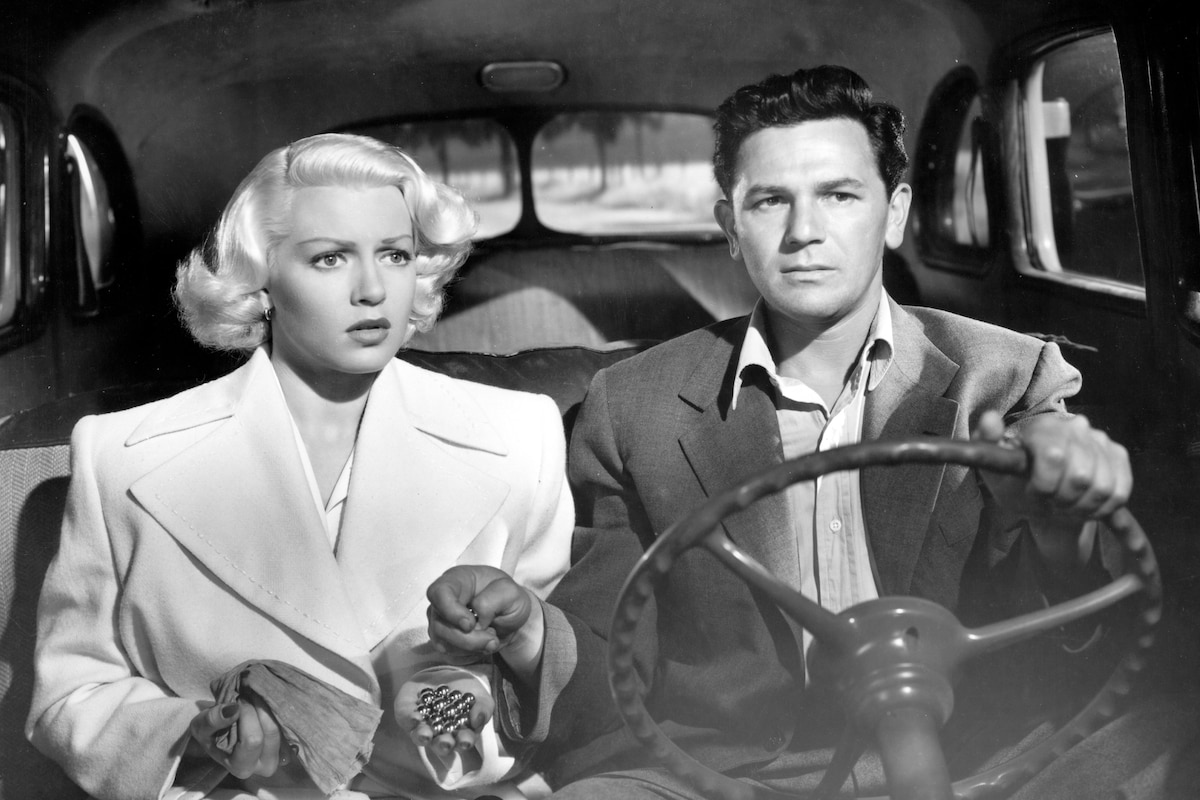
Wilson planned The Postman Always Rings Twice as a vehicle for Lana Turner, who had risen to stardom at MGM in a series of roles capitalizing on her beauty and sex appeal. When she expressed fears about how the public would react to her in such a villainous role, studio head Louis B. Mayer convinced her that she needed to expand her image into more dramatic parts.
In May 1945, the PCA finally approved a script that removed the story's sado-masochistic elements. It also threw heavy emphasis on Frank and Cora's guilt, their inability to enjoy their life together after killing her husband and the just nature of their deaths at the end. Although the lawyers were as corrupt as they were in the original, the insurance investigator became a private eye. In addition, the script suggested that Cora and Frank fell in love before beginning their affair. Nonetheless, the PCA's approval represented a loosening of restrictions on sexuality in Hollywood films.
The role of Frank Chambers was originally offered to Joel McCrea, who turned it down.
MGM casting director Billy Grady had tried to interest John Garfield in the male lead opposite Judy Garland in The Harvey Girls (1946), but the actor had said no. When McCrea refused to appear in The Postman Always Rings Twice, Grady thought Garfield would be perfect in the role.
Production delays on Humoresque (1946), Garfield's next film at his home studio Warner Bros., made the studio amenable to the loan to MGM, particularly since Garfield found the role of Frank Chambers much more suitable.
At some point in the casting process of The Postman Always Rings Twice, MGM considered casting Gregory Peck in the lead.
At the last minute, however, Garfield almost had to pull out of The Postman Always Rings Twice. Toward the end of World War II, he was drafted, and director Tay Garnett considered casting MGM contract player Cameron Mitchell in the lead. Garfield was ruled 4F, however, because of his age and heart problems and was back at work in time to star in the film. Garnett was shocked to see him playing handball a few days after and asked him to lay off, at least until the film had been completed.
Partly as a sop to the censors, Garnett decided to dress Turner almost entirely in white. As he explained later, "There was a problem getting any story with that much sex past the censors. We figured that dressing Lana in white somehow made everything she did less sensuous. It was also attractive as hell...They didn't have 'hot pants' then, but you couldn't tell it by looking at hers." (from Lana: The Lady, the Legend, the Truth).
Another move to appease Breen was Wilson's decision to make Cora's husband more sympathetic, thereby avoiding any suggestion that the affair and murder were justified by his behavior. To avoid offending Greek immigrants, and America's recent allies during World War II, the character lost his ethnic background, and his name was changed from Papadakis to Smith. That opened the door to the casting of Cecil Kellaway, borrowed from Paramount, who gave one of his best performances as the unsuspecting spouse.
by Frank Miller
The Big Idea - The Postman Always Rings Twice
by Frank Miller | January 08, 2008
SIGN UP FOR OUR NEWSLETTERS

CONNECT WITH TCM