Although he is better known today for contemporary crime and mystery stories with an often wryly or ironically humorous edge, Elmore Leonard started his writing career as the author of Western stories. He had his first success in 1951 when Argosy, the adventure magazine, published his short story "Trail of the Apache." More than 30 short stories followed in the next decade, and his first pulp Western novel, The Bounty Hunters, was published in 1953. That same year, his short story "Three-Ten to Yuma" was published in Dime Western Magazine. He received $90 for the story.
Leonard said he chose Yuma as the location for the title because it was the site of a famous territorial prison, the most notorious one in the Old West. It opened in 1876, and during its 33 years of operation, more than 3,000 people were incarcerated there for crimes ranging from polygamy to murder, with grand larceny the most common.
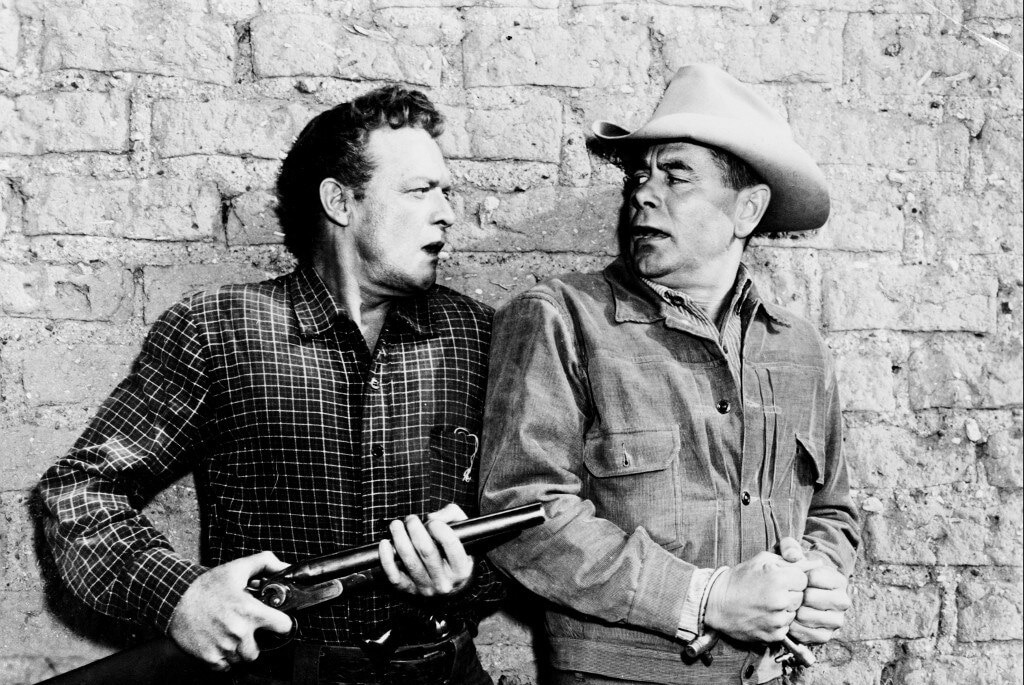
Leonard's work first grabbed attention as a good basis for drama in 1956, when his story "Moment of Vengeance" was adapted as an episode of the TV anthology series Schlitz Playhouse of Stars. It starred Western icon Ward Bond (a frequent player in John Ford's films) and Gene Nelson.
Leonard's work was first picked up for the big screen by director Budd Boetticher, who saw in the author's complex, shaded characters a good foundation for the kind of Western he was turning out in collaboration with Randolph Scott in the 1950s - pared down, often bleak tales with heroes driven by guilt, revenge or an internal moral code. Boetticher and screenwriter Burt Kennedy effectively adapted Leonard's story into The Tall T (1957).
During this period, director Delmer Daves also began turning his attention to the Western. His first in the genre, Broken Arrow (1950), starred James Stewart and featured Jeff Chandler as Apache leader Cochise. It broke new ground as one of the earliest films (and one of the very few of its time) to depict Indians with dignity and understanding. Although he continued to work in several genres, Daves received increased attention for the way he skillfully foregrounded psychological and moral complexity into the Western, long characterized by clear separation of good and bad, right and wrong. Daves saw in Leonard's story "Three-Ten to Yuma" an opportunity to explore these shadings further and bought the screen rights for $4,000, with the promise of another $2,000 for any remakes.
To adapt the story, Daves hired former playwright and stage director Halsted Welles, whose only previous theatrical feature had been the Barbara Stanwyck melodrama The Lady Gambles (1949). Welles spent the years following that debut working in television. He was one of the writers on the series Schlitz Playhouse of Stars, where Leonard's writing was first adapted, although Welles was not the scripter on the Leonard-inspired episode.
Welles took the kernel of the plot and some of the dialogue from Leonard's story but changed the name of most of the characters, except for Charlie Prince, the ruthless second-in-command of Ben Wade's outlaw gang.
by Rob Nixon
The Big Idea - 3:10 to Yuma
by Rob Nixon | January 08, 2008
SIGN UP FOR OUR NEWSLETTERS

CONNECT WITH TCM