SYNOPSIS
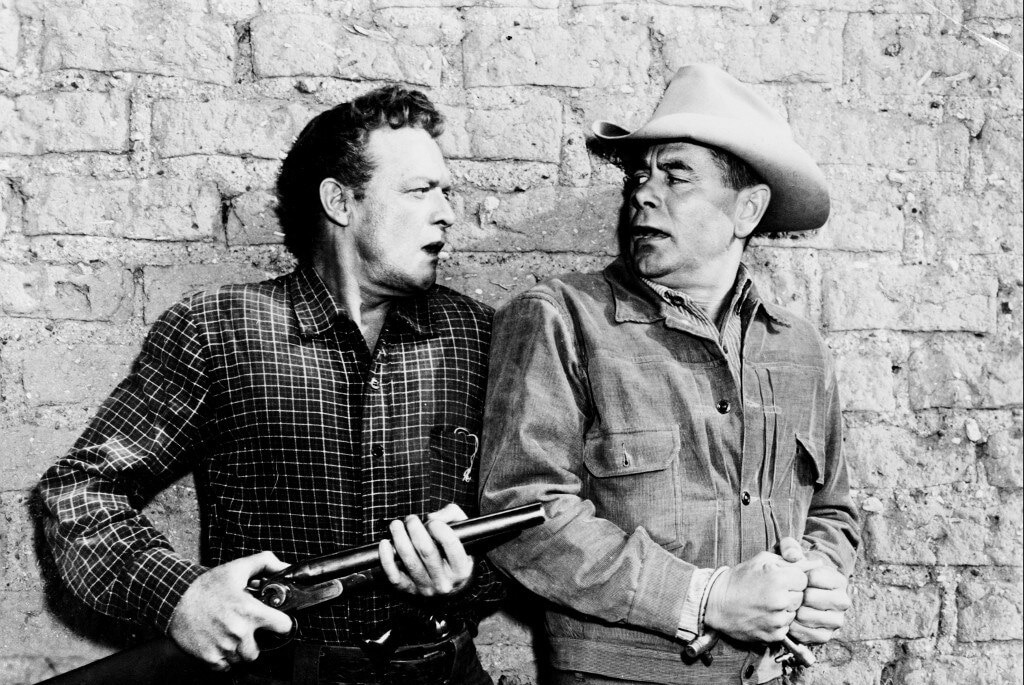
Dan Evans is a farmer struggling to hold onto his land and livelihood during a severe drought. He finds a financial solution for himself and his family when he is offered a large sum of money to secretly escort Ben Wade, the captured leader of an outlaw gang, to a nearby town and place him on board a train that will carry him to trial in Yuma. The two men hole up in a hotel near the station where the smooth-talking Wade tries to mentally and emotionally manipulate his captor into letting him go. Meanwhile, Wade's gang is fast approaching the town where a final showdown between Evans and the outlaws is imminent.
Director: Delmer Daves
Producer: David Heilweil
Screenplay: Halsted Welles , based on a story by Elmore Leonard
Cinematography: Charles Lawton, Jr.
Editing: Al Clark
Art Direction: Frank Hotaling
Music: George Duning, Ned Washington
Cast: Glenn Ford (Ben Wade), Van Heflin (Dan Evans), Felicia Farr (Emmy), Henry Jones (Alex Potter), Richard Jaekel (Charlie Prince).
BW-92m.
Why 3:10 TO YUMA is Essential
An offbeat Western whose tense psychological game could have been played out as easily in any crime drama set in a modern city, 3:10 to Yuma (1957) is one of the best from a director who helped redefine the Western genre in the 1950s. In his 50-year career, Daves racked up credits as actor, writer, producer and director of every type of film Hollywood ever produced, but he did his best and most memorable work in Westerns. Along with a handful of films by other directors notably High Noon (1952), to which 3:10 to Yuma bears some striking similarities Daves ushered in a new era by introducing new elements into an established genre. These included a contemporary, psychological approach to characterizations, a breakdown in romantic stereotypes, and moral ambiguity replacing a clear cut distinction between the good guy and the bad guy.
In 3:10 to Yuma, Daves is ably assisted by the performances of Van Heflin, his solid everyman plainness recalling his work in another Western, Shane (1953), and Glenn Ford, playing against type as the villain, although a charming one who displays a measure of decency at the end.
Ford's Ben Wade was something new for the genre - a villain who is not merely an archetypal bad guy that the hero must face down, but a fully developed character with a point of view. It may be reasonably posited that Wade is actually the central character of the piece, despite being the villain. Instead of being merely the obstacle to the hero's mission, he is in many ways the force that prods Heflin's Dan Evans into a higher moral duty and toward taking greater risks for what is ultimately right.
3:10 to Yuma is as noteworthy for its technique as for its theme and characters. Daves shot the film in black and white in a time when color had become the standard for Westerns. One of its most significant departures from the genre is the setting; much of it takes place not in the great outdoors but within the confines of a single room, where the intense interplay between the two characters frequently earns 3:10 to Yuma its description as a "chamber Western."
The exterior sequences are also very striking; Daves used red filters to give a heightened, harsher sense of a land ravaged by drought, and sets the action against homesteads and towns whose almost barren physicality and less-than-upright citizenry place them at the edge of civilization, a narrative space well suited to the story's ambiguities and tensions.
by Rob Nixon
The Essentials - 3:10 to Yuma
by Rob Nixon | January 08, 2008
SIGN UP FOR OUR NEWSLETTERS

CONNECT WITH TCM