Critical reaction to The Seven Samurai in Japan was initially lukewarm. One review complained that it was not very democratic of Kurosawa to condemn the peasants; another questioned if he was saying the farmers were not worth saving. Yet, it was a major box office success with the Japanese public.
The Seven Samurai has been released in several versions, and it was many years before the original cut (nearly 3 1/2 hours long) was restored; that version is now available on DVD. The full version played only in major cities in Japan when it was released in 1954; a shortened version played second and third runs in other locations. Another edit (161 minutes) was released for export, and for many years, this was the most complete version in distribution and the one most people saw. A third cut was made for the Venice Film Festival, where people complained about the first half being confusing, which Kurosawa admitted was true in this truncated form. The audience there did enjoy the second half, which had only minor cuts that the director said actually helped it. The American release was cut even further by distributor RKO from the export version and was called The Magnificent Seven until John Sturges's 1960 Western remake caused all prints of the original to be recalled.
Toshiro Mifune has Akira Kurosawa largely to thank for his career. Returning home in 1945 after six years in the Army, Mifune found himself with no money or employment. A friend in the Toho photo department told him to come down to the studio to see if he could get him a job. Allegedly, Mifune got in the wrong line and ended up waiting several hours to try out for a "new faces" contest. Asked by casting directors to mime anger, he did so very convincingly because he was furious. Put off by his outburst, they were going to throw Mifune out, but Kurosawa and his mentor, the director Kajiro Yamamoto, had witnessed the incident and spoke up for him. He was then hired as an actor, beginning a long association with the studio and Kurosawa.
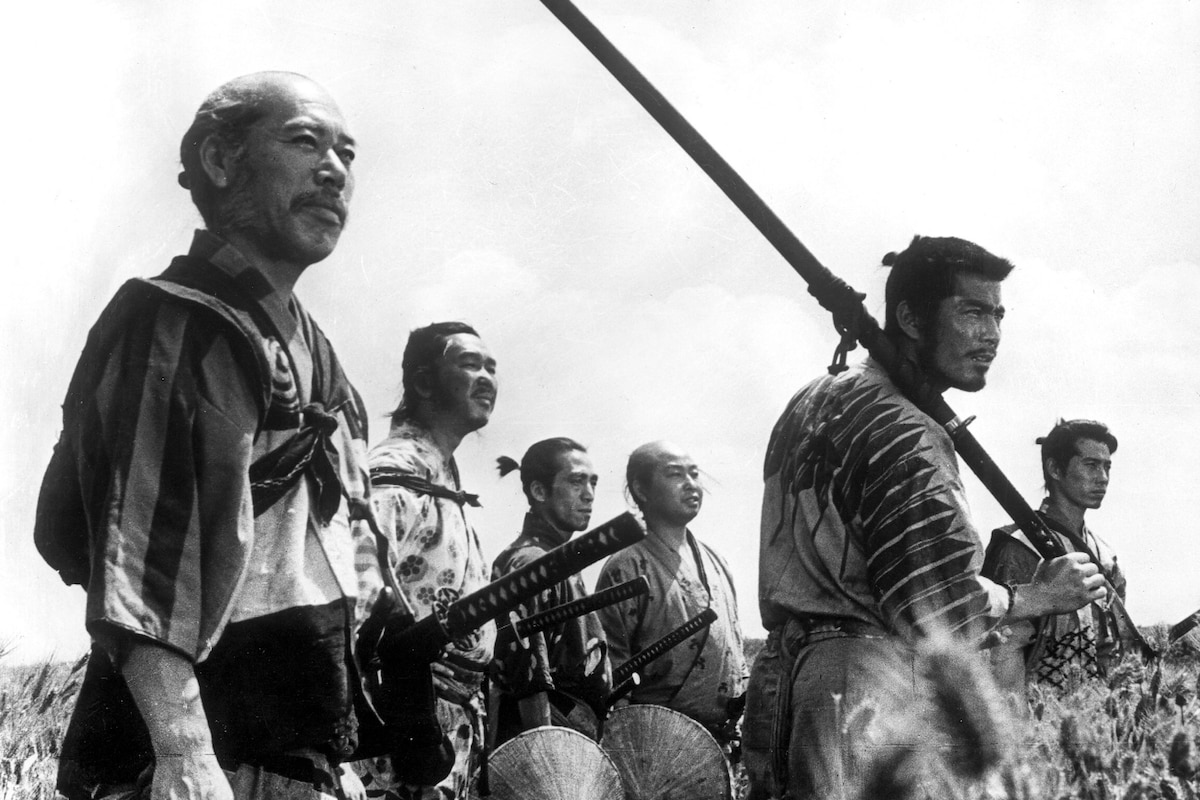
Critics in the West initially criticized Mifune for overacting in his role as Kikuchiyo, and as late as 1994 (in A Biographical Dictionary of Film, Alfred A. Knopf, 2000), David Thomson still remarked, "I am averse to actors who huff and puff that much." But Japanese film scholar Mark Jecks, in his commentary on the film on the Criterion Collection DVD release, states that Mifune's performance is exactly right for the character. He counters that it is Kikuchiyo who is the ham, going over the top to prove himself a warrior, thereby severing his peasant past.
Reportedly a descendant of samurais, Takashi Shimura (Kambei) made more than 200 pictures between 1935 and his death in 1982, but most often as a character actor or supporting player. His only major roles were with Kurosawa, notably the dying bureaucrat in Ikiru (1952). Outside of Japan, he was probably best known to a mass audience as the kindly doctor in the original Godzilla (1956). Although not as well known as Toshiro Mifune, Shimura is an icon of Japanese cinema and considered one of its finest actors.
Toshiro Mifune made sixteen films with Kurosawa. But during the production of Red Beard (1965), their relationship became strained. The film was in principal photography for two years. Mifune had grown a beard for the role, and so could not appear in any other movie. It was a critical success but a commercial failure. Mifune and Kurosawa never worked together again. Nevertheless, in later years, Mifune said of all the films he had made he was only proud of the ones he appeared in for Kurosawa.
Keiko Tsushima (Manzo's daughter Shino) was a modern dancer who was "discovered" by a casting director while standing on the platform of a train station. Previously, she had worked with famed director Yasujiro Ozu on The Flavor of Green Tea over Rice (1952). She never made another film with Kurosawa, but she appeared in many other films and television shows in the next 50 years.
Isao Kimura (Katsushiro) worked with left-wing theater groups and ran several of his own. His final theater group went bankrupt, and he had to take on work to pay off the debt. He died in 1981 at the age of 58.
Yoshio Tsuchiya (Rikichi) was trained as a physician but changed professions to become an actor. An author of several books about UFOs, he most enjoyed appearing in such science fiction movies as The Mysterians [1957], The H-Man [1958] and Varan the Unbelievable [1958].
Sojin Kamiyama (Blind Minstrel) started his career in American silent films, including Douglas Fairbanks's The Thief of Bagdad (1924) and Cecil B. DeMille's biblical epic, The King of Kings (1927). He was one of only three Asian actors to play the Chinese-American detective Charlie Chan (in 1927). His thick accent limited his career in American sound films, and he returned to Japan in the 1930s. He died just a few months after the release of Seven Samurai.
Tatsuya Nakadai, who had an uncredited bit as one of the samurai wandering through town, became one of Japan's biggest stars. He eventually starred in six movies for Kurosawa, including the leads in Kagemusha (1980) and Ran (1985).
Kamatari Fujiwara (Manzo) started his career in the early 1930s, primarily as a comic actor. He made 13 films in all with Kurosawa and one American movie appearance, as "The Artist" in Arthur Penn's off-beat crime drama Mickey One (1965), starring Warren Beatty.
In addition to composing the score for The Seven Samurai, Fumio Hayasaka wrote the music for six previous Kurosawa films and worked often with acclaimed director Kenji Mizoguchi. He was working on Kurosawa's movie, I Live in Fear: Record of a Living Being (1955), when he died of tuberculosis at the age of 41.
Memorable Quotes from SEVEN SAMURAI
PEASANT WOMAN: Land tax. Forced labor. War. Drought. God must want us farmers to starve.
PEASANT MAN: That's true, better we die.
PEASANT WOMAN: Let's give everything to the bandits. All the food we have. And then hang ourselves!
MANZO (Kamatari Fujiwara): Farmers are born to suffer. That's our lot.
KAMBEI (Takashi Shimura): My name is Kambei Shimada. I'm a ronin. And I have no disciples.
MANZO: But will samurai fight for us, just for food?
GRANDFATHER (Toranosuke Ogawa): Find hungry samurai. Even bears will come out of the forests when they're hungry.
KAMBEI: I'm preparing for a tough war. It will bring us neither money or fame. Want to join?
KAMBEI: Train yourself, distinguish yourself in war. ... But time flies. Before your dream materializes, you get gray hair. By that time your parents and friends are dead and gone.
KAMBEI: I'm tired of fighting.
KIKUCHIYO (Toshiro Mifune): Farmers are stingy, foxy, blubbering, mean, stupid, and murderous. ... But who made them such beasts? You samurai did it. You burn their villages, destroy their farms, steal their food, force them to labor, take their women, and kill them if they resist. So what should farmers do?
KIKUCHIYO: Love your wives plenty tonight!
KAMBEI (at Heihachi's funeral): We were counting on him to cheer us when things became gloomy. And now he's gone.
KAMBEI: Again we're defeated. The winners are those farmers. Not us.
Compiled by Rob Nixon
Trivia - Seven Samurai - Trivia & Fun Facts About THE SEVEN SAMURAI
by Rob Nixon | January 08, 2008
SIGN UP FOR OUR NEWSLETTERS

CONNECT WITH TCM