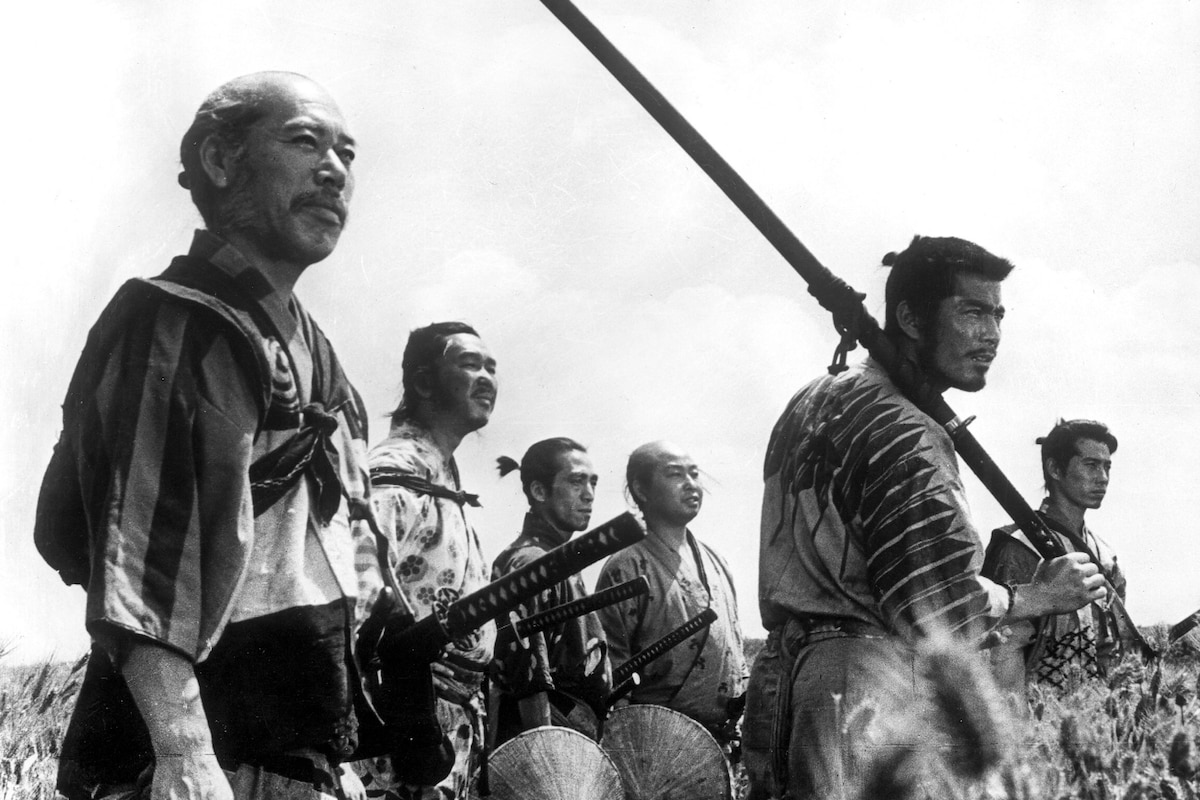
The samurai were the warrior caste in Japan's rigid class system, trained in arms and in the employ of a lord, much like the knights of medieval Europe. In the disorderly, lawless time in which The Seven Samurai is set, the lords were defeated and dead, and their samurai were left unemployed and forced to wander the countryside for their livelihoods. This period appealed to Kurosawa as far richer in terms of character possibilities and historical interest than the usual period film with the samurai at the top of their game.
Kurosawa's idea was initially to create a film about a day in the life of a single samurai, but he expanded the scope of the movie after reading about a real village that hired samurai for protection.
While working on the story of The Seven Samurai, Kurosawa wrote complete dossiers for each character, detailing what they ate, where they came from, and how they talked and moved.
The motif of assembling a team of strangers for a mission, while very commonplace now, was fairly new at the time of The Seven Samurai. Some say it was created first in The Seven Samurai, but there are at least antecedents in American crime films, most notably The Asphalt Jungle (1950). That film was based on a novel by W.R. Burnett, and because Kurosawa was an avid reader of American and British detective/crime stories, it may have been an inspiration.
To collaborate on the screenplay, he hired Shinobu Hashimoto, who worked on the scripts for Kurosawa's earlier films Rashomon (1950) and Ikiru (1952), and Hideo Oguni, who also worked on Ikuru and would do ten more films with Kurosawa. Hashimoto collaborated with the director (and often Oguni) on five more films after The Seven Samurai.
Kurosawa and his writers would go to a hot springs resort or some other remote place, and each would write independently around a big table. They'd then pass their work around and criticize and argue. Kurosawa specifically depended on Hashimoto for his skills in narrative structure and Oguni for bringing truth and humanism to the story and characters.
The six samurai characters were fleshed out early into production, but the director and writers decided they needed a character to bridge the gap between the samurai and the peasants, so they created Kikuchiyo, who is a peasant by birth but aspires to warrior status.
Kurosawa may have based aspects of the character Kikuchiyo and the worshipful apprenticeship of young Katsushiro at least partly on his older brother and their relationship. Kurosawa revered his brother, Heigo, a conflicted man who struggled to find his place in the world and suffered from depression. It was Heigo who introduced the young Akira to the cinema and in particular to foreign film, which greatly influenced the future director's work. Heigo was a benshi, a narrator of silent films (a common occupation in Japan before sound pictures). When talkies came in, he led a strike against them in support of his profession but to no avail. Not long after, he committed suicide.
Like John Ford whom he greatly admired, Kurosawa had already by this time established a stock company of actors he would work with over and over again. For the leader of the samurai band, Kambei, he cast his longtime collaborator Takashi Shimura, who had acted in twelve of the director's films prior to this, the most notable being Rashomon and the lead in Ikiru. Throughout his career, Kurosawa would frequently use Shimura, an actor of such range that he could play the dying bureaucrat in the contemporary drama Ikiru as convincingly as the warrior in a period action film like The Seven Samurai.
As Kikuchiyo, the farmer's son who longs to be a samurai, Kurosawa cast another actor he had used six times previously, Toshiro Mifune, who had also worked with Shimura in Rashomon. Originally, Mifune was to play the master swordsman, Kyuzo, but when Kurosawa created the character of Kikuchiyo, he decided Mifune would be better in that role.
Among the other cast members Kurosawa had used before (and would use often in the future) were Minoru Chiaki (Heihachi), Isao Kimura (Katsushiro), Daisuke Kato (Shichiroji), and Kamatari Fujiwara (Manzo).
by Rob Nixon
The Big Idea - Seven Samurai
by Rob Nixon | January 08, 2008
SIGN UP FOR OUR NEWSLETTERS

CONNECT WITH TCM