SYNOPSIS
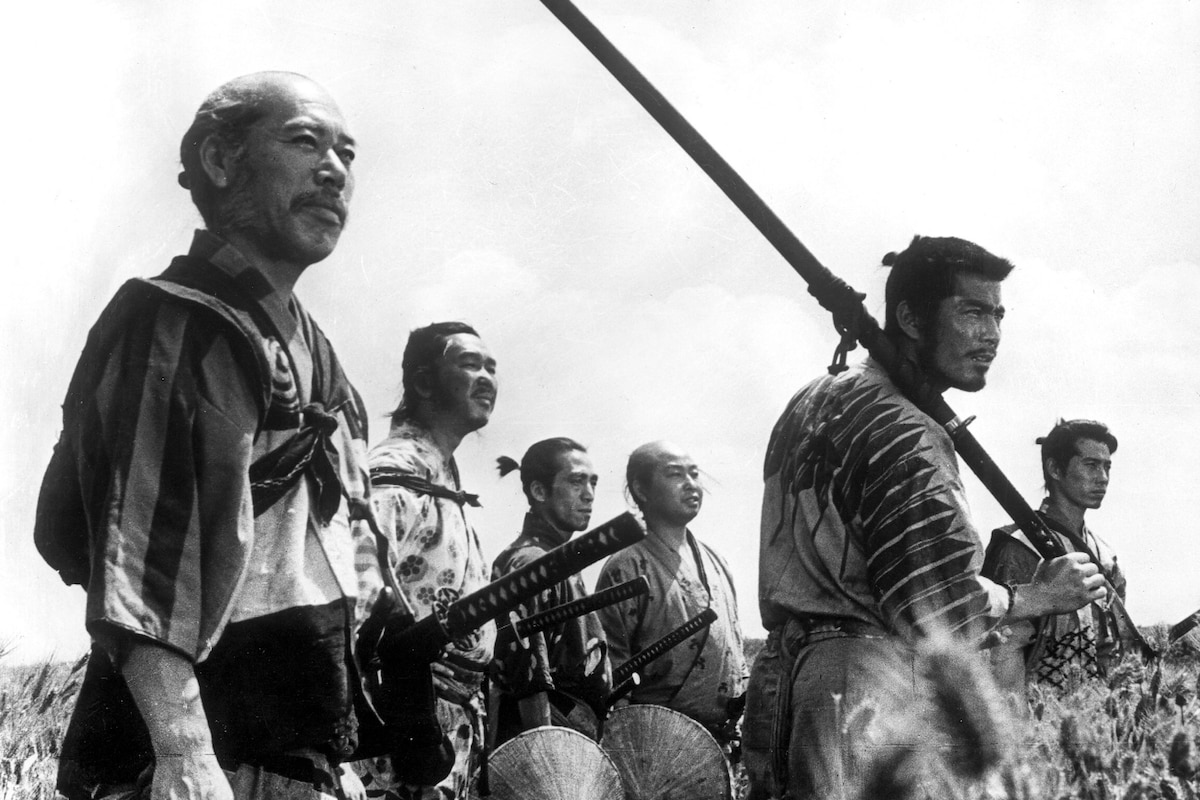
A village of poor, struggling farmers decides to hire samurais to protect them from marauding bandits who attack their homes and families and steal their food. They find a solo samurai named Kambei who, like most of his compatriots, has no master and wanders the country fending for himself. Despite his circumstances, Kambei is an honorable and compassionate man who recruits five other samurais, including the worshipful young Katsushiro, the master swordsman Kyuzo, and Kikuchiyo, a peasant posing as a warrior.
Director: Akira Kurosawa
Producer: Sojiro Motoki
Screenplay: Akira Kurosawa, Shinobu Hashimoto, Hideo Oguni
Cinematography: Asakazu Nakai
Editing: Akira Kurosawa
Production Design: So Matsuyama
Original Music: Fumio Hayasaka
Cast: Takashi Shimura (Kambei Shimada), Toshiro Mifune (Kikuchiyo), Yoshio Inaba (Gorobei Katayama), Seiji Miyaguchi (Kyuzo), Minoru Chiaki (Heihachi Hayashida), Daisuke Kato (Shichiroji), Isao Kimura (Katsushiro Okamoto).
Why THE SEVEN SAMURAI is Essential
The Seven Samurai holds a position occupied by few other filmscompletely grounded in its culture and the periods in which it was set and produced but global in its themes, its appeal, and, most important where this film is concerned, its impact. Some critics have debated how much Kurosawa was consciously seeking to imitate the Westerns of directors like Howard Hawks and John Ford (whom Kurosawa reportedly idolized). There can be no doubt, however, about the impact The Seven Samurai has had on action films made since its release.
As New York Times film critic Bosley Crowther said in 1956, "It is a solid, naturalistic, he-man outdoor action film, wherein the qualities of human strength and weakness are discovered in a crisis taut with peril. And although the occurrence of this crisis is set in the 16th century in a village in Japan, it could be transposed without surrendering a basic element to the nineteenth century and a town on our own frontier." In looking closely at The Seven Samurai, then, we naturally consider the characters, styles, and techniques of any number of other works, from those of Ford and Hawks to Spielberg and Lucas.
Kurosawa was the first Japanese director to break through to the international film audience, but he also broke new ground in his own country; part of it was his use of Hollywood cinematic techniques such as musical motifs to introduce and represent different characters. Through much of its history, at least until the late 1960s, a large percentage of Japan's cinematic product was jidai-geki or period films, particularly those centered on the samurai warrior class. In the postwar era, fewer of these films were made, partly because the genre was frowned upon by Allied occupation authorities who wanted no glorification of a feudal, militarist past. Those that were created tended to be simplistic swordfight films with stock characters, comparable to the later Steve Reeves sword-and-sandal epics in their glancing relationship to real history. What Kurosawa created was something quite different from the usual jidai-geki set in the Tokugawa or Edo period (17th to mid-19th centuries), a time when central authority had been re-established in Japan. He chose to set his story in the Sengoku or Warring States period of the 16th century, a chaotic and violent time of civil war, social upheaval, and political intrigue. His samurai, then, are not well-heeled, noble heroes but wandering ronin (warriors without a master), their days of glory behind them. And instead of the usual ballet-like choreography of the fight scenes, he went for in-the-mud realism, emphasizing the chaos and horror of battle.
The Seven Samurai has been called an ultimate example of an auteurist work because, although there were plenty of collaborators, artists, and technicians involved, it is Kurosawa's film all the way. Known for being demanding, domineering, and a perfectionist in all his productions, he orchestrated every aspect of this film - the performances, music, set, editing, and even the weather. The Japanese film industry was known for giving directors a great deal of autonomy, especially compared to Hollywood, but Kurosawa's eminence by this point in his career and his stubborn personality assured him complete control over the final product to make exactly the film he envisioned.
What he envisioned was put on screen with techniques that opened the eyes of audiences, critics, and other film artists to startling ways of telling a story: telephoto shots that put the action right in your lap; pacing that allowed slow, contemplative scenes to build tension for the inevitable violence to come; single shots of exquisite beauty that were never there for mere pictorial flourish; and perhaps most influential in the years to follow, slow motion shots of violence and death. The result was an immensely popular movie full of rich characterizations, exciting action sequences, and wry humor that, despite its length, was both rousing entertainment and a deeply felt and fully realized "art" film.
by Rob Nixon
The Essentials - Seven Samurai
by Rob Nixon | January 08, 2008
SIGN UP FOR OUR NEWSLETTERS

CONNECT WITH TCM