On November 17, 1957, police in Plainfield, Wisconsin, investigating the robbery of a local hardware store and the disappearance of its owner, Bernice Worden, arrived at the dilapidated farmhouse of 51-year-old Ed Gein, the last person seen at the store. They found Worden's bodyand much more: furniture made of human body parts, female genitalia in a shoebox, a human head, a suit made entirely of skin. Gein admitted to one other murder, although he was believed responsible for the deaths of a number of women missing from the area over the previous decade. What really attracted the media's attention throughout the country, however, was Gein's practice of exhuming the bodies of women from graveyards and using their body parts in bizarre fetishistic rituals. Gein admitted to only two murders, but he also dug up the bodies of middle-aged women from the graveyard who reminded him of his abusive mother; her death in 1945 had left him alone and grief-stricken. He had sealed off her rooms exactly as they were when she was alive and preserved them untouched as a shrine.
By the time of the gruesome discoveries at Ed Gein's farm, Robert Bloch had already established himself as a popular and prolific writer of crime stories and science fiction for more than a decade. Intrigued by the case without delving into the details or researching the case, he began writing a novel focusing on the possibility of a quiet, unassuming small-town man who turns out to be a fiend. He said he was surprised years later to discover just how closely the character he created, Norman Bates, resembled Gein in his acts and motivation.
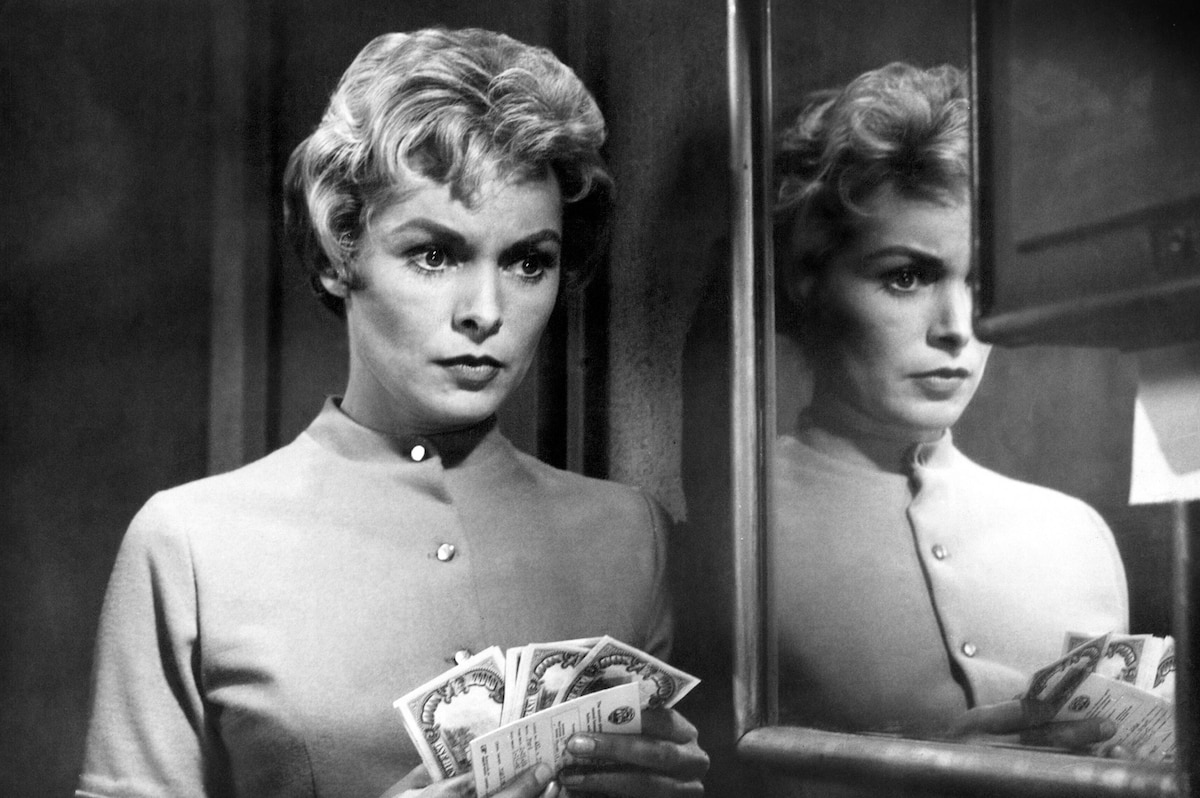
Bloch's novel, Psycho, was published in 1959. It started with the introduction of the chubby, middle-aged alcoholic Norman Bates, a taxidermy hobbyist and manager of a dilapidated motel. Then it relates the story of Mary Crane, who stops at the motel on her way to meet her lover, Sam Loomis, after she has embezzled $40,000 from her company. Hitchcock's adaptation follows the novel very closely in most of the details, and some of the movie's most famous dialogue came directly from the book.
The book was brought to Alfred Hitchcock's attention by his production assistant Peggy Robertson. He bid on the rights anonymously, assuming Bloch and the publisher would ask for more if they knew it was Hitchcock, and got them for $9,000.
"I think the thing that appealed to me [about the book] and made me decide to do the picture was the suddenness of the murder in the shower, coming, as it were, out of the blue," Hitchcock later commented to director Francois Truffaut in their famous set of published interviews.
Hitchcock wanted to make a radical departure from the big budget widescreen color thrillers he had recently turned out, such as Vertigo (1958) and North by Northwest (1959), and Bloch's novel was the ideal subject matter. He wanted to make a movie using the crew from his television series, including cinematographer John L. Russell, assistant director Hilton Green, and costumers Helen Colvig and Rita Riggs. Hitchcock reasoned that if the final film was denied a theatrical release, he could always edit it and distribute it on television.
Hitchcock decided to finance Psycho himself under his production company Shamley and bring in Paramount as the distributor. Some film historians claim, however, that he was forced to finance it himself after Universal balked at producing the film.
James P. Cavanagh, who wrote for the TV series Alfred Hitchcock Presents, was hired to adapt the novel, but Hitchcock was dissatisfied with his work. Joseph Stefano, who had penned two films (Fast and Sexy [1958], The Black Orchid [1958]) and a handful of TV episodes to his credit, was then hired to work on the script, and retained the screen credit for it.
Hitchcock and Stefano changed key aspects of the story. The location was moved from the Midwest to California and Phoenix, Arizona. Norman was changed from an overweight, middle-aged man to a handsome but neurotic young man. Norman's introduction was also saved until well into the story, and the first part of the script focused only on Bloch's subplot about Mary Crane's theft of $40,000. "Mary" ultimately became "Marion."
Two scenes were added that did not appear in the book - the ones involving the highway patrol officer and the car salesman.
Stefano originally wrote longer scenes, such as one in which dialogue establishes a growing bond between Marion's boyfriend and her sister Lila. Hitchcock eliminated most of that, cutting the scene down to about 20 seconds of expositional dialogue in order to keep the story moving.
by Rob Nixon
The Big Idea - Psycho
by Rob Nixon | January 04, 2008
SIGN UP FOR OUR NEWSLETTERS

CONNECT WITH TCM