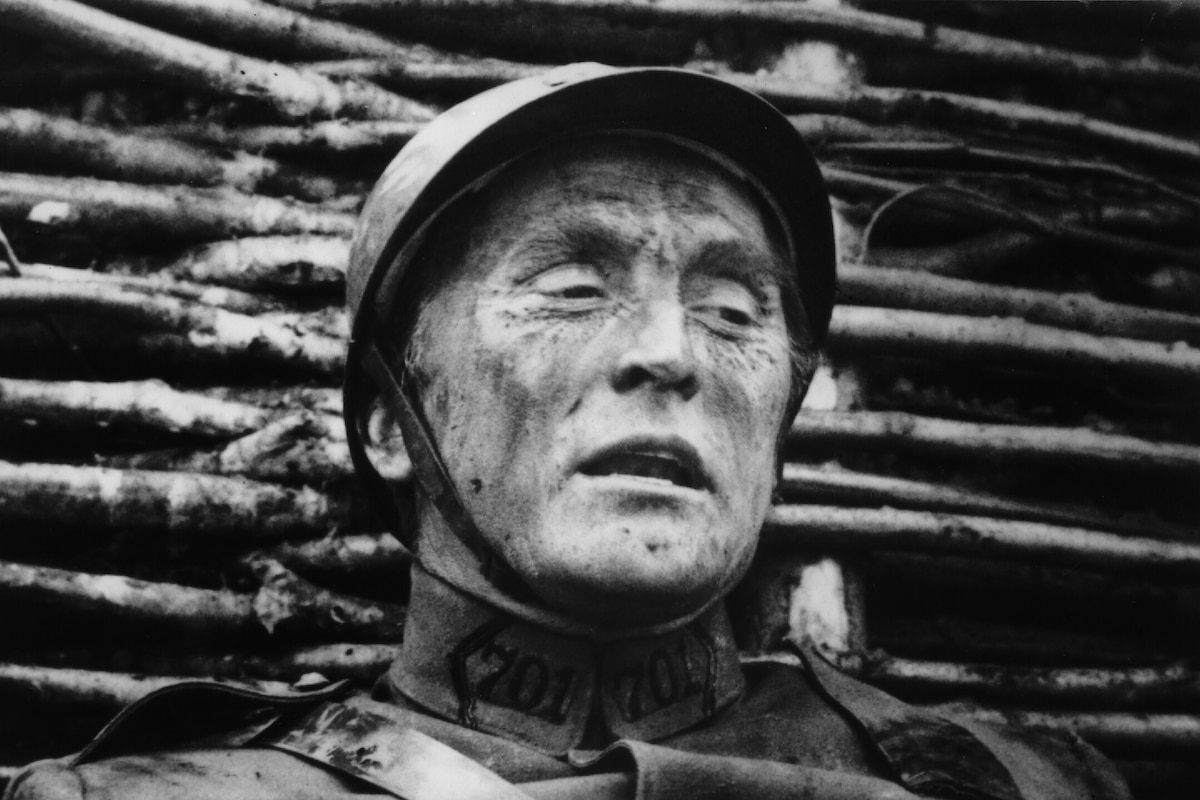
As meticulous as Stanley Kubrick was in the making of his feature films, he did overrule battlefield authenticity in favor of practicality by making the trenches two feet wider than the real trenches in World War I, which were about four feet wide. Kubrick simply needed more room for his many celebrated tracking shots.
Paths of Glory, despite its impressive production design and battlefield pyrotechnics, cost only $900,000, a third of which went to star Kirk Douglas. However, Kubrick's later collaboration with Douglas on Spartacus (1960) cost $10 million.
George Macready, playing the nefarious General Mireau, was considered the villain par excellence for much of his career. He made his Broadway debut in 1926, portraying the Reverend Arthur Dimmesdale in The Scarlet Letter. His many other screen credits include Rita Hayworth's reptilian husband in Gilda (1946). The scar that he sports in Paths of Glory was genuine, incurred in a car accident. Off screen, Macready was one of Hollywood's most cultivated citizens, having owned a Los Angeles art gallery with another Hollywood heavy, Mr. Vincent Price.
Wayne Morris, as Lt. Roget, was an actual war veteran, having earned four Distinguished Flying Crosses and two Air Medals as a Navy aviator in World War II. He was credited with shooting down seven Japanese aircraft in aerial dogfights and with sinking an enemy gunboat and two destroyers. Roget died of a heart attack in 1959 at age 45 while watching aerial maneuvers aboard an aircraft carrier.
You may need to flex that bionic muscle between your ears to remember where you have seen the actor playing Major Saint-Auben. Richard Anderson played government official Oscar Goldman on the TV series, The Six Million Dollar Man (1974-78). Anderson, one of producer James B. Harris' tennis companions, was hired originally to only coach the cast of Paths of Glory, but he was eventually given a strong supporting part as well. Some of Anderson's other film acting credits include Twelve O'Clock High (1949), Forbidden Planet (1956), The Long, Hot Summer (1958) and Seven Days in May (1964).
Sidney Howard, who was the main contributor to the screenplay of Gone With the Wind (1939), adapted the novel Paths of Glory for the stage. The theatre version ran briefly on Broadway at the end of 1935, but it was not a success. Nevertheless, theatre critic Brooks Anderson did offer this bit of prescient insight when he wrote in The New York Times, "Some day the screen will seize this ghastly tale and make a work of art from it."
by Scott McGee
Famous Quotes from PATHS OF GLORY (1957)
General Broulard: Colonel Dax, you're a disappointment to me. You've spoiled the keenness of your mind by wallowing in sentimentality. You really did want to save those men, and you were not angling for Mireau's command. You are an idealist -- and I pity you as I would the village idiot. We're fighting a war, Dax, a war that we've got to win. Those men didn't fight, so they were shot. You bring charges against General Mireau, so I insist that he answer them. Wherein have I done wrong?
Colonel Dax: Because you don't know the answer to that question, I pity you.
(The condemned men are awaiting execution.)
Corporal Paris: See that cockroach? Tomorrow morning, we'll be dead and it'll be alive. It'll have more contact with my wife and child than I will. I'll be nothing, and it'll be alive.
(Ferol smashes the roach.)
Private Ferol: Now you got the edge on him.
General Broulard: Colonel Dax! You will apologize at once or I shall have you placed under arrest!
Colonel Dax: I apologize... for not being entirely honest with you. I apologize for not revealing my true feelings. I apologize, sir, for not telling you sooner that you're a degenerate, sadistic old man. And you can go to hell before I apologize to you now or ever again!
