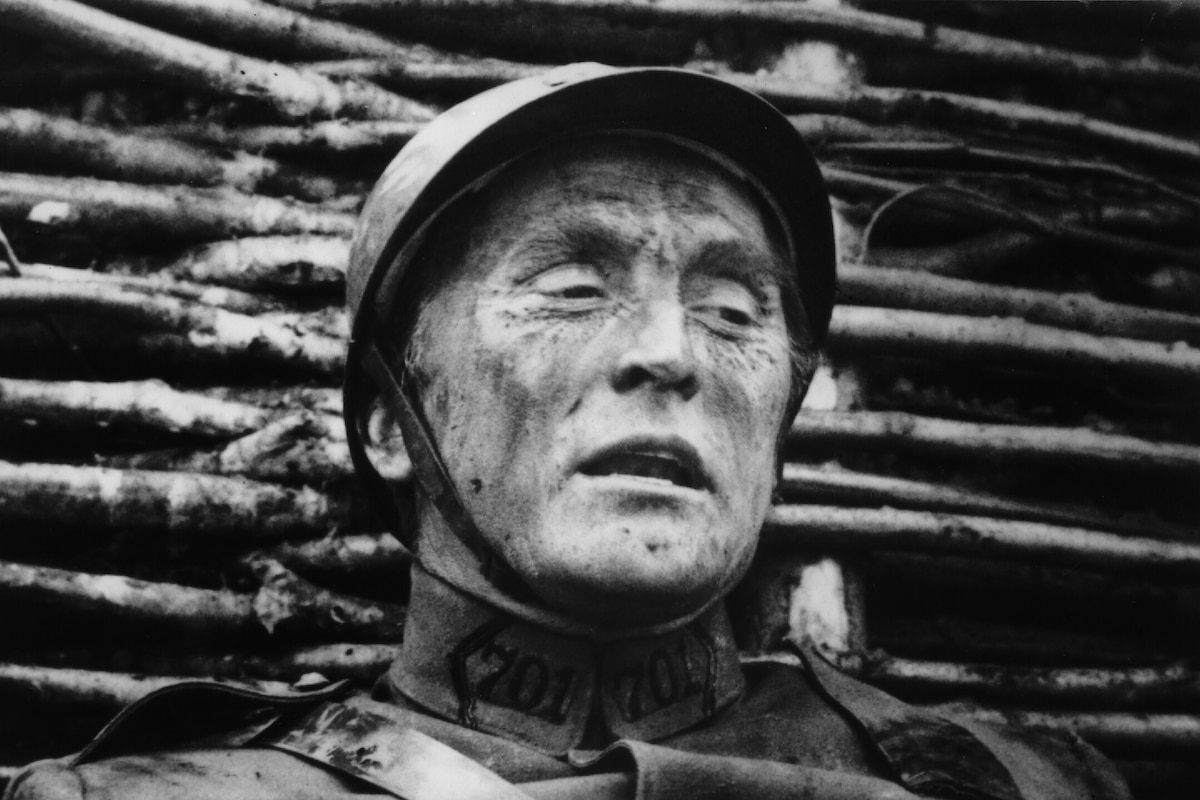
Paths of Glory opened on September 18, 1957, in its world premiere in Munich. Ironically, the stark anti-war drama opened in the United States on Christmas Day 1957.
Paths of Glory was a controversial release in Europe and the United States. It was banned in France for 20 years because the French felt it was a slander against the honor of their country and the men who fought and died in World War I. The French even threatened the filmmakers with criminal charges of libel. They were particularly miffed that the patriotic "Marseillaise" played over the credits. Austria put a disclaimer on the film that stated it represented an isolated incident and did not represent the "vast majority of French soldiers." The movie was even banned on some American military bases in Europe. But in Italy, Paths of Glory was lauded as the best international film of the year. The flick also won admiration from several key figures, notably Sir Winston Churchill, who thought the battle scenes were as authentic as any he had ever seen.
Hollis Alpert of the Saturday Review said it was "unquestionably the finest American film of the year. It is so searing in its intensity that it will probably take its place, in years to come, as one of the screen's most extraordinary achievements."
Variety praised Paths of Glory as "starkly realistic," but then gave it a one-two punch by labeling it "dated" and "grim screen fare." The critic was prescient though when he said the box office take would be "spotty at best."
Bosley Crowther of The New York Times wrote of Paths of Glory as having "an impact of hard reality...a frank avowal of agonizing, uncompensated injustice that is pursued to the bitter, tragic end." But Crowther summed up his review with a rather ambiguous impression: "It is grotesque, appalling, nauseating...but so framed and isolated that...you are left with the feeling that you have been witness to nothing more than a horribly freakish incident."
Similarly, The New York Herald called Paths of Glory "a good hard movie...powerful in design and execution," but that "you may not believe that two such evil men could wield this power, or that French military justice could be so polluted. In this case, Paths of Glory will strike you as a narrow and unlikely drama."
Influential film critic Stanley Kauffman later wrote, "The script of Paths of Glory had all the simplistic and banal anti-war propaganda that Dr. Strangelove (1964) transcends, but it was executed with ruthless, vivid immediacy."
Screen veteran Adolphe Menjou (General Broulard) said of Stanley Kubrick at the time of release: "The greatest director was Chaplin. Stanley works more like him than anybody I've ever seen...in that the actor is always right and the director always wrong...He'll be one of the ten best directors."
by Scott McGee
