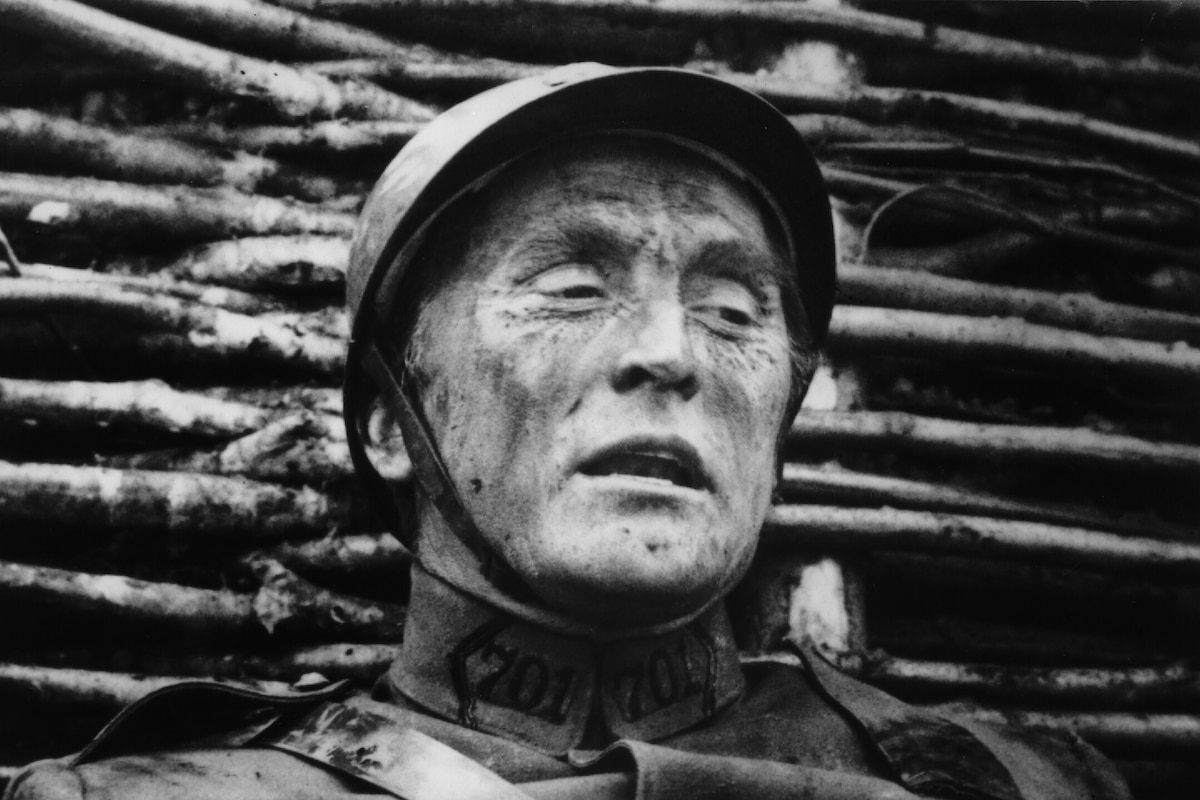
The World War I battle scenes in Paths of Glory, like the Vietnam combat sequences in Full Metal Jacket (1987) thirty years later, were not shot in authentic locations but were recreated in different geographic areas. For instance, Paths of Glory was shot outside the village of Pucheim, west of Munich, Germany. In fact, the entire movie was filmed in Germany, even though it takes place along the Western Front in France. The soldiers' trial and execution were filmed in and around the Schleissheim Palace, just beyond the Dachau Concentration Camp memorial. At the time Paths of Glory went into pre-production, the era of "runaway" productions was in full swing in Hollywood, a time when films often went to other countries to shoot because of cheaper labor and less government interference.
Bryna, Kirk Douglas' production company, hired dozens of German workers to alter several acres into the vast hell of "No Man's Land." They did so by gouging out the crater holes, digging huge ruts and gullies, filling some with water, covering the area with a tangled spider's web of prickly barbed wire, and then planting hundreds of explosives throughout that were to be detonated during the initial attack.
After the workmen had finished dressing the battlefield set, the Paths of Glory production still needed local assistance and manpower: six hundred German policemen were hired as extras to play the French troops, while six cameras tracked the attack, recording their "deaths." Each one of the extras, many of whom had fathers that served in the Great War, were assigned "dying zones," the exact locations in the battle area where they were to fall dead by machine gun bullets, artillery shrapnel, or other horrendous demises. Kubrick had a bit of a problem though; he had to keep reminding the policemen, who had three years military training, that they were supposed to act fearful on the battlefield. Only after Kubrick's repeated directions did the extras get the idea of acting scared. Moreover, they stopped performing foolish feats of physical courage such as leaping in and out of foxholes that were lined with explosives and were capable of inflicting severe burns.
Stanley Kubrick also had trouble getting one of his stock players to take direction. The eccentric character actor, Timothy Carey, who had played the sicko racehorse assassin in Kubrick's The Killing (1956), was cast as one of the condemned soldiers. For his last meal of roast duck, Carey could never remember to tear into it the same way for repeated takes, so every take required a new, unmolested duck. Kirk Douglas was irritated by Carey's erratic acting, and made his impressions known, loudly. But Kubrick seemed to have enjoyed getting Douglas riled up. During the court-martial scene, when Douglas was criticizing Carey's delivery, Kubrick whispered to Carey, "Make this a good one, because Kirk doesn't like it."
Stanley Kubrick met his third wife Christiane Harlan while filming Paths of Glory in Germany. Near the close of the film, Harlan plays the timid girl in the cafe who sings for the soldiers (she was the only German character actually seen in the picture). James B. Harris was alarmed that Kubrick put his own girlfriend on the payroll, as well as by the fact that she was related to Nazi filmmaker Veit Harlan, director of the notorious Jud Süss (1940). Christiane and Stanley were married until his death in 1999. Of course, Kubrick's first two wives were involved in his earlier films. His first wife, Toba Etta Metz Kubrick, was the dialogue director for Stanley's first feature film Fear And Desire (1953). His second wife, Ruth Sobotka Kubrick, was in Killer's Kiss (1955) as a ballet dancer named Iris in a short sequence for which she also did the choreography.
Both Stanley Kubrick and star/producer Kirk Douglas knew that Paths of Glory was bound to be a hard sell at the box office. Despite the minor box office take, Douglas still pocketed a salary that was roughly equal to a third of the film's total budget, which came to about $1 million. Kubrick, meanwhile, worked for a percentage of the profits, but received no salary.
by Scott McGee
