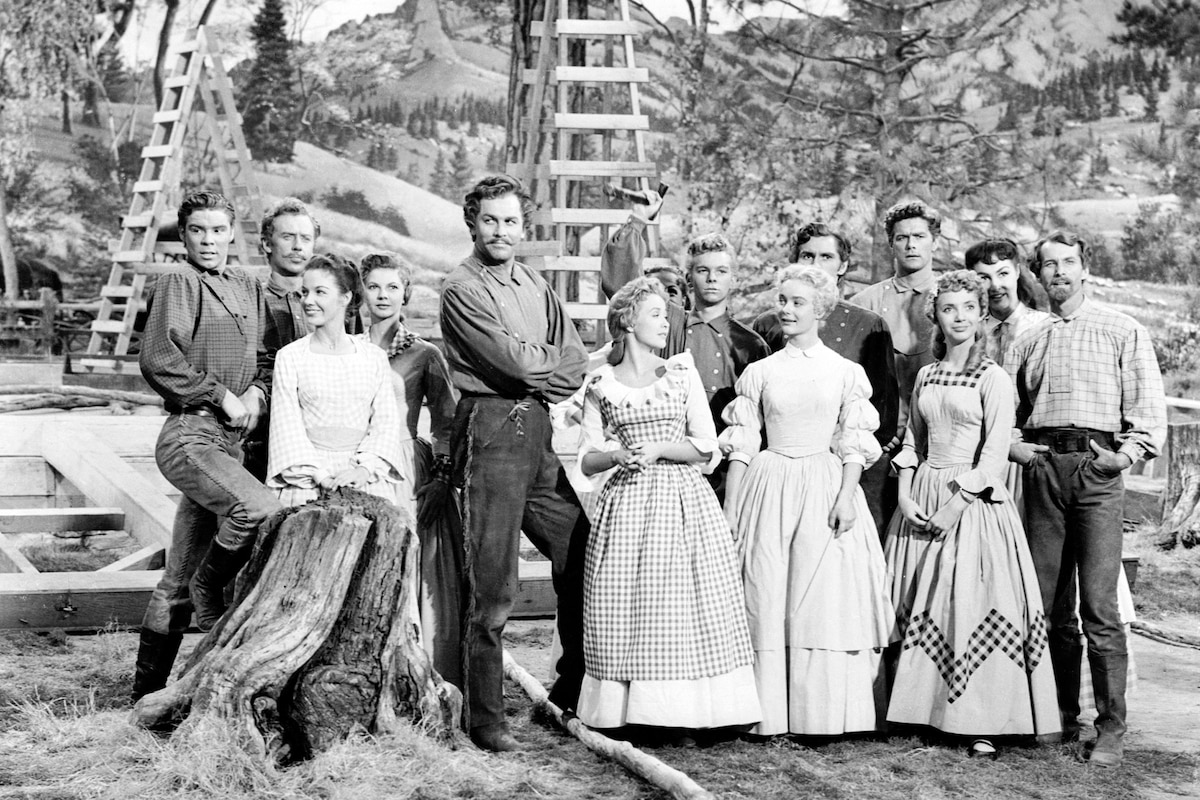
Shooting got off to an auspicious start on Seven Brides for Seven Brothers in November of 1953 at MGM. Despite the extra work that shooting two different versions created, the cast had a marvelous time and Stanley Donen embraced the challenge of CinemaScope. He thought that with seven brides and seven brothers, the story itself lent itself perfectly to the medium since so many characters often had to be onscreen at the same time. He utilized every inch of the frame to maximize the visual impact of the new technology. The studio, who was being extremely tight with the budget, wound up having to put more money into the production anyway, despite trying to cut every corner. "I had to shoot and cut everything twice-restage scenes, put in a different set of marks, light it differently, loop it," said Stanley Donen. "We had two cutting rooms going, and it cost the studio another $500,000, which was a lot for then."
For the famous barn raising dance sequence, which many consider the highlight of the film, the cast rehearsed for three weeks in order to get the intricate choreography down. It was during one of these rehearsals that Russ Tamblyn, one of the non-dancers hired to play Gideon Pontipee, wandered over to the set along with co-star Jeff Richards to see how the scene was coming along. "Michael Kidd called me over and said, 'Rusty, somebody told me that you're a good tumbler, that you can do some flips'," said Tamblyn in a 2004 interview. "So I did a back flip for him. 'Fantastic!' he said. 'We'll put it in a number.' I told him I really wasn't a dancer, except for some tap dancing. But he said, 'Listen, this is just like square dancing. All you have to do is lift your legs high. You can do a lot of acrobatic stuff. It's perfect.' That's how I became a dancer in Seven Brides."
Though Howard Keel was happy with most of the production, he disagreed on two points in reference to his character. He first objected to Adam reprising the song "When You're in Love" after Milly first sings it. He felt it didn't work because Adam at that point in the film couldn't possibly understand what love was all about. Secondly, he objected to singing a soliloquy number when he's holed up by himself in the winter cabin. It was, Keel felt, too similar to the soliloquy from the musical Carousel. As a result of these disagreements, the original two writers Albert Hackett and Frances Goodrich walked off the picture. The third writer, Dorothy Kingsley, took over. "I'm sorry about the original script writers walking away," Keel says in his autobiography, "but I think I was right, and Jack Cummings agreed with me."
When Seven Brides for Seven Brothers premiered in the summer of 1954, its blockbuster success surprised everyone-especially MGM who was expecting a modest hit at best. Instead, it became one of the top box office hits of the year and was nominated for five Academy Awards, including Best Picture. What's more is that Seven Brides outperformed the more expensive Brigadoon. "Seven Brides was a big hit, a real sleeper, and Brigadoon seemed to disappear," says Jane Powell in her 1988 autobiography. "We all felt pretty smug about that." For director Stanley Donen, the film's success marked a turning point in his career. He proved that he could pull off a top-notch musical all by himself.
While Seven Brides for Seven Brothers was a career peak for musical veterans Howard Keel and Jane Powell, the film marked the real beginning for young Russ Tamblyn's career. Tamblyn's charm along with his show-stopping acrobatics in the barn raising sequence made people everywhere sit up and take notice. Tamblyn, who had not been expected to dance one step in the film, was now known the world over as a hoofer as well as an actor. "After Seven Brides was released," said Tamblyn, "my career really took off. Dance magazine photographed me for their cover and, suddenly, I was known as a dancer." Star Howard Keel saw it coming. "Russ Tamblyn as Gideon was undeniably the most effective Pontipee," he says in his autobiography. "Wherever he was, you couldn't take your eyes off him."
Seven Brides for Seven Brothers went on to become a musical classic. It was a joyous experience for all to make. Howard Keel called the film, "one of my happiest filmmaking experiences at Metro Goldwyn Mayer." "The cast was magnificent, and the chemistry irresistible," he says in his autobiography. "Jack Cummings had his stamp on the whole picture. Jane Powell, as Milly, was perfect, and I loved working with her. She was cute and persnickety and a multi-talented pro...It truly was one big happy family." Stanley Donen always saw this film as one of his fondest memories as well as was quick to always point out the enormous contribution by choreographer Michael Kidd to the overall success of Seven Brides for Seven Brothers. "I enjoyed Kidd enormously," said Donen. "His contribution to the film was gigantic."
by Andrea Passafiume
Behind the Camera - Seven Brides for Seven Brothers
by Andrea Passafiume | January 04, 2008
SIGN UP FOR OUR NEWSLETTERS

CONNECT WITH TCM