SYNOPSIS
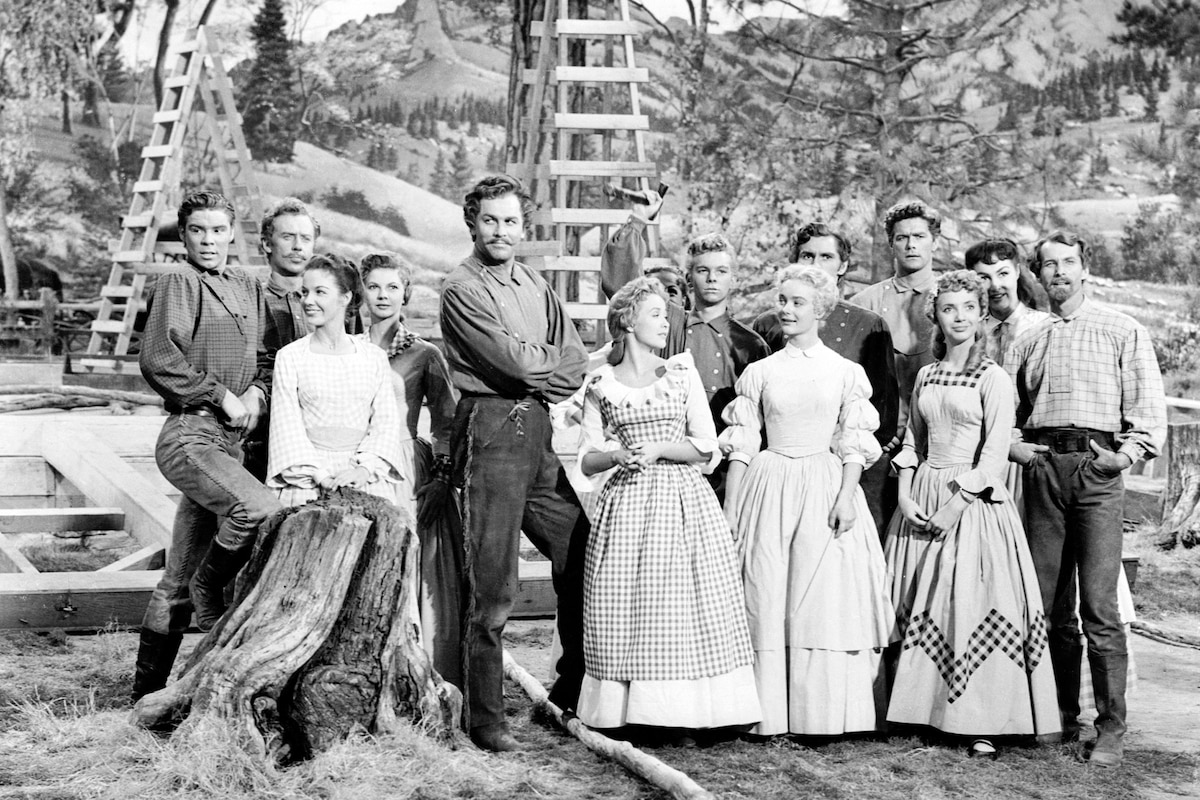
The rugged Pontipee brothers are living a life of self-sufficiency in the Oregon mountains during the 1850s. When the eldest brother, Adam, brings home his pretty new wife from town, Milly, the brothers decide that they too should find brides. First, however, Milly must teach the well-meaning but ignorant brothers how to behave so that they can successfully woo the women of their choice.
Director: Stanley Donen
Producer: Jack Cummings
Screenplay: Albert Hackett, Frances Goodrich, Dorothy Kingsley
Cinematography: George Folsey
Editing: Ralph E. Winters
Music Director: Adolph Deutsch
Music Supervisor: Saul Chaplin
Music Composers: Johnny Mercer, Gene de Paul
Costume Designer: Walter Plunkett
Cast: Howard Keel (Adam Pontipee), Jeff Richards (Benjamin Pontipee), Russ Tamblyn (Gideon Pontipee), Tommy Rall (Frank Pontipee), Marc Platt (Daniel Pontipee), Matt Mattox (Caleb Pontipee), Jacques d'Amboise (Ephraim Pontipee), Jane Powell (Milly), Julie Newmeyer (Dorcas), Nancy Kilgas (Alice), Betty Carr (Sarah), Virginia Gibson (Liza), Ruta Kilmonis (Ruth), Norma Doggett (Martha), Ian Wolfe (Reverend Elcott), Howard Petrie (Pete Perkins), Earl Barton (Harry), Dante DiPaolo (Matt), Kelly Brown (Carl), Matt Moore (Ruth's Uncle), Dick Rich (Dorcas' Father), Marjorie Wood (Mrs. Bixby), Russell Simpson (Mr. Bixby), Anna Q. Nilsson (Mrs. Elcott).
C-103m. Letterboxed. Closed captioning. Descriptive Video.
Why SEVEN BRIDES FOR SEVEN BROTHERS is Essential
Seven Brides for Seven Brothers is one of the few but great film musicals that expertly integrates music, dance and story. Exuberant and full of charm, this film is thoroughly entertaining from start to finish. Unlike many of the film musicals of its time, Seven Brides did not come from an already existing Broadway stage version. It was an original musical made expressly for the big screen, which makes its success all the more critical in the history of the movie musical.
Michael Kidd's stunning athletic choreography for Seven Brides for Seven Brothers is one of the film's greatest strengths and contributed enormously to its box office success. Kidd's choreography helped revitalize and influence the way in which movie musicals were staged. From the show stopping barn dance number to the quiet rhythmic movement of "Lament (Lonesome Polecat)," Kidd's choreography always manages to find the perfect note to suit each scene and make singing and dancing mountain men thoroughly believable and charming.
One of the earliest CinemaScope films made for MGM, Seven Brides for Seven Brothers is visually exciting, making the most of the widescreen process. With up to fourteen characters (the seven brides and seven brothers) dancing and interacting on the screen at the same time, the technical achievement of this film is no small feat. It remains an excellent example of the beauty of CinemaScope.
Though he had directed some films on his own by 1954, Stanley Donen's major successes in film musicals had always been in conjunction with Gene Kelly, with whom he shared directing credit on the huge hits On the Town (1949) and Singin' in the Rain (1952). The enormous popularity of Seven Brides for Seven Brothers was something Donen achieved entirely on his own. It helped established him as one of the best directors of film musicals and one of the most sought after by studios.
Seven Brides for Seven Brothers features one of the most appealing casts of actors, singers and dancers ever to appear in a musical film. As the two leads, established stars Howard Keel and Jane Powell do some of the finest work in their careers. Up-and-coming actor Russ Tamblyn is also a wonder to watch as he shows off his acrobatic dancing skills that first put the young actor on the map and led to greater things (West Side Story, 1961).
by Andrea Passafiume
The Essentials - Seven Brides for Seven Brothers
by Andrea Passafiume | January 04, 2008
SIGN UP FOR OUR NEWSLETTERS

CONNECT WITH TCM