AWARDS & HONORS
The National Board of Review placed Rebecca tenth on its ten-best list for 1940, with The Grapes of Wrath at number one. They also listed Joan Fontaine's as one of the year's best performances.
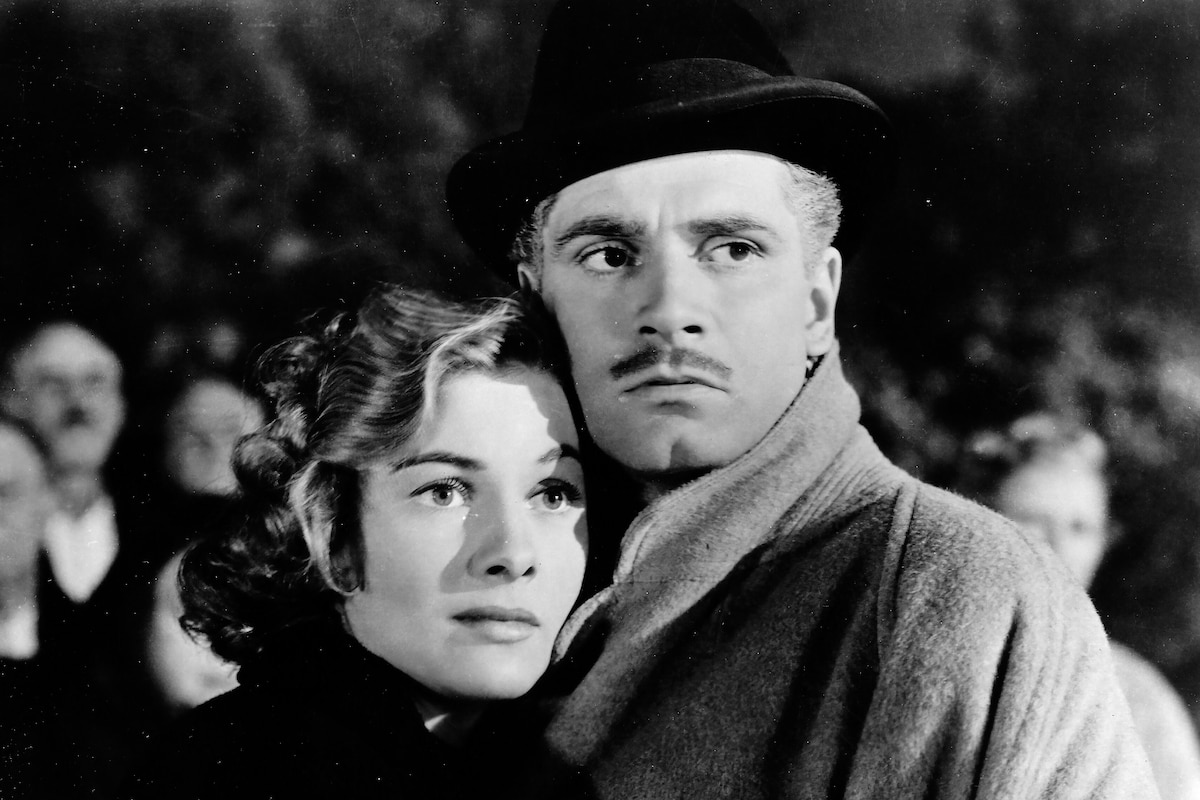
Rebecca won 11 Oscar® nominations -- Best Picture, Best Director, Best Actor (Laurence Olivier), Best Actress (Fontaine), Best Supporting Actress (Judith Anderson), Best Screenplay, Best Cinematography, Best Editing, Best Score, Best Art Direction and Best Visual Effects. Following 1939's Gone with the Wind, this was the second year in a row producer David O. Selznick had produced the film with the most nominations.
Rebecca's competition for Best Picture was formidable and included The Grapes of Wrath, The Philadelphia Story, The Great Dictator and Hitchcock's own Foreign Correspondent.
To improve his Oscar® chances, Selznick hosted a "re-premiere" of Rebecca at a second-run house in Los Angeles the day the nominations were announced. He even got the governor of California to re-name Hollywood Boulevard "Rebecca Boulevard" for the day.
Rebecca took Best Picture, the only such honor for a Hitchcock film, and Best Cinematography. Hitchcock lost the directing prize to John Ford for The Grapes of Wrath. Olivier lost Best Actor to James Stewart in The Philadelphia Story, while Ginger Rogers in Kitty Foyle beat Fontaine for Best Actress.
THE CRITICS' CORNER
"Rebecca is an artistic success whose b.o. lure will be limited...Dave Selznick's picture is too tragic and deeply psychological to hit the fancy of wide audience appeal. It will receive attention from critics and class patronage as an example of the power in narrative drama of vivid screen portraiture, but general audiences will tab it as a long-drawn out drama that could have been told better in less footage....Alfred Hitchcock, English director, pilots his first American production with capable assurance and exceptional understanding of the motivation and story mood."
-- Walt., Variety.
"Miss Du Maurier never really convinced me any one could behave quite as the second Mrs. de Winter behaved and still be sweet, modest, attractive and alive. But Miss Fontaine does it not simply with her eyes, her mouth, her hands and her words, but with her spine. Possibly it's unethical to criticize performances anatomically. Still we insist Miss Fontaine has the most expressive spine -- and shoulders we've bothered to notice this season."
-- Frank S. Nugent, The New York Times.
"Magnificent, romantic-gothic corn, full of Alfred Hitchcock's humor and inventiveness. It features one of Laurence Olivier's rare poor performances; he seems pinched and too calculated -- but even when he's uncomfortable in his role he's more fascinating than most actors. Joan Fontaine gives one of her rare really fine performances -- she makes her character's shyness deeply charming."
-- Pauline Kael, 5,001 Nights at the Movies.
"There are too many conflicting levels of authorship--between Alfred Hitchcock, Daphne Du Maurier, and David O. Selznick--for this 1940 film to be a complete success, but through its first two-thirds it is as perfect a myth of adolescence as any of the Disney films, documenting the childlike, nameless heroine's initiation into the adult mysteries of sex, death, and identity, and the impossibility of reconciling these forces with family strictures."
-- Dave Kehr, Chicago Reader
"A splendid example of the cinema as a popular storyteller...Hitchcock fashioned an impeccable film, with the help of a clever screenplay by Robert E. Sherwood and Joan Harrison..."
- Leslie Halliwell, The Filmgoer's Companion
"Daphne Du Maurier's fairly lightweight bestseller...became a tale of fear and guilt, power and class. What makes the film doubly interesting is Hitchcock's fear of women, and the way it goes beyond the simple limits of narrative...A riveting and painful film."
- Helen MacKintosh, TimeOut Film Guide
"The sheer, swooning pleasure that this film affords - its melodrama, its romance, its extravagant menace - makes it a must-see... it really is a masterclass in craftsmanship. The novel is expertly opened out in visual and dramatic terms, and shows something rare in any film from any period: characters who change, and are satisfyingly seen to do so during the course of the story...A superb cast is rounded off by George Sanders, playing Rebecca's caddish cousin: again, a superb lightness and virility in the acting, and, again, some exquisite suitings. A gorgeous treat from one of cinema's masters. Not to be missed."
- Peter Bradshaw, The Guardian
"Taking in Lyle Wheeler's magnificent interior sets (they dwarf Fontaine's timid character) and a wonderfully caddish turn from a blackmailing George Sanders, Rebecca sweeps the viewer along to an incendiary conclusion."
- Thomas Dawson, BBC
"Shot like a horror film and featuring Olivier as one of the least sympathetic heroes in the Hitchcock canon, Rebecca's smart extrapolation on themes inherited from gothic thrillers and Brontë novels allows the director to begin with a suspenseful romance that barely keeps its subtext under the surface, and smuggle in a story of one woman's immersion into the sexual expectations of her era. Rebecca may not be a Hitchcock picture, but it's hard to imagine what we now think of as a Hitchcock picture without it."
- Keith Phipps, The Onion A. V. Club
Compiled by Frank Miller & Jeff Stafford
Critics' Corner - Rebecca
by Frank Miller & Jeff Stafford | January 04, 2008
SIGN UP FOR OUR NEWSLETTERS

CONNECT WITH TCM