A few
months before filming began on The Night of the Hunter, Laurence Olivier learned
about the film and campaigned heavily to play Preacher Powell, even though Mitchum was
already cast in the role. Laughton was quite upset by the situation but United Artists
agreed that Mitchum's name was more bankable than Olivier's when it came to ticket
sales.
Betty Grable was Laughton's first
choice to play Willa, the role that eventually went to Shelley Winters. Teresa Wright was
also considered for the part as well.
The Night of the Hunter was actor
Charles Laughton's only directorial effort. Starting out on the British stage in 1926,
he had been acting in film since 1928 and came to Hollywood in the early '30s. A portly,
homely man with very particular idiosyncrasies and affectations, he was an unlikely
candidate for movie stardom. Nevertheless he gave several unforgettable performances in
popular and acclaimed American and British films of the decade, among them the imperious
father in The Barretts of Wimpole Street (1934), the fish-out-of-water valet in
the comedy Ruggles of Red Gap (1935), Inspector Javert in Les Miserables
(1935), and the title roles in Rembrandt (1936) and The Hunchback of Notre
Dame (1939). He was nominated for an Oscar® as Captain Bligh in Mutiny on the
Bounty (1935) and won Best Actor as the British monarch in The Private Life of
Henry VIII (1933). He also portrayed the reluctant Roman Emperor in Joseph von
Sternberg's aborted I, Claudius (1937), one of the most legendary of all "lost
films." Laughton continued acting into his sixties in such pictures as The
Canterville GhostThe Paradine Case (1947), as Henry VIII
again in Young Bess (1953), Spartacus (1960), and his final movie,
Advise and Consent (1962). He received another Best Actor Oscar® nomination
as the irrepressible barrister in Billy Wilder's Witness for the Prosecution
(1957), in which he appeared with his wife of many years (although he was known to be
homosexual), Elsa Lanchester.
Eager to continue the collaboration begun with
Laughton on The Night of the Hunter, producer Paul Gregory bought the film rights
to Norman Mailer's war novel, The Naked and the Dead. Laughton was at first eager
to do it; he worked with Stanley Cortez on ideas for cinematography and sent him to
Hawaii to scout locations. He hired the Sanders brothers to help him develop a script.
But after six months, it became apparent Laughton was drawing the process out too long
for undetermined reasons. Nevertheless, Norman Mailer wrote later about what he learned
from him: "He gave me, in fact, a marvelous brief education in the problems of a movie
director, as he would explain to me, sometimes patiently, sometimes at the edge of his
monumental impatience, how certain scenes which worked in the book just weren't feasible
for the movie." The story was eventually brought to the screen in 1958 - the only other
movie Paul Gregory ever produced - with Raoul Walsh directing.
Cinematographer
Stanley Cortez is the brother of actor Ricardo Cortez, who started out in the 1920s as a
Valentino-like Latin Lover. Stanley Cortez's Oscar®-nominated photography for Orson
Welles' The Magnificent Ambersons (1942) solidified his reputation as a masterful
black-and-white cinematographer. Among his other work is Since You Went Away
(1944), The Three Faces of Eve (1957), and Samuel Fuller's Shock Corridor
(1963). He won the Film Critics of America award in 1942 for The Magnificent
Ambersons and a lifetime achievement award from the American Society of
Cinematographers in 1990.
When Robert Mitchum first learned that Shelley Winters
had won the part of Willa Harper, he said, "She looks and sounds as much like a wasted
West Virginia girl as I do. The only bit she'll do convincingly is to float in the water
with her throat cut."
Billy Chapin is the brother of TV child star Lauren Chapin
(Father Knows Best).
James Gleason (Uncle Birdie) appeared with Charles
Laughton in the film Tales of Manhattan (1942).
Laughton's uncredited
assistants on the picture, Terry and Dennis Sanders, had only one short film to their
credit before working on this - A Time Out of War (1954). They went on to film
careers of their own, with Terry producing many of his brother's pictures, most of which
were B-movies like Crime and Punishment USA (1959) and War Hunt (1962).
Dennis Sanders' most notable work was the concert documentary, Elvis: That's the Way
It Is (1970).
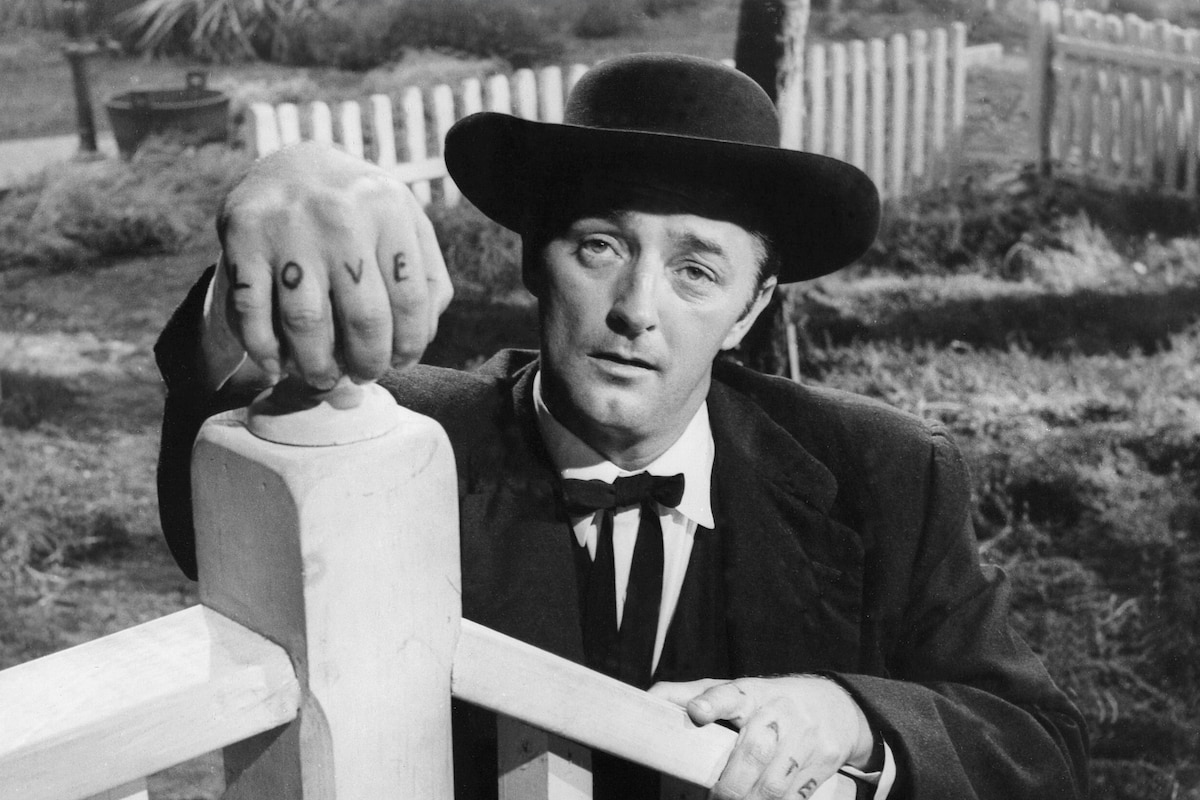
To promote the movie, Robert Mitchum and Shelley Winters did a
guest shot on The Ed Sullivan Show in the spring of 1955. Winters recounted in
her autobiography how the stress of doing live television caused Mitchum to drink and
caused her to become "shrill and numb." The two got into costume - with Mitchum
displaying the words "love" and "hate" on his hands - and performed their scene quite
badly. Winters said she stuttered and lapsed into "Brooklynese," while Mitchum spoke so
quietly their microphones had to be cranked up so loud "millions of viewers across the
U.S. could hear our stomachs rumble." During the scene, according to Winters, Mitchum
held up the wrong hand to illustrate a point about love and hate, and the audience
laughed.
The children's father was played by Peter Graves, brother of James
(star of TV's Gunsmoke series) Arness and perhaps best known for his role as Jim
Phelps on the TV series Mission: Impossible and as Capt. Oveur in the comedy
Airplane! (1980).
Lillian Gish is probably best known for her films with
D.W. Griffith, the pioneer of American cinema - The Birth of a Nation (1915),
Intolerance (1916), Orphans of the Storm (1921). Before appearing in
The Night of the Hunter, she hadn't made a film since Portrait of Jennie
(1948). Her remarkable career stretched from 1912 to her last film, The Whales of
August (1987).
FAMOUS QUOTES from THE NIGHT OF THE HUNTER
MOVIE TAGLINE: "The wedding night, the anticipation, the kiss, the knife, but above
allÉthe suspense!"
RACHEL COOPER (Lillian Gish): "Beware of false prophets
which come to you in sheep's clothing. But inwardly they are ravenous wolves."
HARRY POWELL (Robert Mitchum): "Now what's it to be, Lord, another widow? How many's it
been? Six? Twelve?"
HARRY POWELL: "Lord, I am tired. Sometimes I wonder if
you really understand. Not that you mind the killings. Your book is full of killings.
But there are things you hate, Lord. Perfume-smelling things. Lacey things. Things
with curly hair."
BEN HARPER (Peter Graves): "I robbed that bank cause I got
tired of seeing children roaming the woodlands without food. Children roaming the
highways in this here Depression. Children sleeping in old abandoned car bodies and junk
heaps. And I promised myself I'd never see the day when my young'uns would want."
HARRY POWELL: "I come not with peace, but with a sword."
BEN HARPER:
"What religion you profess, preacher?"
HARRY POWELL: "The religion the Almighty and
me worked out betwixt us."
HARRY POWELL: "H-A-T-E. It was with this left hand
that ol' brother Cain struck the blow that laid his brother low. L-O-V-E. You see these
fingers, dear hearts, these fingers has veins that run straight to the soul of man, the
right hand, friends, the hand of love. Now watch and I'll show you the story of life.
These fingers, dear hearts, is always warrin' and tuggin', one agin the other. Now watch
Ôem. Ol' brother left hand, left hand Hate's a fighter and it looks like Love's a goner.
But wait a minute, wait a minute! Hot dog! Love's a winnin', yessiree. It's Love that
won and ol' left hand's down for the count!"
ICEY SPOON: "When you been married
to a man 40 years, you know all that don't amount to a hill o' beans. I been married to
my Walt that long and I swear, in all that time I just lie there thinkin' about my
cannin'. A woman's a fool to marry for that. That's something for a man. The good Lord
never meant for a decent woman to want that, not really want it. It's all just a fake
and a pipe dream."
WILLA HARPER (Shelley Winters): "I feel clean now. My whole
body's just a quiverin' with cleanness."
HARRY POWELL: "You thought, Willa, that
the minute you walked through that door I'd start pawin' at you in that abominable way
men are supposed to do on their weddin' night. É Look at yourself. What do you see,
girl? You see the body of a woman, the temple of creation and motherhood. You see the
flesh of Eve that man since Adam has profaned. That body was meant for begettin'
children. It was not meant for the lust of men. You want more children, Willa?"
W
ILLA HARPER: "IÉno."
HARRY POWELL: "It's the business of this marriage to mind those
two you have now, not to beget more."
WILLA HARPER: "Help me to be clean, so I
can be what Harry wants me to be."
HARRY POWELL: "Don't touch my knife. That
makes me mad, that makes me very mad."
RACHEL COOPER: "She'll be losin' her mind
to a tricky mouth and a full moon, and like as not I'll be saddled with the
consequences."
RACHEL COOPER: "I'm a strong tree with branches for many birds.
I'm good for somethin' in this world and I know it, too."
RACHEL COOPER: "It's a
hard world for little things."
Compiled by Rob Nixon
Trivia - The Night of the Hunter - Trivia & Fun Facts About THE NIGHT OF THE HUNTER
by Rob Nixon | January 04, 2008
SIGN UP FOR OUR NEWSLETTERS

CONNECT WITH TCM