AWARDS & HONORS:
In 1992, the National Film Preservation Board selected The Night of the Hunter to be preserved in the Library of Congress National Film Registry.
The Critics' Corner: THE NIGHT OF THE HUNTER
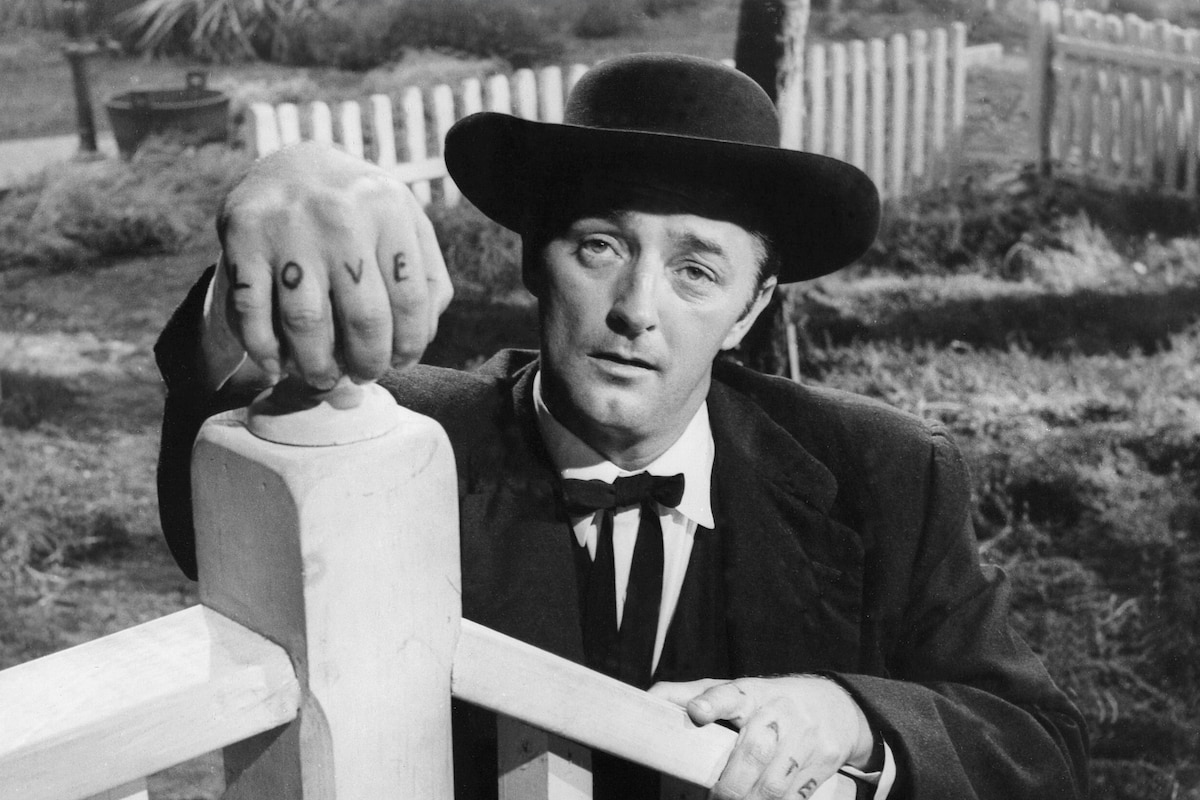
"The atmosphere of the sticks is intense, and Robert Mitchum plays the murderous minister with an icy unctuousness that gives you the chills. There is more than malevolence and menace in his character. There is a strong trace of Freudian aberration, fanaticism, and iniquity. É [Laughton] has got out of Shelley Winters a grueling performance as the vapid widow and wife. The scene of the wedding-night of Miss Winters and the preacher is one of the most devastating of its sort since Von Stroheim's Greed [1925]." - Bosley Crowther, The New York Times, September 30, 1955
"A remarkably effective scene has Miss Winters, now spirited, confessing her sins and asking forgiveness at a prayer meeting after she is persuaded into marriage by Mitchum." - Variety, July 20, 1955.
"From its opening moment, with the face of Lillian Gish magically materializing out of a star-filled sky, to its last shot of a snow-covered farm house as comfortably banal as a calendar illustration, The Night of the Hunter is one of the more unclassifiable films ever made. É As directed by Charles Laughton, this 1955 production is a film of looming expressionist shadows, homespun back-fence chatter, psychopathic sexual craving, and victorious maternal wisdom. It is also along with Lang's Moonfleet [1955] and Erice's Spirit of the Beehive [1973], one of the finest, truest portraits of the childhood experience." - David Ehrenstein, Los Angeles Reader, May 1982.
"Despite its peculiar overtones of humor, this is one of the most frightening movies ever made (and truly frightening movies become classics of a kind). É The two kids' flight from the madman is a mysterious, dream-like episode - a deliberately "artistic" suspense fantasy, broken by the appearance of a Christian variety fairy godmother." - Pauline Kael, The New Yorker, January 1983.
"A distinctly American Gothic interpretation of German Expressionism, with tilt pans, Stanley Cortez's moody cinematography, and a startling appearance of Lillian Gish as the incarnation of Good combating Mitchum's unreconstructed Evil. A movie about the American nightmare of greed, about the precipitous experience of two innocents, about the triumph of spirit over will, The Night of the Hunter embodies the evil of Pox Americana and its transcendence." - Carrie Rickey, The Village Voice, January 1983.
"While many films are spoken of as offbeat or unusual, it generally becomes evident with the passing of time that these films are more conventional than they once appeared to be. É It remains possible, however, for an occasional film to be extremely idiosyncratic, and one film that may be so described is The Night of the Hunter, the only film directed by the celebrated actor Charles Laughton. This work remains unexpected and strange after 25 years; far from being simply a curiosity, however, it is an important achievement, reflecting directly the influence of the silent cinema in a highly personal way." - Blake Lucas, Magill's Survey of the Cinema (Series I, Vol. 3).
"The film runs counter to the rules of commercialism; it will probably be Laughton's single experience as a director. It's a pity, for despite failures of style, The Night of the Hunter is immensely inventive. It's like a horrifying news item retold by small children. É It makes us fall in love again with an experimental cinema that truly experiments, and a cinema of discovery that, in fact, discovers." - Francois Truffaut, 1956 (reprinted in The Films in My Life, Simon & Schuster, 1975).
"Rumor has it that the final shooting script of The Night of the Hunter was one-third Laughton, one-third James Agee, and one-third Davis Grubb. Be that what it may, The Night of the Hunter displays a striking visual style, almost semi-Germanic Griffith, which is completely lacking in the Huston-Agee-Forester The African Queen [1951]É. Moral: Directors, not writers, are the ultimate auteurs of the cinema, at least of cinema that has any visual meaning and merit." - Andrew Sarris, The American Cinema (Dutton, 1968).
"It is easy to see, however, that Night of the Hunter would never be a popular hit. Not only is the subject matter complex, the movie itself has a poetic and imagistic density which make it somewhat indigestible on first viewing. It benefits enormously from being seen twice, or more - something that can be expected of no popular audience; in fact, it would be correct to say it needs to be seen twice. It doesn't grab you by the lapel; it tries to suck you in." - Simon Callow, Charles Laughton: A Difficult Actor (Grove, 1987).
"First time viewers are invariably startled by how weird and how brilliant is Charles Laughton's movie adaptation of Davis Grubb's riveting best-seller. It is a fascinating, truly unique work." - Danny Peary, Cult Movies 3 (Fireside).
Compiled by Rob Nixon & Jeff Stafford
Critics' Corner - The Night of the Hunter
by Rob Nixon & Jeff Stafford | January 04, 2008
SIGN UP FOR OUR NEWSLETTERS

CONNECT WITH TCM