Davis
Grubb's novel The Night of the Hunter was on the best-seller lists early in 1954
when producer Paul Gregory snapped it up. Gregory immediately saw it as the perfect
project for actor Charles Laughton's directorial debut. The two men had worked together
on stage projects, and Gregory, who had never produced a motion picture before, felt the
theater and screen performances given by the often difficult and conflicted actor were
"killing" him and that he needed to turn his talents to directing.
From the very
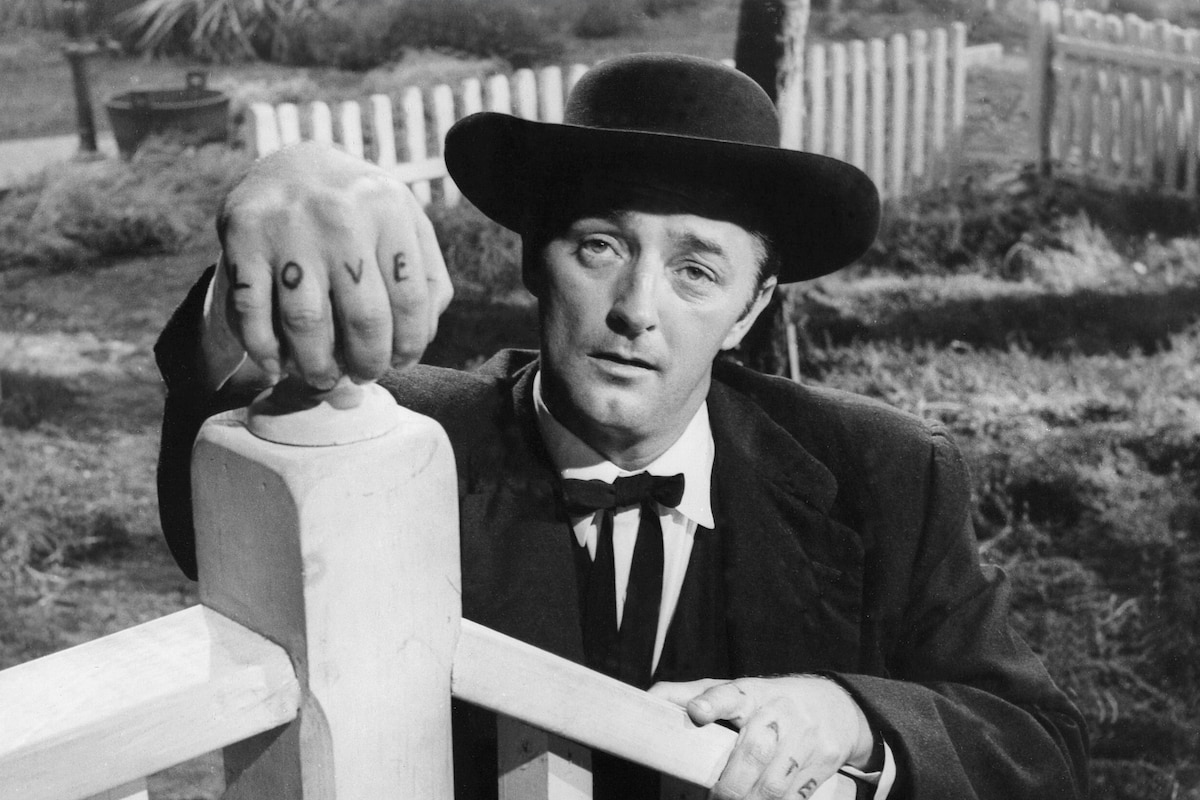
beginning, it was decided by both men that Robert Mitchum would play the murderous
preacher. Gregory thought the actor's unique and "quicksilver" personality was ideal for
the role, the way he kept people off balance with his unpredictability - "a little
scary," the producer said. "This character I want you to play is a diabolical sh*t,"
Laughton told Mitchum to which the actor replied, "Present." With Mitchum's name
attached to the project, United Artists agreed to put up the small $700,000
budget
To adapt the novel, they hired Southern-born James Agee, a poet and
journalist who made a name for himself providing the text for Walker Evans' photos in the
highly acclaimed Depression chronicle, Let Us Now Praise Famous Men (1941). In
1939, Agee wrote a treatment for a film based on Andre Malraux's Man's Fate.
Although it was never produced, it began Agee's long and deep interest in film, and he
became one of cinema's most passionate and intelligent critics, first for Time,
then The Nation. Laughton and Gregory hired Agee largely on the strength of his
screenplay for John Huston's highly successful The African Queen (1951). What
they apparently did not know was that, by the mid-1950s, the writer was a difficult and
quickly degenerating alcoholic. "The credits say Jim Agee wrote The Night of the
Hunter, but he was rolling around on the floor drunk most of the time," Gregory later
wrote. "He turned in a screenplay four times thicker than the book. Eventually Charles
took on Dennis and Terry Sanders, whose only experience was an Academy Award-winning
short they'd done as students at UCLA, to bounce ideas off."
According to a biographer
of Agee, the renowned writer's script was not an adaptation at all but a "cinematic version" of the book in
great detail with newsreel footage to document the Southern Depression setting and "any
number of elaborate, impractical montages." Dennis Sanders confirmed that Laughton "tried
to tell Jim Agee what to do" but that Agee didn't get it and Laughton wrote most of the
screenplay himself. Refuting the above claim, however, was the discovery of Agee's first draft of the script in 2004; it proved that it reflected Laughton's final release version, almost scene for scene.
According to novelist Davis Grubb, Laughton wanted the film
to closely resemble the mental pictures the author had in mind while writing the book. In
the Lee Server biography, Robert Mitchum: Baby, I Don't Care, the author stated
that Laughton "learned that Grubb was an amateur sketch artist who liked to draw scenes
and caricatures of the people he created in his fiction. Seeing the value in such
visualizations by the hand of the author himself, Laughton had him send them to Hollywood
and phoned him up begging for new ones throughout the production, sometimes specifying
that Grubb draw in the exact expression on a character's face that he'd had in mind while
writing a particular scene. The writer produced over a hundred of these pen-and-ink
drawings for the film. "I declare, perhaps immodestly," Grubb said, "that I was not only
the author of the novel from which the screenplay was adapted but was the actual scene
designer as well."
by Rob Nixon
The Big Idea - The Night of the Hunter
by Rob Nixon | January 04, 2008
SIGN UP FOR OUR NEWSLETTERS

CONNECT WITH TCM