SYNOPSIS
In the depths of the Great Depression of the 1930s in the rural South, Ben Harper has
committed murder while robbing a bank to get enough money to keep his family from being
hungry and homeless. Awaiting hanging, Harper shares a cell with Harry Powell, a
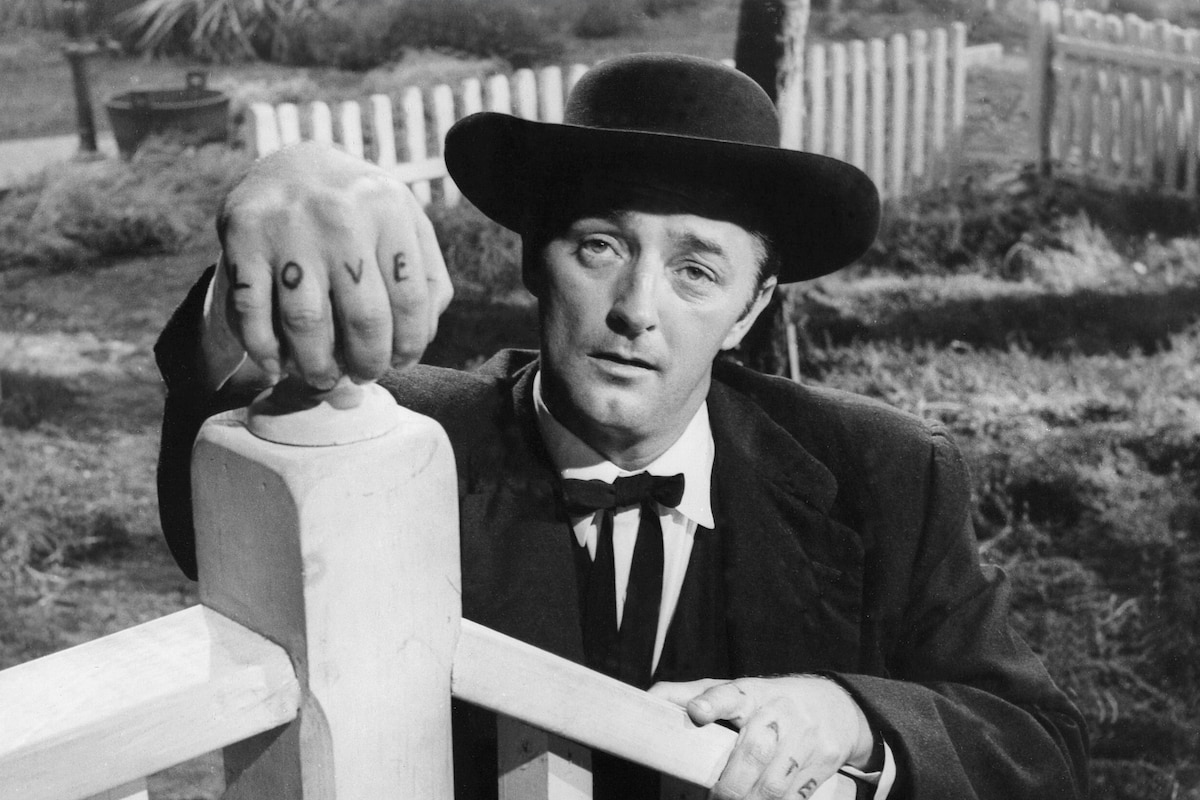
deranged, self-appointed preacher with the words LOVE and HATE tattooed on his knuckles.
Harry, temporarily in the pen for car theft, tries to get Harper to tell him where he hid
the cash, but all he learns is the location of Harper's family. When he's released from
jail, Harry goes to the town and seduces Harper's widow, Willa, into marriage, despite
the suspicions of her young son, John. Although John's little sister Pearl also adores
and trusts the preacher, John reminds her they swore to their father never to reveal the
hiding place of the stolen money. The Reverend Powell soon reveals his true intentions
and begins tormenting the kids in an effort to learn their secret. When the nave Willa
discovers her husband threatening John and Pearl, Harry kills her and dumps her body in
the river. The children escape with the money hidden in Pearl's doll, and Harry takes
off after them.
Director: Charles Laughton
Producer: Paul Gregory
S
creenplay: James Agee, Charles Laughton (uncredited), based on the novel by Davis
Grubb
Cinematography: Stanley Cortez
Editor: Robert Golden
Art Direction:
Hilyard Brown
Music: Walter Schumann
Cast: Robert Mitchum (Rev. Harry Powell),
Shelley Winters (Willa Harper), Lillian Gish (Rachel Cooper), James Gleason (Birdie
Steptoe), Evelyn Varden (Icey Spoon), Billy Chapin (John Harper), Jane Bruce (Pearl
Harper), Peter Graves (Ben Harper), Don Beddoe (Walt Spoon).
BW-93m.
Why
THE NIGHT OF THE HUNTER is Essential
A simple recount of the story of The
Night of the Hunter cannot do justice to this unique film, often considered one of
the most extraordinary contributions to American cinema. Directing a movie for the first
and only time, British actor Charles Laughton creates a poetic and unusual parable of
greed, corruption, and redemption in a visual and rhythmic style that consciously echoes
both German Expressionism and the films of cinema pioneer D.W. Griffith. Aided by former
Griffith star and muse Lillian Gish, stunning imagery from renowned cinematographer
Stanley Cortez, and evocative music by Walter Schumann, Laughton transformed Davis
Grubb's novel into the closest thing to a gothic fairy tale ever put on film. All the
classic elements of that form are there - dead parents, a wicked guardian, children in
peril, a secret that must be guarded at all cost, a magical journey through a world
populated by animals and shadows, the longing for the peace and safety of home, and a
fairy godmother figure (Gish) who brings a resolution to the story and redemption for the
children.
"It's really a nightmarish sort of Mother Goose tale we were telling,"
Laughton said. "We tried to surround the children with creatures they might have
observed, and that might have seemed part of a dream. It was, in a way, a dream for
them."
Laughton worked with James Agee on the screenplay for The Night of the
Hunter but the famous author of Let Us Now Praise Famous Men had a severe
drinking problem (he died the same year) and the screenplay he delivered was a mammoth script by Hollywood standards that Laughton had to whittle down to an acceptable length. Luckily,
Laughton had a more positive experience with his second-unit directors, Terry and Denis
Sanders, whose documentary film, A Time Out of War (1954) won an Oscar, and
cinematographer, Stanley Cortez. The latter once remarked: "Apart from The Magnificent
Ambersons, the most exciting experience I have had in the cinema was with Charles
Laughton on Night of the Hunter..every day I consider something new about light,
that incredible thing that can't be described. Of the directors I've worked with, only
two have understood it: Orson Welles and Charles Laughton."
Although critical
reaction was generally favorable, the film was a commercial flop on its release, and it's
not hard to understand why. One of the strangest movies in American film history, it was
a total anomaly in the midst of the 1950s. It was an adult story told through the eyes of
children, an almost Biblical tale steeped in barely suppressed sex and violence with
elements of pure horror and touches of macabre humor. Yet images from the movie remain
in the mind's eye long after viewing it - the preacher pursuing the children up the
cellar stairs like the Frankenstein monster; the dead mother in her car at the bottom of
the river, her long blond hair swaying in the current with the underwater vegetation; the
deliberately unrealistic look of the journey down river with animals dominating the
forefront of the image as they seem to watch the strange figures adrift in their boat;
the unexpected and terrifying appearance of the preacher on his stolen horse silhouetted
on the horizon; the face of Gish appearing in a starry sky in the film's finale.
For all these poetic and almost ethereal qualities, film scholars have noted the intense
physicality of The Night of the Hunter, not only in its juxtaposition of light and
shadow but in the harsh emptiness of the depressed rural towns against the eerie
nighttime river landscape. The film may also be seen as a child-like vision of the
confusing and contradictory nature of sex and the trap inherent in denying it or burying
it under false religiosity. The children's widowed young mother, trapped in a
small-minded gossip-ridden town, is easy prey for the repressed and tortured preacher
with his condemnation of lust (even as his pocket knife bursts with fury through his
clothes at the first stirring of desire). She is so swayed by what she believes is true
religious fervor, she willingly accepts both sexual rejection by the preacher and her own
murder as salvation. On the other hand there is the benevolent Rachel, who spouts Bible
verses about compassion and forgiveness and does not condemn. She wants to protect her
blossoming young ward Ruby from making mistakes she'll regret, but she also presents the
girl with an eye-catching brooch that acknowledges her need to feel attractive and adult.
The most honestly religious or spiritual voice in the movie, she looks on the
temptations and realities of the physical world with a gentle bemusement.
Much
of the film's power, however, is due to the incredible central performance of Robert
Mitchum. Making full use of his tough-guy image and sleepy-eyed sexuality while equally
playing against it, the persona he and Laughton create for the preacher is that of a
brutal coward and a repressed psychotic. Many observers - Mitchum included - consider
this his most complex and rich performance. One thing is certain, however - he's one of
the most terrifying characters in cinema, worthy of taking his place beside any of the
monsters lurking under the beds or in the minds of children scared and bewildered by the
world around them.
The Night of the Hunter had to wait several decades
before it took its rightful place alongside other revered works of the American cinema
like John Ford's The Searchers (1956) and Alfred Hitchcock's Vertigo
(1958). It was the sole directorial effort of actor Charles Laughton and he took the
film's commercial failure very hard, abandoning any future plans to direct another
film.
by Rob Nixon & Jeff Stafford
The Essentials - The Night of the Hunter
by Rob Nixon & Jeff Stafford | January 04, 2008
SIGN UP FOR OUR NEWSLETTERS

CONNECT WITH TCM