In April of 1950 the cast and crew of All About Eve traveled to San Francisco to begin filming. Bette Davis traveled by train, while Gary Merrill, Hugh Marlowe and Celeste Holm all flew together on Darryl Zanuck's private seaplane. "I wonder what it's going to be like working with the Queen Bee," said Celeste Holm to Gary Merrill during the flight, referring to Bette Davis. "I know one thing," replied Merrill, "it'll all be over in eight weeks."
Davis, who had recently separated from husband number three, William Sherry, arrived in San Francisco with her infant daughter B.D., a nanny, a secretary and a bodyguard just in case there was any trouble from her estranged husband. The night before shooting was to commence at the Curran Theatre, Gary Merrill invited everyone on the production to have drinks at the elegant Fairmont Hotel. Davis agreed to attend. "Everybody was showing off," recalls co-star Celeste Holm about that night in Ed Sikov's 2007 book Dark Victory: The Life of Bette Davis. "Bette had taken one look at Gary and Gary had taken one look at Bette, and something had happened. And from then on she didn't care whether the rest of us lived or died."
While Bette Davis gained a new fan in Gary Merrill, she gained a new enemy in Celeste Holm who found Davis' behavior extremely rude from start to finish. On one of the first days of shooting, recalls Holm, she innocently said to Davis, "Good Morning." "Oh, shit," replied Davis, "good manners." Holm was extremely offended. Though they played best friends convincingly while the cameras were rolling, Holm made a point to never speak to Davis off the set again. The feeling was mutual.
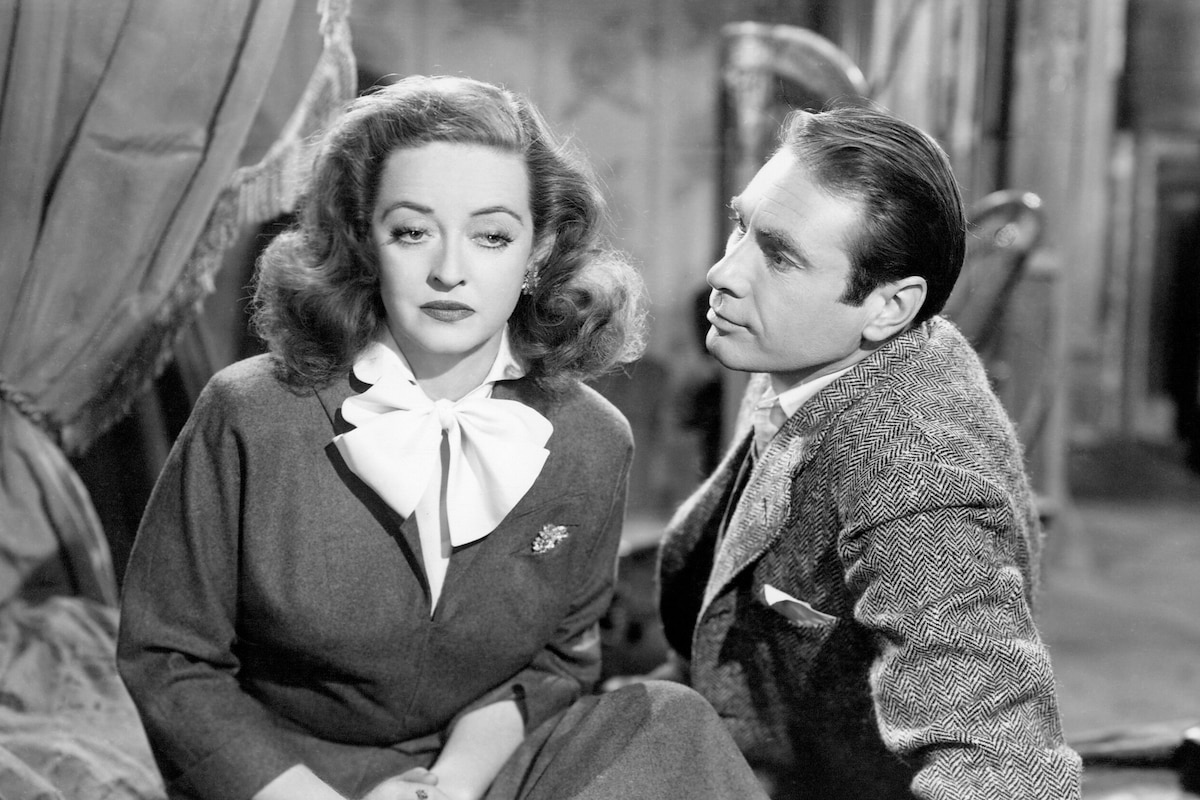
The growing attraction between Bette Davis and the married Gary Merrill was increasingly obvious to everyone on All About Eve. To the film's benefit, the chemistry worked for their characters on screen. Soon Merrill and Davis were inseparable. "Before long we were walking about holding hands, going to the movies," recalled Merrill in his 1988 autobiography Bette, Rita and the Rest of My Life. "From simple compassion, my feelings shifted to uncontrollable lust."
After the first week of filming, the cast and crew gathered to view the rushes in San Francisco. From what everyone saw on screen, it was clear that All About Eve was something special. People got excited, and that excitement fueled what already seemed to be a charmed production into an even better picture. "None of us could wait to get to work," recalled Anne Baxter.
Despite their characters' tense relationship on screen, Bette Davis and Anne Baxter got along very well during the making of All About Eve. "The studio tried to play that up all during the filming," recalled Anne Baxter in Ed Sikov's book, "but I liked Bette very much. She'd come on the set and go 'Sssssss' at me, but it was just a joke between us." Davis liked Baxter, too, which was quite a compliment as Davis reportedly didn't often like her female co-stars. She felt that Baxter did an excellent job with her part as Eve, and publicly praised her for it.
Marilyn Monroe, who was just starting out in pictures when she made All About Eve was very insecure working among such great established talent and struggled to hold her own. Bette Davis and some of the other actors could get impatient with her inexperience, but Monroe worked hard and tried to put forth her best efforts. Monroe's presence caused the most trouble for co-star George Sanders, who plays Addison De Witt. Sanders was newly married to Zsa Zsa Gabor at the time, and Gabor was none too pleased to have her husband away on location with the breathy blonde bombshell. According to Sanders, she was wild with jealousy and convinced that Monroe had her sights set on him. Gabor even asked Sanders to see if he could find a part for her to play in the film so she could be with him and keep an eye out. Sanders thought that his wife's concerns were ill founded. He believed Monroe to be nothing more than a beautiful lost, innocent child at heart. In his 1960 autobiography Memoirs of a Professional Cad Sanders says about Monroe, "Even then she struck me as a character in search of an author...She was very beautiful and very inquiring and very unsure-she was somebody in a play not yet written, uncertain of her part in the over-all plot. As far as I can recall, she was humble, punctual and untemperamental. She wanted people to like her." Gabor, however, called Monroe "an innocent, wild animal." The Sanders/Gabor marriage didn't last.
Gary Merrill described the experience of working with Monroe in his autobiography as occasionally frustrating. He describes a dinner party that Davis hosted the night before she and Monroe were to shoot a scene together. "The party went on quite late," he recalls, "but Marilyn excused herself early because she had to work the next morning. We all knew the scene Marilyn had to work on the next morning was really Bette's scene and that Marilyn had only a few lines...Bette had more, but she was an experienced actress and accomplished the scene with little bother. It had to be done in ten takes, however-Marilyn kept forgetting her lines."
After two weeks of filming on location in San Francisco, the production then moved back to Los Angeles for another month of shooting. Darryl Zanuck kept a close eye on the production, viewing the dailies on a regular basis along with other studio executives. It was clear to 20th Century Fox that they had an extraordinary picture on their hands. Zanuck was so confident that All About Eve would be a smash that no advance audience screenings were held-only press screenings to generate positive word of mouth for the film. In a confident move, the studio even financed the production of four separate trailers to advertise All About Eve.
By the end of filming, the affair that had begun between Bette Davis and Gary Merrill had blossomed into true love, despite the fact that they were both still married to other people. Following the film's wrap, both actors received quickie divorces and married each other on July 28, 1950 in Juarez, Mexico. The marriage lasted ten years.
When All About Eve opened in the fall of 1950, the buzz was overwhelmingly positive. The word on the street was that Bette Davis had given the performance of her career. She was once again happy and on top. The film went on to receive fourteen Academy Award nominations and become a bona fide cinema classic.
The experience of making All About Eve was a fond memory for all involved. "I suppose the best film I have been in was All About Eve," said George Sanders in his autobiography. "The critics and the trades loved it. It was a film of distinction: witty, sophisticated, and brilliantly written and directed." Bette Davis said in her autobiography, "I can think of no project that from the outset was as rewarding from the first day to the last. It is easy to understand why. It was a great script, had a great director, and was a cast of professionals all with parts they liked. It was a charmed production from the word go." As for Joseph Mankiewicz, Davis forever credited him for reviving her career at a crucial time. "He handed me the beginning of a new life professionally and personally," she said. "I also say thank you to Claudette Colbert for hurting her back. Claudette's loss was my gain."
by Andrea Passafiume
Behind the Camera - All About Eve
by Andrea Passafiume | January 03, 2008
SIGN UP FOR OUR NEWSLETTERS

CONNECT WITH TCM