"If I have drawn from anyone more than others, I would say it would be Laurel and Hardy. I guess I have every film they ever did, and quite often they come to my rescue in a strange way. If there's a moment when I need a physically humorous perspective and I'm dealing with one or two people, I seem to revert to doing Stan and Ollie...and that seems to save me. I love them dearly. They bring tears to my eyes along with the laughter. I owe them a lot of thanks." Blake Edwards, director of such comedies as 10 (1979), Victor/Victoria (1982), and the Pink Panther series.
Actor Chuck McCann has performed as Oliver Hardy a number of times with various co-stars as Laurel. His first network prime time television appearance in tribute to Hardy was in a late 1950s episode of The Gary Moore Show with Dick Van Dyke as Laurel. Other "Laurels" have included Tom Poston and Jim MacGeorge, with whom McCann appeared in a series of TV ads for such products as Arby's, Tony's Pizza, and Anco Windshield Wipers. McCann also had a couple of early TV shows based on the duo: Chuck McCann's Laurel and Hardy Show and Laurel and Hardy and Chuck. He was one of the founding members of the Sons of the Desert organization.
The staircase used in The Music Box has become a popular tourist site, although for many years its location was unknown. Dedicated Laurel and Hardy fans spent years trying to find the stairs, and in 1970, Pratfall magazine published a photo of co-star Billy Gilbert (whose home the duo destroys in the picture) with fans and magazine staffers standing next to a set of stairs assumed to be the ones from the movie. They were, however, similar stairs used in the Three Stooges movie An Ache in Every Stake (1941), which was inspired in some measure by the Laurel and Hardy picture. The real stairs were identified several years later, and in 1994, a plaque was placed at the location (between 923 and 927 Vendome St. in the Silverlake neighborhood of Los Angeles) marking the 67th anniversary of Hats Off (1927), the first film in which they struggled comically with the steep location. The ceremony included music, a video of The Music Box, reporters, city officials, Laurel and Hardy impersonations, and a speech by film critic Leonard Maltin.
Author Ray Bradbury (Fahrenheit 451, The Martian Chronicles) has been a lifelong fan of Laurel and Hardy and frequently tells of his delight in seeing them perform live in Dublin in the 1940s. Bradbury wrote two short stories set at the famous steps of The Music Box. In "Another Fine Mess," their ghosts haunt the location after dark, and in "The Laurel and Hardy Love Affair," a romantic couple arranges regular picnics at the foot of the staircase.
The Music Box was not the only time the duo made comedy around a piano. They destroyed the instrument in such films as Big Business (1929), Wrong Again (1929), Beau Hunks (1931), and Dirty Work (1933). They hauled one across a narrow, swaying suspension bridge in Swiss Miss (1938) and hid inside one in Way Out West (1937). The frequency of this motif prompted film critic James Agee to make note of the duo's "love-hate relationship with pianos."
The shots of the piano rolling repeatedly down the long staircase could possibly be a comic homage to the much more serious (and even more famous ) use of stairs in the Odessa Steps sequence of Sergei Eisenstein's Battleship Potemkin (1925).
Hal Roach tried to repeat the success of the Laurel and Hardy team by creating a German/Dutch/Yiddish version called the Schmaltz Brothers in the early 1930s. Played by The Music Box co-star Billy Gilbert (using his hybrid Teutonic accent from the Laurel and Hardy movie) and Billy Bletcher, the teaming was very short-lived and never achieved the popularity of its model.
Johnny Carson, as one of his recurring Tonight Show sketch characters, the Matinee Host, often credited the fictional movies he was introducing with "featuring the ever-popular Mae Busch," the actress who played Hardy's wife in Sons of the Desert and three other movies. She also appeared in nine other films with the duo, including a few where someone else (such as Thelma Todd) played Mrs. Hardy.
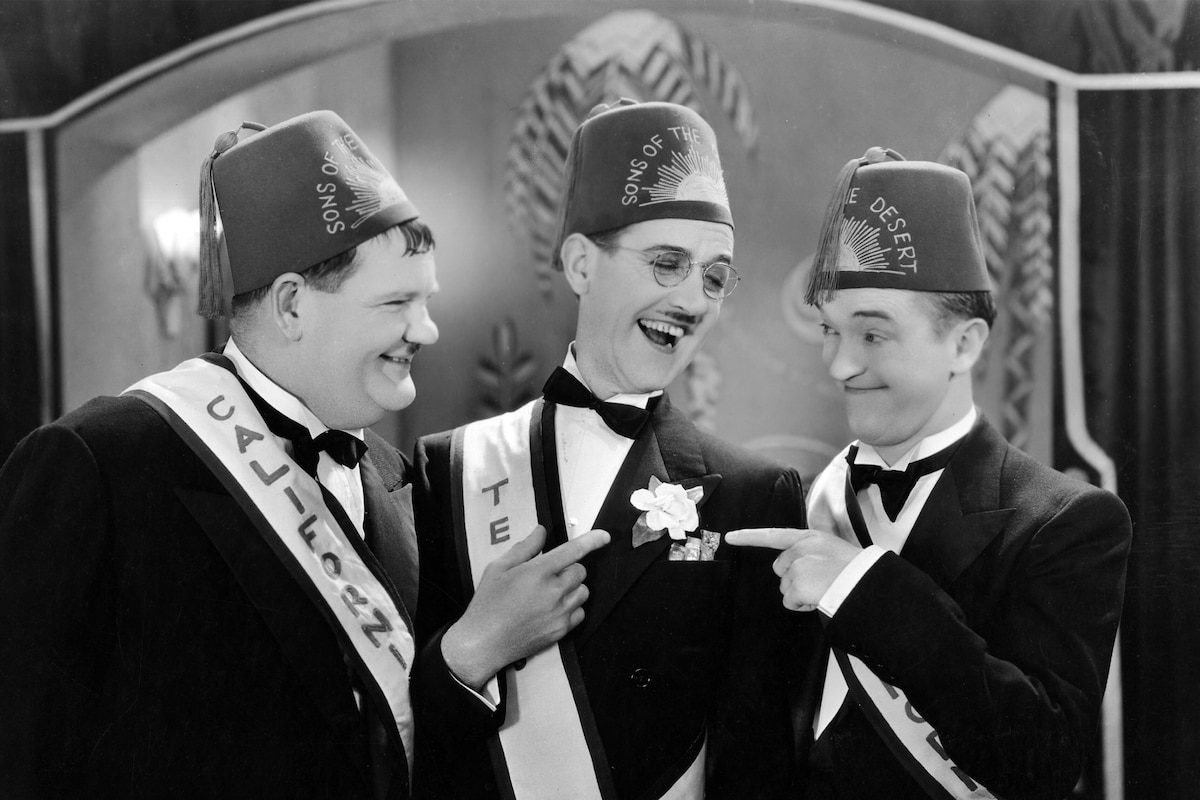
In 1965, Laurel and Hardy biographer John McCabe and a handful of others founded, with the blessing of Stan Laurel, an appreciation society called Sons of the Desert. In tribute to the movie from which it takes its name, each local chapter of the organization is known as a "tent," and there are countless "tents" all over the world, bearing such names as Below Zero Tent (Anchorage, Alaska), Berth Marks Tent (Harlem, Georgia, Hardy's birthplace), Tit for Tat Tent (one of eight in Germany), Another Fine Mess Tent (one of 40 in the UK), and four Music Box Tents (Phoenix, San Antonio, Pennsylvania, and Luxembourg).
The newspaper with the blaring headline "Honolulu Liner Sinking!" used in Sons of the Desert appears again in the Our Gang short Sprucin' Up (1935).
A few years after Sons of the Desert, Charley Chase, who played the raucous lodge member the boys meet at the convention, poked fun of fraternal orders again in The Grand Hooter (1937), the lampooned group this time called the Lodge of Hoot Owls.
In addition to the obvious physical and personality connections (large, easily frustrated man partnered with a skinny, somewhat dim and emotional sidekick), the characters created by Jackie Gleason (as Ralph Cramden) and Art Carney (as Ed Norton) in the 1950s television comedy series The Honeymooners were inspired to a degree by Laurel and Hardy. And Sons of the Desert figures into their depiction of Ralph and Ed's adventures with their fraternal order The Raccoons, whose activities they must occasionally sneak off to despite their wives' objections.
The Revenge of the Sons of the Desert is an Emmy-winning documentary short by Alexander Marshall about the 1986 biennial convention of the organization.
There is a country music group called Sons of the Desert.
In 1995, Playboy magazine founder and publisher Hugh Hefner sponsored a screening of newly struck prints of Sons of the Desert and Brats (1930) as a benefit for the Los Angeles Conservancy, an organization dedicated to preserving old movie palaces. The event drew 2,000 people and featured a pre-show parade (reminiscent of the Sons of the Desert convention parade seen in the newsreel within the movie), Hawaiian food and music (including "Honolulu Baby"), and an appearance by Chuck McCann and Jim MacGeorge as Laurel and Hardy.
A 2006 BBC production, Stan, based on the radio play of the same name by Neil Brand, imagines a final meeting between Laurel and his partner after Hardy suffered the major strokes that eventually claimed his life.
Animated likenesses of the duo have appeared since the 1930s in various mediums, among them the Looney Tunes cartoons, the syndicated comic strip "Bloom County," and The Simpsons TV series.
The catchphrase "Here's another nice mess you've gotten me into" (often misquoted as "this is another fine mess...") has passed into common usage. It was first used in The Laurel-Hardy Murder Case (1930) and is uttered by Hardy in Sons of the Desert. The frequent misquote may be attributed in part to the fact that they made a movie called Another Fine Mess (1930). In 2005 the line was ranked number 60 in the American Film Institute's list of the 100 greatest movie quotes of all time.
Director Blake Edwards was a big fan of the boys and in 1983 made a deal with Roach to do a remake of The Music Box, to star Burt Reynolds and Richard Pryor. It was finally released in 1986 as A Fine Mess with Ted Danson and Howie Mandel. Although the final product did retain a bit about moving a piano and the title reference to Hardy's famous line, it was not a success or considered much of a tribute to the comic geniuses who inspired it.
Bob Einstein made a political satire about Richard Nixon and Spiro Agnew called Another Nice Mess (1972), referencing Oliver Hardy's famous tag line.
by Rob Nixon
Pop Culture 101 - The Music Box/Sons of the Desert
by Rob Nixon | January 03, 2008
SIGN UP FOR OUR NEWSLETTERS

CONNECT WITH TCM