Stan Laurel has been credited with many of the immortal comic bits in the duo's pictures. Often during shooting he would get an inspiration for a bit or gag, which he would jot down on a pad he kept just for that purpose, whether or not it was appropriate for the picture they were filming. Upon returning home, he would further flesh out the idea and store it in a meticulously arranged file cabinet for quick reference at any time.
Laurel was known for taking charge on the set whenever he thought a scene wasn't clicking. Shooting would stop while he and the writers broke the scene apart, ad-libbed new bits, and came up with new approaches, often jumping right in after these sessions to film the scene immediately without rehearsal.
Laurel once explained that the two always used their own names for the characters in their pictures because "it makes our performance more natural and also lends a certain intimacy to the roles we portray. Further this procedure insures against the confusion of the characters."
Because their comedy depended heavily on spontaneity and because it was often necessary to alter their gags and situations, Laurel and Hardy insisted on shooting their films in sequence, rather than the usual (and less costly and time-consuming) practice of shooting all scenes set in one location at the same time.
Around the time of the release of Sons of the Desert, Hardy noted that despite the hilarious final result, shooting one of their pictures could be a very arduous task, involving bumps, bruises, lacerations, scratches and the destruction of many costumes. "If anyone thinks that this is fun, they should try working in comedies," he said. In 1964, Laurel weighed in on the subject: "It's just bloody hard work. These people who say making pictures is fun...they kill me!"
Publicity materials commented on the trademark "genteel shabbiness" of the clothes the duo wore, the same basic costume in every picture (the exception being the outfits they wore in the occasional period piece). The same publicity claimed that it took a lot of money and expert tailoring to create the ill-fitting, seemingly cheap suits that would stand up under the rough treatment given them in the course of shooting the films.
THE MUSIC BOX
Principal photography took place in less than two weeks during December 1931.
The working titles for the film were, at various times, "Top Heavy," "Words and Music," and "The Up and Up."
Although the staircase was a real location, the house at the top was shot in the studio.
A special police squad was on duty at the Vendome Street staircase over the course of the four-day location shoot to keep more than 3,500 onlookers and fans from interfering with the production. During their lunch breaks, Laurel and Hardy reportedly signed about 2,000 autographs.
According to some sources, the crate the boys wrestle with on the stairs was empty but the one shown sliding down the staircase on its own really did have a piano in it.
Unlike now, when sound effects and background noise are usually created in post-production, recording engineers went on location to pick up authentic ambient noise.
Billy Gilbert developed an accent for his character in the movie so as to avoid confusion, he claimed, with other Laurel and Hardy foils, such as Edgar Kennedy. The accent was a mix of German, Dutch, Greek and Italian, he said, in order to avoid offending any one group.
Unlike the usual practice on most Laurel and Hardy pictures, The Music Box was not always shot in sequence, largely due to changing cloud conditions that made it necessary to wait for the right sun to match the lighting from one shot to the next.
The piano that Billy Gilbert destroys at the end of the short was made of balsa wood and spare parts from a real piano, in order to break up easily.
Musician Marvin Hatley was just off camera playing the piano to simulate the automatic player piano sounds in the scene where the boys are cleaning up the house and dancing. When Billy Gilbert begins smashing the piano with an axe, Hatley played along off screen, matching the axe hits.
News stories at the time, possibly planted by the publicity department, said Laurel nearly broke his leg when he had to fall through a second-story window carrying the piano crate and Hardy received a severe "burn" on his head in the shot where the piano rolls over him on the stairs.
True to his practice of overseeing most aspects of all their productions, Stan Laurel worked in the cutting room around the clock as The Music Box was being edited.
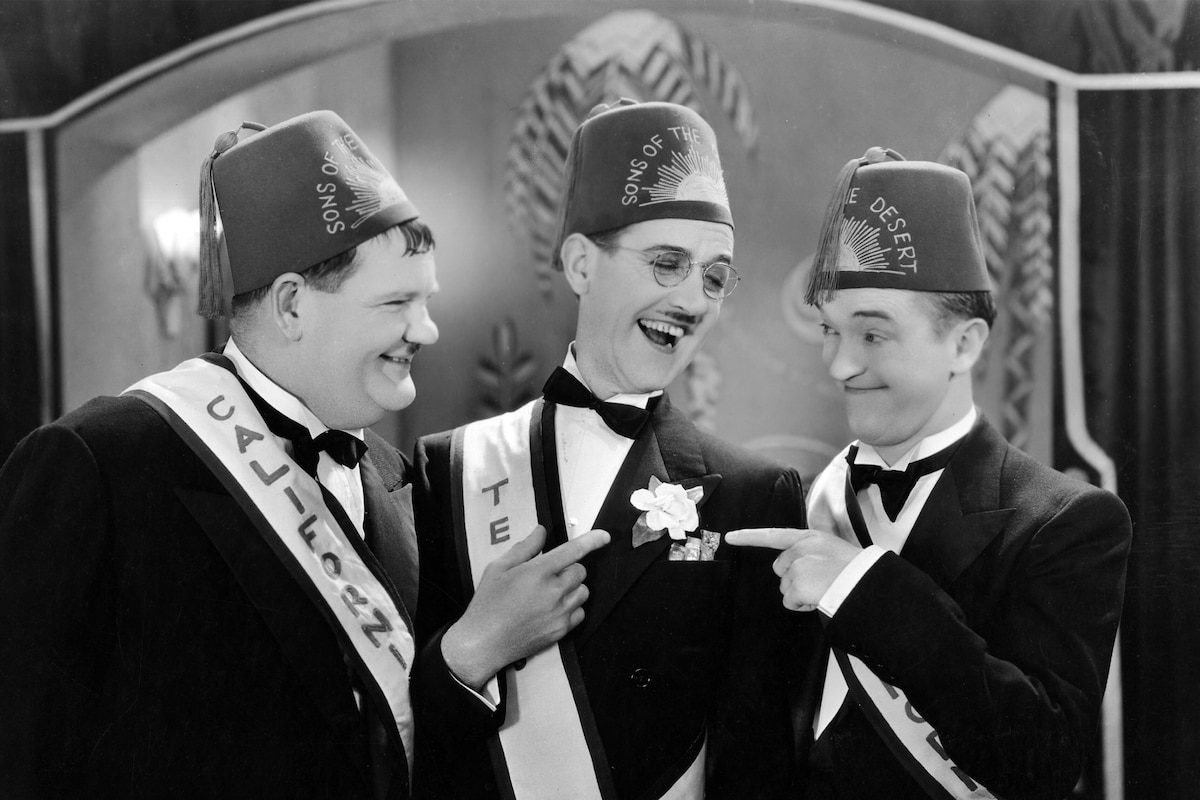
SONS OF THE DESERT
The filming of Sons of the Desert took place over a period of three weeks in October 1933. Director William Seiter reportedly brought the picture in five days ahead of schedule.
The working title was "Fraternally Yours," and the movie was eventually released in Europe under that name.
Roach said in later years that William Seiter had more control than any of Laurel and Hardy's other directors. He described Seiter as "genial, competent, and the kind of director who had a good sense of building the story while also focusing hard on characterization."
Laurel and Hardy took time off from filming this feature to shoot their sequences in MGM's guest star-laden Jimmy Durante movie Hollywood Party (1934).
According to studio publicity releases, scenes had to be reshot frequently because director and crew would often break up in laughter over the stars' antics. The story went on to assert that Laurel's expression in the scene with Charley Chase was so funny "that it completely upset the equanimity of Hardy, and it was several minutes before the latter was able to regain his composure." According to film historian Richard W. Bann (a specialist on the films produced by Hal Roach Studios), Roach recalled in 1979 how often such things happened on set. "I was never upset that it was costing me money," he said. "I was upset that we couldn't use some of the funniest scenes we saw every day," the ones that were ruined by cast or crew members breaking up.
Among the stories planted by studio publicists was one stating that during production, cast and crew formed their own "Sons of the Desert" fraternal order, electing Laurel "High Factotum" and Hardy "Good Knight." Director Bill Seiter, according to the story, was named "Sergeant Without Arms."
Sons of the Desert's comic take on marital discord mirrored the far more serious and stressful domestic problems that Laurel and Hardy were experiencing at the time. Seiter was also in the process of splitting from his first wife, actress Laura La Plante. Chase also had numerous difficulties at home because of his drinking.
At the time of filming, Hardy was estranged from his wife Myrtle (with whom he reconciled, briefly) and rumored to be seeing Lillian DeBorba, mother of child actress Dorothy DeBorba from Roach's "Our Gang" series. Lillian was drafted into being an extra to fill a seat in the movie theater scene and was seated in front of Mae Busch and Dorothy Christy (who play Hardy's and Laurel's wives).
During the shooting of Sons of the Desert, Laurel was also seeing someone else, Virginia Ruth Rogers, even though his divorce from his first wife was not yet final. Rogers even filled in as a crowd scene extra and also stood closely by during the filming of the rooftop downpour scene. As the soaking wet Laurel finished shooting, she threw a towel around him, rushed him to his dressing room, ran a hot shower, and made him a hot toddy of whiskey, lemon and sugar. She said Laurel began to cry in gratitude, noting how his wife never took any interest in his work or showed her concern for him in that way. Rogers later became his second (and fourth!) wife
In the early 1960s, Stan Laurel told actor Chuck McCann (a Laurel and Hardy devotee and Hardy impersonator), that he found Charley Chase to be an easy-going, delightful person to work with and know, and much quieter than his screen image suggested. Laurel mentioned how during a rehearsal on Sons of the Desert, he reached for what he thought was his glass of water and grabbed Chase's by mistake, finding instead a tumbler full of gin. (Chase was a known alcoholic.)
Comedy star Patsy Kelly was originally cast as Laurel's wife, but producer Hal Roach had loaned her to MGM for Going Hollywood (1933), which was running over schedule when production began on this picture. Dorothy Christy stepped into to play the duck-hunting spouse four days into the shooting.
Among the cast members but never seen on screen was Billy Gilbert, frequent Laurel and Hardy foil, who played the blustering Teutonic professor in The Music Box. Gilbert provided a voiceover in Sons of the Desert.
Two players who would become far better known in the future were extras in Sons of the Desert: Robert Cummings (lost in the steamship crowd) who would make his mark later in such films as Kings Row (1942) and Alfred Hitchcock's Saboteur (1942); and Ellen Corby (at a table in the scene featuring Charley Chase), best known today as Grandma on the television series The Waltons.
According to the pressbook for Sons of the Desert and a Hollywood Reporter news item, extras in the newsreel footage of the convention parade included members of the Glendale post of the American Legion, the Hollywood American Legion, and the Santa Monica Elks Lodge.
The number of extras wasn't the only thing to push up the cost of shooting the parade scene. To modernize the available backlot sets to look more like contemporary Chicago, $25,000 was spent on refurbishing three blocks of the studio's "New York street." Four crews built new buildings and store fronts over the course of nine days. The job went $10,000 over budget after set decorations, asphalt repaving and lighting were added.
The parade newsreel was supplemented with stock footage from the Elks Lodge state convention held in Santa Monica some months before.
In the original script of Sons of the Desert, the parade scene was to have included an extended sequence of the boys causing mayhem as they participate in - and subsequently ruin- a bicycle procession. The scene was not used in the movie.
by Rob Nixon
Behind the Camera - The Music Box/Sons of the Desert
by Rob Nixon | January 03, 2008
SIGN UP FOR OUR NEWSLETTERS

CONNECT WITH TCM