THE MUSIC BOX
The plot of The Music Box is essentially a remake of a long-lost Laurel and Hardy silent short, Hats Off (1927), which had the boys lugging a washing machine up and down the same flight of stairs.
The inspiration to build a comedy around those steps apparently came to producer Hal Roach even before Hats Off. The location was used in a Charley Chase two-reeler produced by Roach and directed by Leo McCarey, Isn't Life Terrible? (1925), which also featured Fay Wray and Oliver Hardy prior to teaming with Stan Laurel. And they may have also figured in a Laurel solo, as a door-to-door salesman in The Pest (1922), as well as in a chase scene in one of Roach's "Our Gang" comedies, A Quiet Street (1922). It's not certain that the stairs used in those last two titles are the same as those in The Music Box, but it's a testament to the indelible imagery of that location that one can't see similar stairs without thinking of Laurel and Hardy.
The inspiration to remake Hats Off using a piano instead of a washing machine may have been inspired in part by a reissue around this time of the Charlie Chaplin short His Musical Career (1914, aka Musical Tramps, The Piano Movers) in which Chaplin and Mack Swain (another comic duo that accented their wildly dissimilar body shapes) try to move a piano with similar comic mishaps.
SONS OF THE DESERT
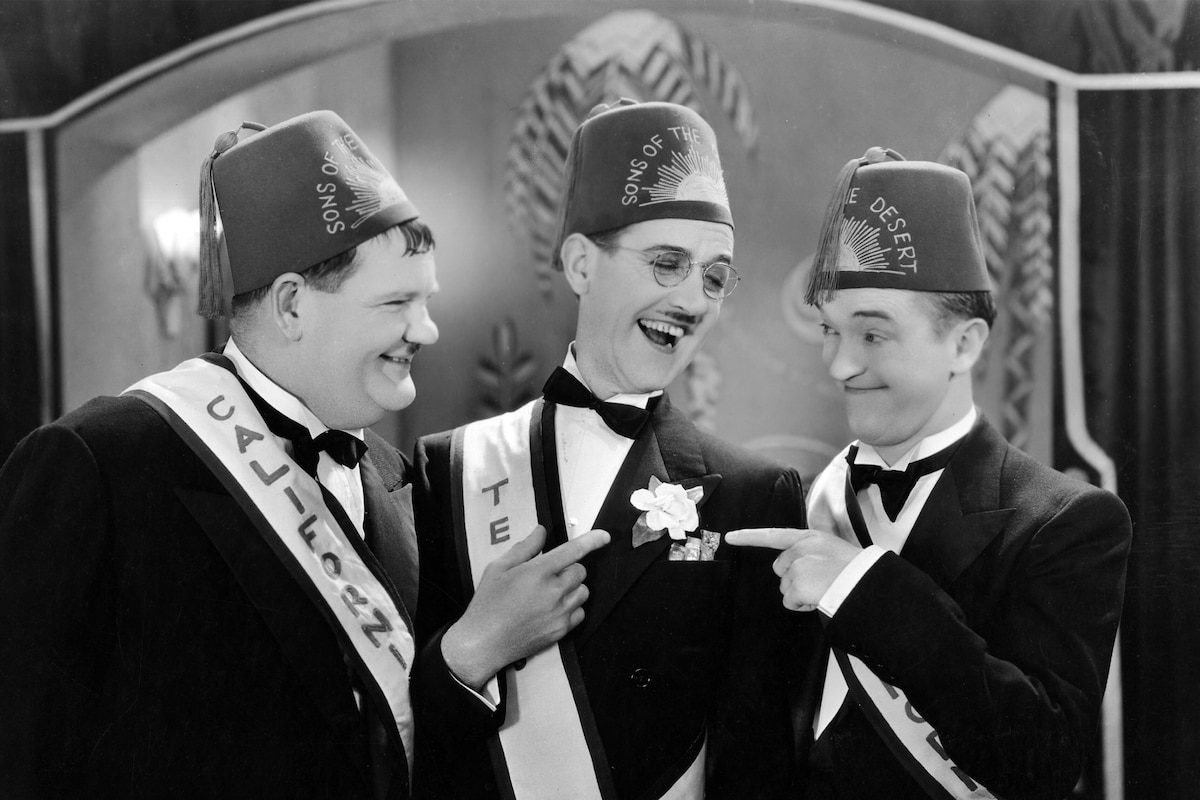
Although Laurel and Hardy had achieved tremendous success at Hal Roach Studios with one hit short comedy after another, by the 1930s the trend seemed to be moving toward feature double bills. Although he wasn't pleased with the change, Roach wisely turned to feature production to meet the need. He first showcased his biggest stars in the new format in Pardon Us (1931). Sons of the Desert was their fourth feature. The pair continued to make shorts into the mid-1930s, while making longer features through the rest of their careers into the early 1950s.
To facilitate feature production, Roach struck an agreement with MGM to distribute six-reel-plus movies made by his studio. For Sons of the Desert, Metro advanced $25,000 per week towards production costs, up to a maximum of $150,000. Roach put up approximately one-fourth of the projected negative cost, about $50,000. The contract would yield 60 percent of the gross receipts to Roach's company.
The story of Sons of the Desert arises from a motif frequently played out in the earlier Laurel and Hardy shorts of the boys trying to have some fun or concocting some scheme without their domineering wives learning about it. Be Big! (1931) provided much of the basis of the storyline for Sons of the Desert. In it, Stan and Ollie are invited to a party in their honor at their lodge. Ollie pretends to be ill in order to get out of a vacation he and Stan planned to take with their wives. They tell the wives to go on ahead and that they will meet them the next day. But the wives miss their train and when they return home and discover the deception, they go after the boys with shotguns. An earlier short, We Faw Down (1928), has even greater similarities. The boys pretend to be going to a show at the Orpheum Theatre in order to sneak off to a poker game. Along the way, they get involved with two young women in distress and are threatened by the boyfriend of one of them, a tough boxer. They're forced out onto a roof, frantically pulling on their clothes as they escape, and are spotted by their wives, who have rushed downtown upon hearing the Orpheum has burned down. At the end, a furious Mrs. Hardy fetches her hunting rifle, a weapon shifted to Mrs. Laurel's possession in Sons of the Desert.
Despite the antecedents in a number of earlier Laurel and Hardy shorts, plot elements for Sons of the Desert, at least according to articles in the Spring 1933 trade journal Film Daily, may have been inspired by a trip Roach took to attend an MGM sales division meeting in Kansas City. Not only was the gathering an occasion for partying, much like the Sons of the Desert national convention in the picture, but Roach's flight back was plagued by a terrible storm, which he claimed gave him an idea for a new comedy. The experience may have suggested the ship-downed-by-typhoon motif and the heavy downpour on the roof that ended up in this picture.
Oliver Hardy's good pal, actor-writer Frank Craven, was hired by Roach in July 1933 to develop the ideas for Sons of the Desert into a working script. A number of other writers, as well as director William Seiter and Laurel and Hardy themselves, also contributed to the script, without receiving onscreen credit.
William Seiter, who had been directing since the early days of motion pictures and had just completed two Ginger Rogers vehicles Rafter Romance and Chance at Heaven (both 1933) was hired at the substantial sum of $2,000 per week to helm the Laurel and Hardy feature.
by Rob Nixon
The Big Idea - The Music Box/Sons of the Desert
by Rob Nixon | January 03, 2008
SIGN UP FOR OUR NEWSLETTERS

CONNECT WITH TCM