THE MUSIC BOX Synopsis
Laurel and Hardy play a couple of movers consigned to hauling a cumbersome player piano up a gigantic set of stairs that runs from the street level to a house high above. They encounter numerous difficulties, interruptions and pratfalls along the way but finally manage, after considerable damage to the house, to complete the delivery, only to find that the blustering, angry resident, Professor von Schwarzenhoffen, hates pianos. Appropriate comic destruction and revenge ensues.
Director: James Parrott
Producer: Hal Roach
Screenplay: H.M. Walker
Cinematography: Len Powers
Editing: Richard Currier
Original Music: Harry Graham, Marvin Hatley, Leroy Shield (all uncredited)
Cast: Stan Laurel (Stanley), Oliver Hardy (Oliver), Billy Gilbert (Prof. von Schwarzenhoffen), Hazel Howell (Mrs. von Schwarzenhoffen), Charlie Hall (Postman).
BW-29m.
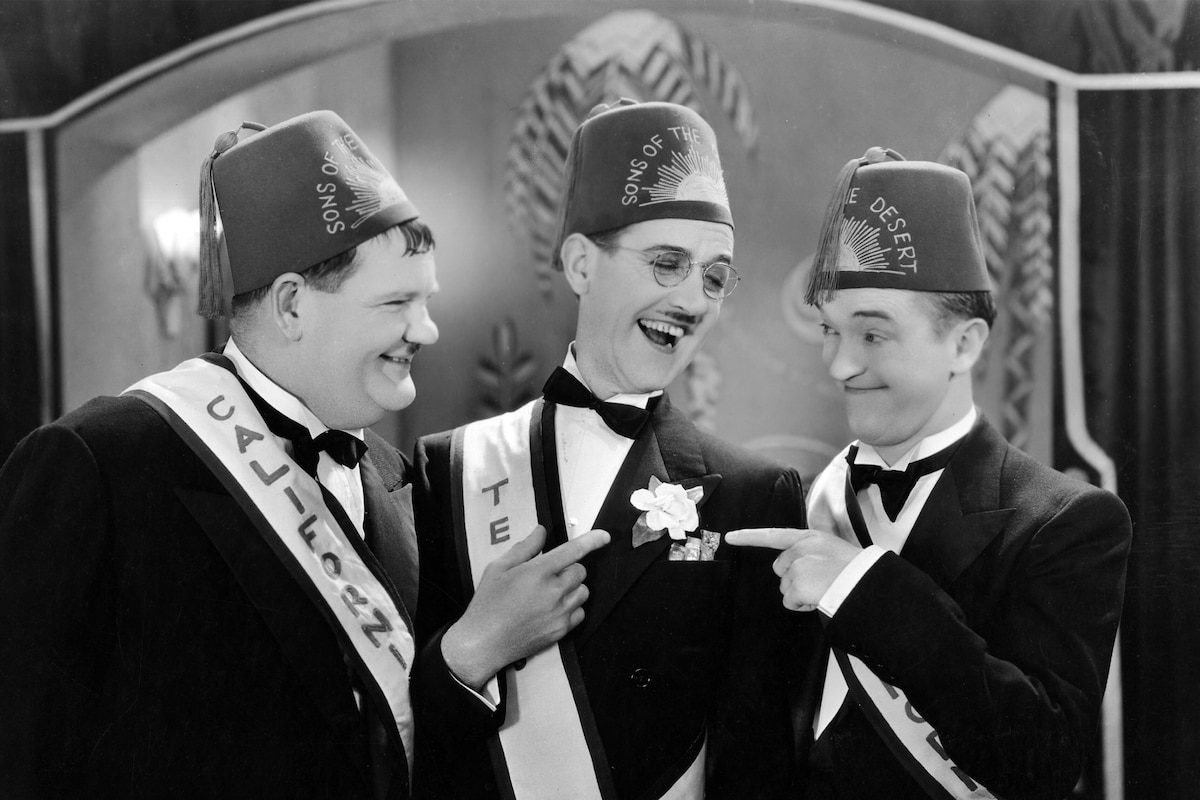
SONS OF THE DESERT Synopsis
Stan and Ollie take a solemn oath to attend the annual convention of their fraternal order, the Sons of the Desert, in Chicago. But getting their wives to agree to it is quite another matter. So Ollie devises a plan whereby he will appear to be seriously ill. Stan gets a "doctor" to prescribe an ocean voyage to Hawaii. Because Ollie's wife is terribly frightened of the sea, she agrees to allow her husband to go on the life-saving trip with his best friend. While the boys whoop it up in Chicago, their wives get word that the ship they supposedly sailed on is sinking in a typhoon at sea. Distraught, they attend a movie to take their minds off the worry and spot their wayward spouses in a newsreel report about the convention. When they return home, the boys are forced into greater acts of deception to cover themselves, but to no avail, of course.
Director: William A. Seiter
Producer: Hal Roach
Screenplay: Frank Craven
Cinematography: Kenneth Peach
Editing: Bert Jordan
Original Music: William Axt, George M. Cohan, Marvin Hatley, Paul Marquardt, O'Donnell-Heath, Leroy Shield (all uncredited)
Cast: Stan Laurel (Stanley), Oliver Hardy (Oliver), Charley Chase (Charley Chase), Mae Busch (Lottie Hardy), Dorothy Christy (Betty Laurel), Lucien Littlefield (Dr. Meddick).
BW-65m.
Why THE MUSIC BOX and SONS OF THE DESERT Are Essential
When Stan Laurel and Oliver Hardy were officially and permanently constituted as a team in 1927 after years of separate movie careers (10 for Laurel, 13 for Hardy), the silent era was nearly over and the screen was already dominated by the "Big Three" of screen comedy Chaplin, Keaton, and Lloyd as well as a number of other lesser but popular talents. But within the next two years before the coming of sound and over the course of more than 20 two-reel silent shorts for producer Hal Roach, Laurel and Hardy became immensely popular with critics and audiences alike. Even more remarkable than this burst of success, they alone among their comic contemporaries made the transition to talkies without a hitch, becoming more popular than ever before. They achieved this by forging an indelible on-screen relationship that became possible only after they reversed their previous film personae. Laurel, who had come to America as Chaplin's understudy on a vaudeville tour, started his motion picture career as a grinning, aggressive, even frantic presence, while Hardy was a cherubic, self-effacing second or third banana as well as an occasional mock-villain in comic melodramas. With these images, they co-starred in a handful of movies for Roach, who seemed unable or unwilling to recognize at first what he had in the pair. But once Hardy was elevated to the position of perturbable take-charge perpetrator and Laurel became the timid, blinking reactor to his actions, an interaction became possible that no screen team before or since has quite matched. (Ironically, it was Laurel who not only claimed first billing but also retained creative control of all of their material).
Their brand of comedy, based on relationship and emotion as much as slapstick and physicality, translated well into talking pictures, and their voices matched their visual personalities so well that audiences immediately accepted them with sound. The Music Box and Sons of the Desert represent the best of this period. The Boys (as they were often known) were at their best in two-reel shorts that allowed them to find a rich variety of gags within a single basic situation. Such was the case with The Music Box. The simple story offered a number of physical comedy possibilities in the movement of a piano up an implausibly long flight of stairs and verbal humor in interactions with a range of characters providing roadblocks along the way. Although expanded beyond their earlier shorts to three reels, some of which were built around the same basic premise, the comedy is fresh and inventive. Case in point: cutting away for just a moment from the awesome load they bear, the camera follows a hat bouncing merrily down the staircase, almost giddy with freedom and lightness, until it lands in the street and is immediately squashed by a passing vehicle. The film so impressed and delighted the public, the reviewers and the industry alike, that Roach was able to convince the Academy of Motion Picture Arts and Sciences to create an award for comedy shorts, and The Music Box became the first film to win in that category. The film has remained so indelibly in the popular imagination that the staircase location has become a historic site, revered by fans and other artists.
With the coming of sound and the Depression years, motion picture exhibition underwent some changes. More and more, people wanted to see double features, and Hal Roach, who had built his comic empire on shorts, reluctantly turned to feature production to meet the demand. Laurel and Hardy were the top attraction in shorts, and their names alone often brought in more audience members than the full-length films with which they were paired. But the trend was inevitable, and Roach knew he had to build longer films around his two biggest stars. In later years, particularly after they left the Roach Studios, the duo's features would become uninspired and monotonous and too lengthy to play to their strengths as effectively. But in the early 30s, Roach was able to fashion films of approximately an hour's length that still captured what the Boys did best.
Sons of the Desert, the fourth of their longer films, is generally considered the pinnacle of Laurel and Hardy's feature work for Roach, and an inspiration for fans the world over. Playing on a familiar Laurel and Hardy motif their attempts to outwit their domineering wives to enjoy themselves at more "manly" activities and featuring a guest appearance by popular Roach player Charley Chase (whom the duo supported in the comic's early silent shorts), the picture became one of the Top 10 box office hits of the year. While not totally avoiding full-out slapstick, the humor in this picture derives primarily from character and situation, making it one of their subtlest yet funniest films, thanks to the association with one of their most compatible directors, William Seiter. Unfortunately, the three never worked together again.
For fans, these are the films to return to again and again; for the uninitiated, they are the ones to go to for a clear picture of what made this team so great. Stan Laurel always resisted analyzing their comedy, believing it an impossible task because of the ephemeral nature of humor. But Oliver Hardy once noted that the characters they created "were nice, very nice people. They never get anywhere because they are both so dumb, but they don't know they're dumb. One of the reasons people like us, I guess, is because they feel superior to us." Perhaps Hal Roach said it best: "Each was individually brilliant as a comedian, yet each could serve as a foil for the other. They complemented each other perfectly. Basically, the Stan and Ollie characters were childlike, innocent. The best visual comedians imitate children, really. No one could do this as well as Laurel and Hardy, and still be believable. We always strived for that and we sure must have succeeded....People like that aren't around anymore."
by Rob Nixon
The Essentials - The Music Box/Sons of the Desert
by Rob Nixon | January 03, 2008
SIGN UP FOR OUR NEWSLETTERS

CONNECT WITH TCM