Edward G. Robinson enjoyed a welcome change of pace from his usual tough
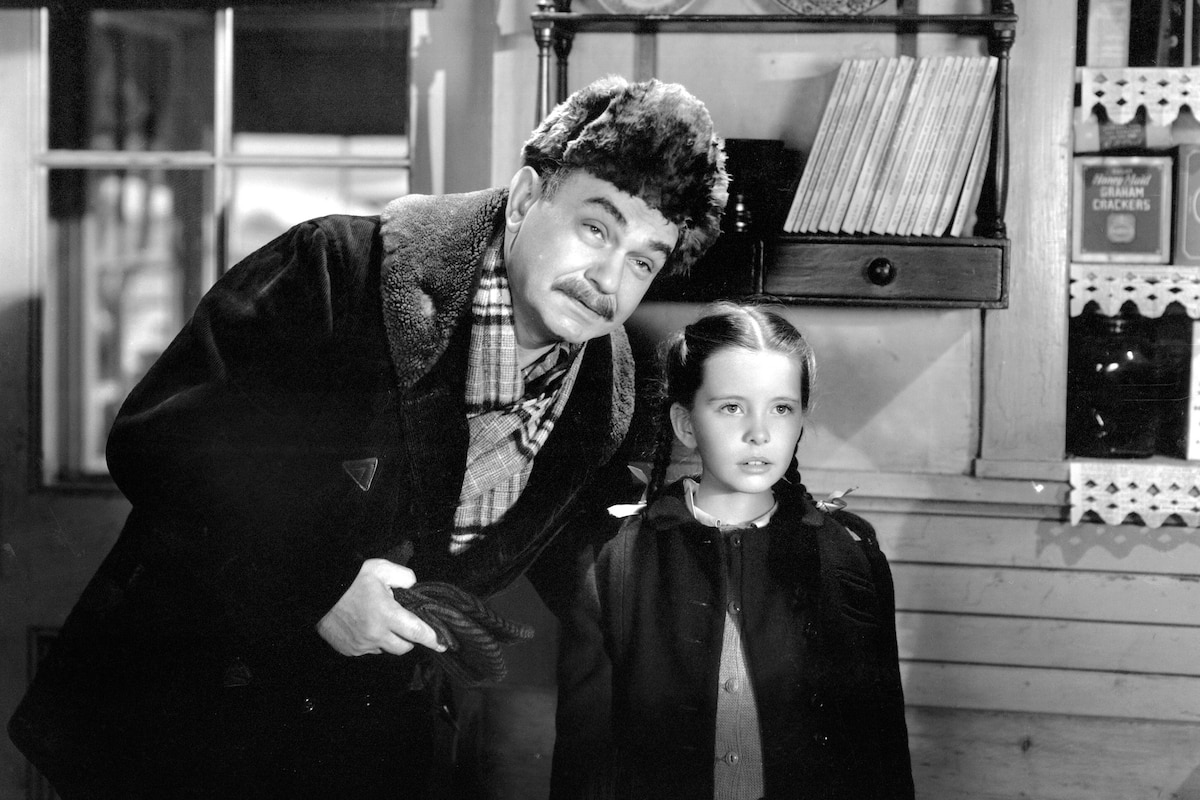
guy roles when MGM cast him as a simple immigrant farmer in the family drama Our Vines Have Tender Grapes (1945). But although his character was a bastion of all-American
ideals, Robinson's association with screenwriter Dalton Trumbo on the film
would come back to haunt him in later years, ultimately leading to his
blacklisting during the early part of the '50s.
That the former Little Caesar would even have been considered for
the role of Margaret O'Brien's father in this touching tale of small-town
America is a tribute to Robinson's versatility and tenacity. He had fought
for more varied roles throughout his career, impressing audiences and
studio executives with his work as a pioneering medical researcher in
Dr. Ehrlich's Magic Bullet (1940), a hobo trying to save face at his class
reunion in Tales of Manhattan (1942) and a tough-talking insurance
investigator in Double Indemnity (1944). In Our Vines Have Tender
Grapes, he tugged at the heart strings as a simple man who drives all
night so his daughter can see a circus elephant and gives up his dream of
building a new barn to help out a neighbor who's lost everything. His
performance earned widespread raves. Even James Agee, long an opponent of
the studio star system, praised Robinson, O'Brien and Agnes Moorehead (as
Robinson's wife) for their simple natural acting.
Robinson was thrilled to be working with screenwriter Dalton Trumbo, whom
he would describe in his memoirs as "hot-headed, wildly gifted,
inordinately progressive, and, it seemed to me, intensely logical." Trumbo
had already scored back-to-back hits at MGM with the wartime fantasy A
Guy Named Joe (1943) and the documentary style Thirty Seconds Over
Tokyo (1944). For Our Vines Have Tender Grapes, he drew on his
small-town Colorado roots to flesh out the characters in George Victor
Martin's episodic novel. With three successes in a row, he negotiated an
unprecedented contract at MGM, guaranteeing him $75,000 per picture and the
right to work at home, where he slept all day and typed through the night
-- in the bathtub.
But Trumbo's world would soon come crashing down when he was called as one
of the Hollywood Ten to testify before the House Un -American Activities
Committee (HUAC) about his alleged affiliation with Communist
organizations. The Ten's refusal to answer questions about their political
affiliations led to prison sentences and the birth of the Hollywood
blacklist. Unable to work, Trumbo appealed to Robinson for a loan to help
keep his family together. When word got out that Robinson had written him
a check for $2,500, the star found himself unable to find work either.
Robinson refused to name names or publicly declare himself a "commie dupe,"
so he remained unemployed, despite appeals to FBI head J. Edgar Hoover to
help him clear his name. It took three appearances before the HUAC before
he could finally return to work.
Ironically, Trumbo never stopped working during that time. He wrote
scripts under pseudonyms and through fronts, even smuggling one script out
of prison. And he won Oscars® for The Brave One (1956) and Roman
Holiday (1953) -- but not under his own name. The latter film almost led to
another encounter with one of the actors he'd written Our Vines Have
Tender Grapes for. In the late '50s, he got a call from Margaret
O'Brien's mother. By this time, O'Brien's days as a child star were over,
and her mother was hoping to find a comeback vehicle to lead her to adult
stardom. She approached Trumbo about writing a script for her daughter,
initially claiming she wanted him because Our Vines Have Tender
Grapes had been one of her daughter's best films. Then she admitted
she was sure a picture like Roman Holiday would put her daughter
back on top. Refusing to admit or deny that he had written the film,
Trumbo suggested she turn to Ian McLellan Hunter, the writer who had put
his name on the script. Ironically, Hunter was also on the blacklist by
that time -- proving that the real world was a far cry from the simple
American community Trumbo had written about in Our Vines Have Tender
Grapes. Ultimately, O'Brien never got her comeback vehicle, though
audiences will long remember her as the farm girl riding on an elephant's
trunk and giving up her pet calf to save a neighbor from bankruptcy.
Producer: Robert Sisk
Director: Roy Rowland
Screenplay: Dalton Trumbo
Based on the Novel by George Victor Martin
Cinematography: Robert Surtees
Art Direction: Cedric Gibbons, Edward Carfagno
Music: Bronislau Kaper
Principal Cast: Edward G. Robinson (Martinius Jacobson), Margaret O'Brien (Selma Jacobson), James Craig (Nels Halverson), Agnes Moorehead (Bruna Jacobson), Jackie "Butch" Jenkins (Arnold Hanson), Morris Carnovsky (Bjorn Bjornson), Frances Gifford (Viola Johnson), Sara Haden (Mrs. Bjornson), Charles Middleton (Kurt Jensen).
BW-106m. Closed captioning
by Frank Miller
Our Vines Have Tender Grapes
by Frank Miller | December 16, 2002
SIGN UP FOR OUR NEWSLETTERS

CONNECT WITH TCM