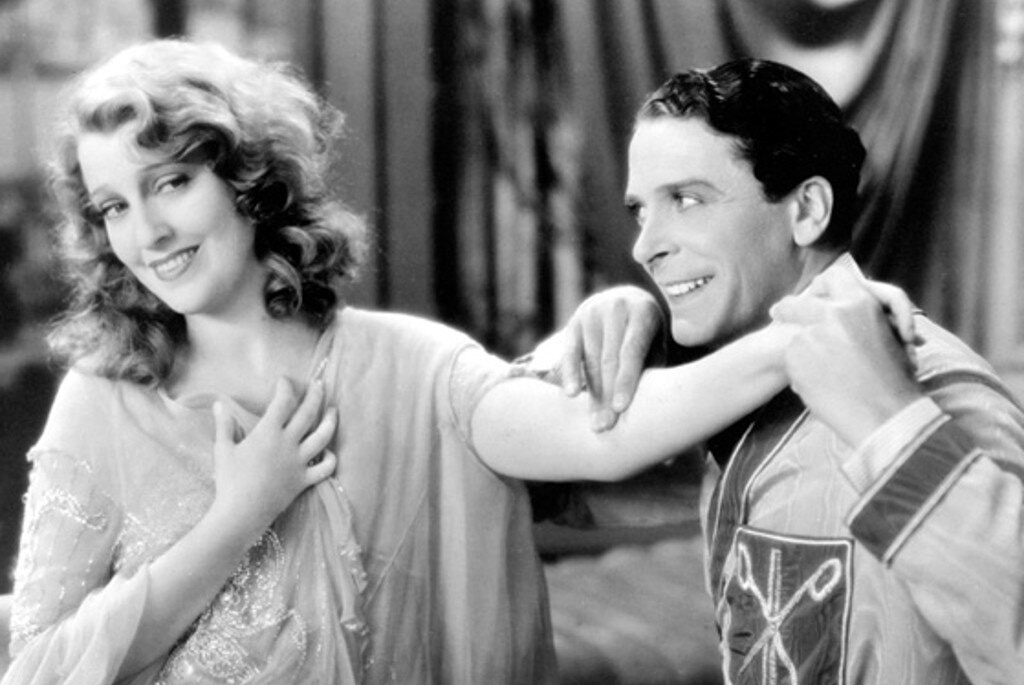
Monte Carlo is remarkably fresh and fluid for a movie made in 1930. It contains very little early-talkie creakiness, and the credit goes
entirely to the master director Ernst Lubitsch. Sandwiched between two unabashed Lubitsch masterpieces - The Love Parade (1929) and
The Smiling Lieutenant (1931) - the merely "very good" Monte Carlo tends to be underrated. Now, along with Lubitsch's One
Hour With You (1932), all these musicals are finally available on DVD from Criterion's Eclipse line, in a must-own package.
Two of the four star Jeanette MacDonald and Maurice Chevalier, one of the great screen pairs. The Smiling Lieutenant stars Chevalier but
not MacDonald, and Monte Carlo has MacDonald but not Chevalier. In his place is the actor Jack Buchanan, who despite a long career
in show business (as actor, writer, director and producer) is singly remembered for his turn in The Band Wagon (1953).
He is something of a weakness in Monte Carlo, but not disastrously so; he even survives having to perform the film's worst song,
"Trimmin' the Women," with two other gents. No, what keeps Monte Carlo afloat and alive are the creativity of Lubitsch and the charm
and voice of MacDonald. The film begins with a wedding scene - actually, a non-wedding, as we soon realize we are watching the aftermath of a
bride having fled the premises just before going to the altar. Lubitsch gives it to us all pictorially (and musically), with a sequence of witty and
visual humor outside in the rain. It sets up the story, it establishes a level of visual storytelling that the movie will mostly maintain, and it gets us
used to music as a meaningful device. Not a word of dialogue is necessary. And when the first word does come, it is hilarious in its
unexpectedness. Talk about making every word count!
The bride, of course, is played by MacDonald, and the first we see of her is hopping aboard a train, not even knowing where it is going. She just
wants no part of the duke (Claude Allister) she was to marry. On the train with barely any clothes and almost no money, she impulsively decides
to take it as far as Monte Carlo, where she plans to turn her 10,000 francs into millions. She succeeds...and then she doesn't...in a roulette
sequence as entertaining as it is exasperating to witness. More importantly, a count (Buchanan) gets a good look at her, and, through plot
devices too outlandish to explain here, ends up posing as her hairdresser in order to spend time with her and slowly seduce her. It's basically a
modernization of Booth Tarkington's Monsieur Beaucaire, which receives a screenplay credit as a source material along with Hans
Mueller's play The Blue Coast. Ernest Vajda is credited with the screenplay adaptation. It's all done in light-musical-comedy mode, and
while the film runs out of steam a bit as it goes along, it works. In the end, there's a scene at an opera house in which Monsieur
Beaucaire is being performed on stage, and Lubitsch takes the opportunity to let the words from the opera substitute for the characters'
dialogue.
Touches like that are quite astounding for such an early talkie, and they remain innovative even today. Not many contemporary filmmakers still
treat picture and sound as two distinct and separate tools. Lubitsch thrived on such devices. He also gives us a slap on the face off-screen and
makes a naughty joke entirely by two shots of a musical clock. And he integrates the songs in a way that furthers the plot and keeps them
cinematically fluid. In "Beyond the Blue Horizon," MacDonald sings as the train passes through farmland; the train whistle blows on beat, and
workers in the countryside sing along as the train passes through, the land basically coming alive in music. The film's best and most hummable
tune, however, is "Always in All Ways," charmingly sung by the two stars and used as underscoring in a few other sequences.
Claude Allister is perfectly cast as the jilted suitor who ends up in Monte himself to try and win back his bride, and Frances Dee can be seen
briefly as a receptionist, in one of her earliest screen appearances. Her first credited role would come two films later, when she starred opposite
Maurice Chevalier in The Playboy of Paris (1930).
Eagle-eyed viewers will spot a funny in-joke just before the final opera sequence. A shot of a poster lists Lucien Ballard starring as Monsieur
Beaucaire. Ballard was actually the camera operator on this film and was starting what would be a long and distinguished career as one of the
best directors of photography in the business. He later shot The Wild Bunch [1969], for instance.
Print quality is uneven, with some speckling and scratchiness (and one shot downright blurry), but overall it's perfectly acceptable. As usual in
the Eclipse line, there are no extras, save for liner notes on the inside of each slim-case.
For more information about Monte Carlo, visit Eclipse. To order Monte Carlo
(which is only available as part of the Lubitsch Musicals set), go to
TCM
Shopping.
by Jeremy Arnold
Monte Carlo - Jeanette MacDonald Stars in Ernst Lubitsch's MONTE CARLO on DVD
by Jeremy Arnold | December 12, 2007
SIGN UP FOR OUR NEWSLETTERS

CONNECT WITH TCM