From today's perspective, it's hard to believe that Strange Cargo was a mainstream studio movie, but
sure enough, MGM produced and released this concoction in 1940. Perhaps the studio thought that pairing Joan
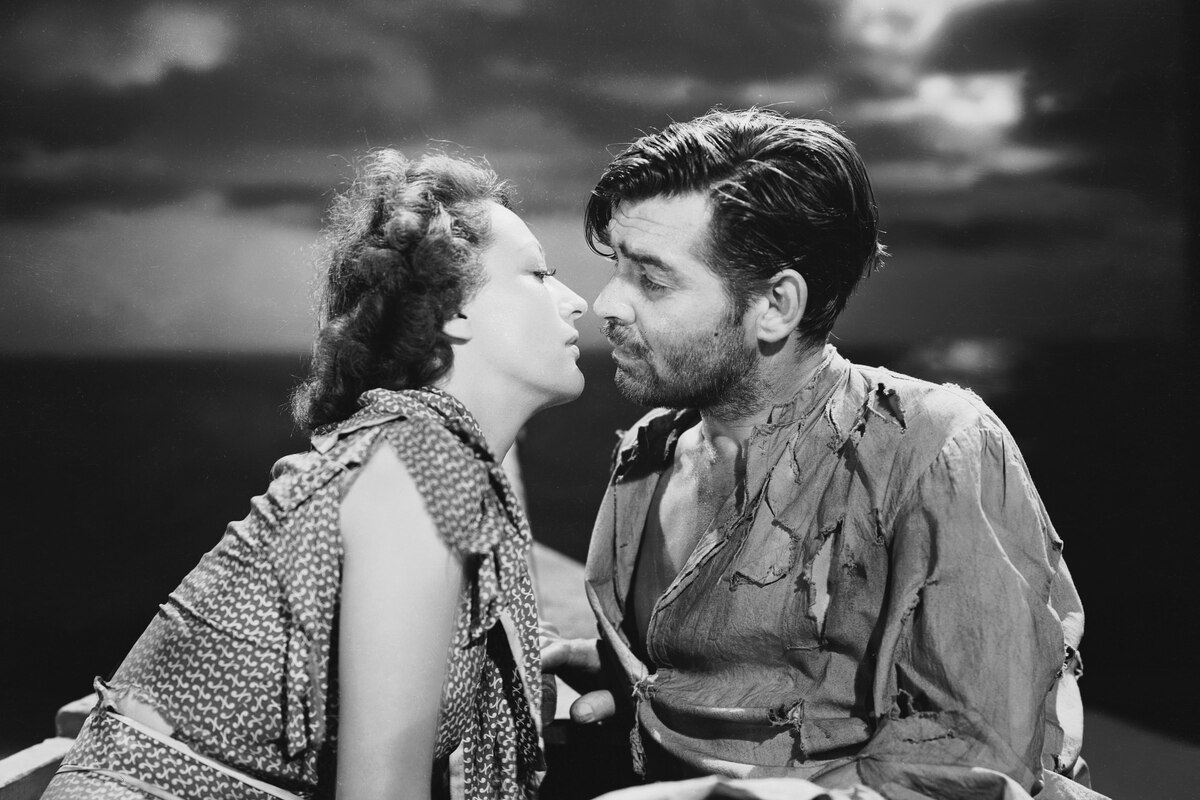
Crawford and Clark Gable for an eighth time was all they needed for the usual, dependable result; after all, the
pair had created memorable heat in earlier pictures. They do indeed create heat again here, but with Strange
Cargo the studio got something different. It's a prison escape melodrama on the one hand, but also a
somewhat meandering meditation on faith and spirituality on the other. The end result is both gritty and lush, a
bit uneven yet consistently (and yes, strangely) compelling.
The script, based on a Richard Sale novel called Not Too Narrow...Not Too Deep, follows the escape of
inmates from Devil's Island, the penal colony on French Guiana, in three distinct acts: in the colony and
surrounding jungle, on an ocean voyage in a small sailboat, and finally on the mainland.
Religious allegory and symbolism are rampant. Before the prisoners plot their escape, a mysterious man named
Cambreau (Ian Hunter, superb) wanders into the prison, posing as an inmate. He is calm and peaceful even as
all the other characters argue and squabble amongst themselves. It's not long before we realize that Cambreau is
meant to be God, especially in counterpoint to the inmate Hessler (Paul Lukas), who is essentially the Devil.
The other inmates, including Gable, each have their own inner demons, and Crawford tags along as a tough
saloon singer who is simply trying to get off the island. The ocean voyage acts as a sort of baptism for everyone,
through which they start to undergo spiritual transformations thanks to Cambreau.
The characters debate issues of religion, philosophy, and the notion of good vs. evil throughout their journey, but
this is not some heavy-handed, proselytizing "religious movie." Rather, the aforementioned themes are
embedded in what is a Gable-Crawford melodrama with entertaining, hard-boiled dialogue, albeit one with
especially thoughtful issues on its mind. A deglamorized Crawford delivers an excellent performance, and Gable
is his usual man's-man self. Peter Lorre turns up as a character named "Monsieur Pig" (or just plain "Pig") who
lusts after Crawford and is otherwise underused.
The biggest strength of Strange Cargo is that as the characters become aware of a spiritual world, the
audience is made to feel something of the same. This is really the substance of the movie, since the plot per se
doesn't amount to much. The characters - and their growing awareness of something beyond themselves - are
had to get out of one's mind afterwards.
Director Frank Borzage uses visuals of darkness, fog, storminess, the ocean, and the jungle to lend a
mysterious, otherworldly quality to the proceedings. Visually and thematically, it's his most mystical movie. In
fact, while Strange Cargo is packaged in a new box set of Joan Crawford movies, it's really a Frank
Borzage movie which happens to star Crawford. Borzage was a romantic idealist who made the most touching
and beautiful love stories in the history of American cinema, coaxing performances out of Margaret Sullavan,
Irene Dunne, Janet Gaynor and James Stewart that were among the best of their careers.
He is perhaps at the top of the list of great American directors whose films are wildly under-represented on DVD.
Very few of his movies have been released, and of those that have, most are not among his really important
works. Sadly missing on home video (as of 2008) are Borzage pictures like Street Angel (1928), Lucky
Star (1929), After Tomorrow (1932), Man's Castle (1933), Little Man, What Now?
(1934), No Greater Glory (1934), Desire (1936), History is Made at Night (1937), Three
Comrades (1938), The Mortal Storm (1940), and Moonrise (1948). All are worth seeking out
whenever one gets the chance.
There is an ethereal beauty to his best movies, both in their physical lighting and in the emotions that Borzage
pulls out of the story and performances. Often in his films there is a primary romantic couple whose struggle of
some sort isolates them, thereby concentrating their experience and feelings to an intense degree not often
depicted on screen. Strange Cargo is something of an anomaly for Borzage. It has the spirituality of his
other films - taken to the limit with a character who is essentially a living Jesus Christ - and it has Clark Gable
and Joan Crawford as a couple, but it is not primarily a romance picture. Instead of a couple being isolated from
the world, here a group is isolated. Instead of love between two people intensified, here everyone's own individual
sense of spirituality is heightened. It's both totally different and quite similar to his other movies.
Strange Cargo is included in Warner Home Video's Joan Crawford Collection Volume 2. Image
quality varies, with the interiors generally looking sharper; mostly, though, it looks great. Among the extras is an
excellent 14-minute featurette on Gable and Crawford produced by Peter Fitzgerald. Both stars came from rough
childhoods. As film historian Jeanine Basinger explains, "They were tough human beings who were uneducated,
from small towns with bad backgrounds, and that's partly why people loved them, because they reached out and
touched real people. They seemed real, but grander than real." Gable and Crawford had amazing screen
chemistry which carried on into a real-life affair that was on-and-off-again for many years, as each entered into
other marriages. They were among the top 10 box-office stars through most of the 1930s, though by decade's
end Crawford was considered box-office poison. Other talking heads in this featurette include Molly Haskell,
Richard Barrios, and Crawford's daughter. Very well-chosen clips and stills add appropriate context.
Other extras include a short subject, More About Nostradamus, a so-so MGM cartoon, The Lonesome
Stranger, and a trailer. Elsewhere in the box set are Sadie McKee (1934), A Woman's Face
(1941), Flamingo Road (1949) and the camp classic Torch Song (1953). All have various extras
including cartoons, shorts, radio adaptations, recording sessions, and two additional new featurettes featuring
the same film historians as on the Strange Cargo disc. The DVDs come in an attractive fold-out
package with brief liner notes. This "fold-out" packaging seems to be a new thing for Warner Home Video. Most
collectors prefer individual slim cases for each title; perhaps this is Warner's way of trying to prevent reselling. In
any event, this is another terrific box set from the studio and well worth a look.
For more information about Strange Cargo, visit Warner
Video. To order Strange Cargo (which is available only as The Joan Crawford Collection, Volume
2), go to
TCM Shopping.
by Jeremy Arnold
Strange Cargo - Joan Crawford and Clark Gable in the Offbeat 1940 Melodrama STRANGE CARGO on DVD
by Jeremy Arnold | December 12, 2007
SIGN UP FOR OUR NEWSLETTERS

CONNECT WITH TCM