A highly entertaining, fast-moving film with endlessly fascinating subject matter,
The Prisoner of Shark Island (1936) is also one of director John Ford's
less-talked-about pictures. Now that it's available on DVD as part of the
mammoth "Ford at Fox" box set and as a stand-alone disc, it has a chance of
being rediscovered.
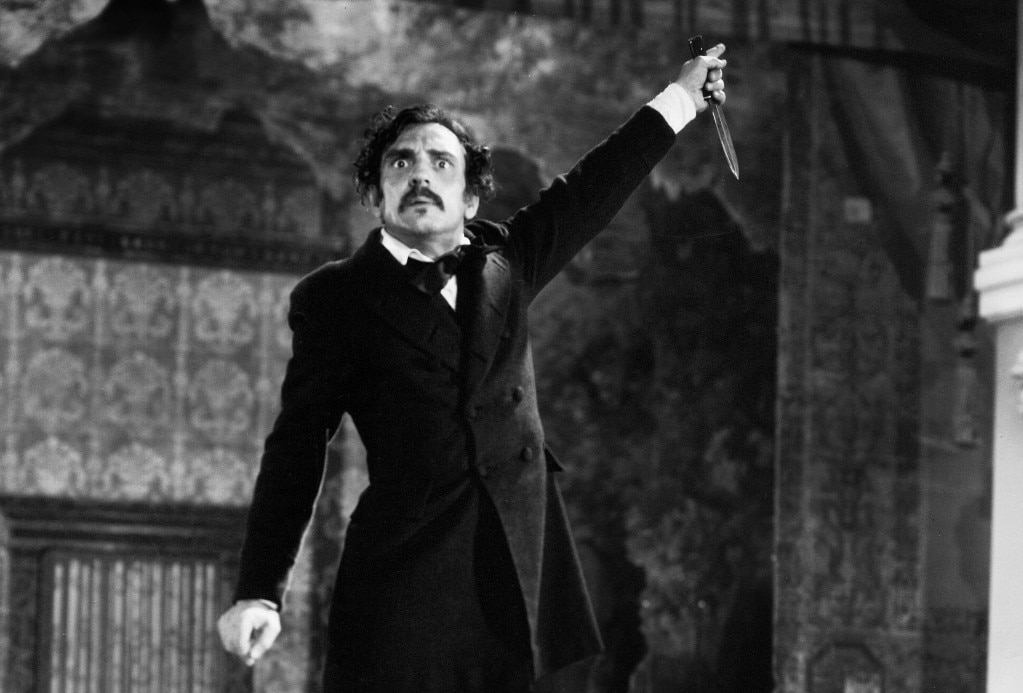
Warner Baxter stars as Dr. Samuel A. Mudd, the doctor who unwittingly helped
John Wilkes Booth mere hours after Booth assassinated President Abraham
Lincoln. (At least it's "unwittingly" in the movie; there remains to this day some
doubt as to just how innocent Dr. Mudd was.) A compelling opening sequence
shows Lincoln performing an act of reconciliation by asking a band to play "Dixie"
for an assembled crowd (a true event) before taking his seat in Ford's Theater,
Washington, DC. The assassination is depicted true to historical fact, and Booth
then makes his escape, his leg broken in his fall to the theater stage. He rides
into Maryland and, needing a doctor, happens upon Dr. Mudd's home, where the
good doctor sets the leg and Booth is off once more. The next morning, soldiers
arrive, deduce that Booth was there, and arrest Mudd.
Then, in a sequence astonishingly relevant to the world of 2007, Mudd and seven
other prisoners are led, hooded and shackled, into a courtoom where military
judges have been instructed to think more about placating angry mobs than about
dispensing proper justice. The concept of reasonable doubt is "an obnoxious
creation of legal nonsense," they have been told by the Assistant Secretary of
War. The prisoners are to be tried in a military rather than a civil court because
their punishment must be swift and hard in order to prevent any further public
discontent. They will not be allowed to mount a defense, or even speak.
It doesn't matter that at least some of the accused are innocent. A few are
executed and others are sent to prison, in Mudd's case for life. Off he goes to
Fort Jefferson, on Dry Tortugas near the Florida keys and sort of an American
Devil's Island, where the rest of the drama plays out. Harry Carey plays the Fort
commander, but it's John Carradine who really runs things there, and he is
deliciously evil and nasty in one of the most memorable performances of his
career. Warner Baxter as Mudd gives perhaps THE best performance of his own
career, and the rest of the cast are also excellent: Gloria Stuart as Mudd's feisty,
attractive wife; Ernest Whitman as Mudd's slave who goes to Fort Jefferson to
help him (the role is similar to the one he would later play in Jesse James,
1939, in which he is equally superb); and John Ford's brother Francis in a
bit.
The movie is beautifully shot by Bert Glennon, who would go on to shoot
Stagecoach (1939), Drums Along the Mohawk (1939) and
Wagon Master (1950), among others, for Ford. The Prisoner of Shark
Island moves very quickly, but there are still some great, highly pictorial
"Fordian" moments, such as the slow closing of the gates at Fort Jefferson as a
bugler plays taps, and the lowering of a veil over Lincoln's face - a purely visual
expression of not only the death of a great man but the poignant close of a
chapter of American history. It's downright poetic in its simplicity.
Fox Home Entertainment's DVD boasts superb image and sound. Extras include
a restoration comparison, an interactive press book, and photo galleries. There's
also a commentary track in which film historian Anthony Slide offers biographical
sketches of the cast and throws in factual context to the story so we know what
was embellished for the sake of drama. Slide does err, however, in claiming that
the expression "His name is mud" refers to this Dr. Mudd. The expression
actually first appeared in print in 1820, 45 years before Lincoln's assassination,
and refers to British slang of the time for "dope," and later on, "scab."
Slide also at times sarcastically repeats pieces of dialogue right after we've heard
them as a way of lamenting their political incorrectness, which is annoying and
unnecessary and tells us more about him than about the movie. He's better when
he makes observations such as the following about an attempted-escape
sequence: "The impressive camera angles help divert our attention away from the
artificiality of the sets."
Twentieth Century-Fox had only very recently been formed from the merger of the
two studios when this picture was made. The opening credits announce "A
Twentieth Century Production," though the copyright credit reads "Twentieth
Century-Fox Film Corporation."
To order The Prisoner of Shark Island, go to
TCM Shopping.
by Jeremy Arnold
The Prisoner of Shark Island - Warner Baxter Stars in the Historical Drama THE PRISONER OF SHARK ISLAND, Directed by John Ford
by Jeremy Arnold | December 12, 2007
SIGN UP FOR OUR NEWSLETTERS

CONNECT WITH TCM