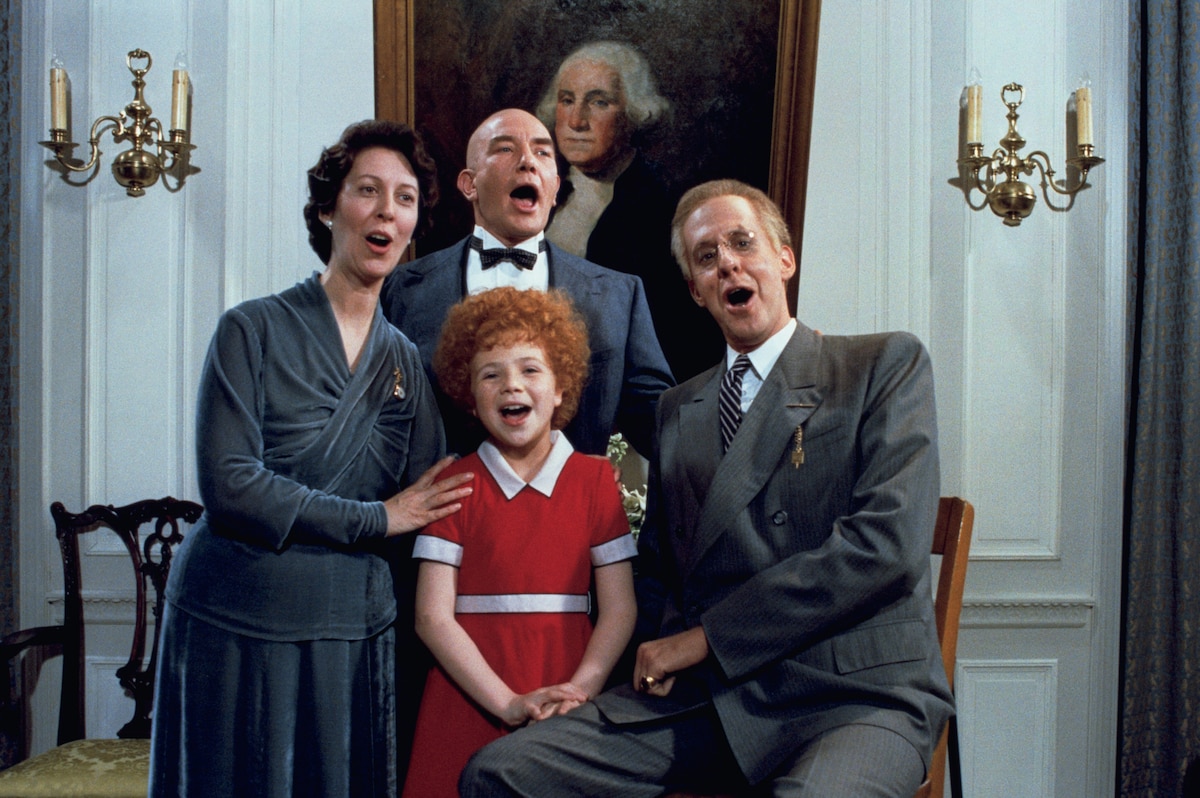
The film musical was a dying breed in 1982, when Columbia Pictures and producer Ray Stark took on the adaptation of the popular comic strip Little Orphan Annie. Whether Stark made the right choice in hiring John Huston to direct his first film in the genre -- at the tender age of 76 -- has been debated ever since. With a sumptuous production and an all-star cast headed by Albert Finney and Carol Burnett, Annie was a natural to pick up at least a few Oscar® nominations (Best Art Direction and Adapted Score). But its budget ($40 million, the biggest for a Columbia film since 1977's Close Encounters of the Third Kind) made recouping the studio's investment a big gamble, one they ultimately lost.
Harold Gray had introduced his comic strip in 1924, though it was originally planned as Little Orphan Otto until Chicago Tribune editor James Patterson convinced him to change the child to "Annie" in tribute to James Whitcomb Riley's famous poem. The plucky orphan picked up her pet dog, Sandy, shortly after her debut. A year later, she was adopted by business tycoon Oliver "Daddy" Warbucks, creating the mythology that would endure for the rest of the comic strip's history.
Annie moved into other media starting with a popular radio series that ran from 1930 to 1942. David O. Selznick produced the first film based on the strip, with Mitzi Green and Edgar Kennedy starring in 1932's Little Orphan Annie. Another version followed in 1938 at Paramount.
The real media explosion didn't start until 1977, when the Charles Strouse, Martin Charnin musical became a surprise hit on Broadway, running for six years. It also swept the Tony Awards, and turned Annie's plaintive song "Tomorrow" into a standard. Andrea McArdle was Broadway's first Annie, followed by Sarah Jessica Parker and Allison Smith. The scene-stealing role of orphanage-keeper Miss Hannigan, which brought Dorothy Loudon a Tony, would later be played by Alice Ghostley, Betty Hutton, Marcia Lewis and June Havoc. With the show's success, Hollywood's studios started competing for film rights, with Columbia finally offering a record $9.5 million.
Part of the deal included a stipulation that Annie not be released until the show's Broadway run was over. That and regime changes at Columbia kept the film out of production for years. Finally, studio head Frank Price asked Ray Stark, whose string of hits included Funny Girl (1968) and The Way We Were (1973), to take over production. Considering the stage version geared toward children, Stark decided to toughen it up for the screen. To do that, he turned to John Huston, with whom he had worked on such films as The Night of the Iguana (1964) and Fat City (1972). The choice had Hollywood insiders scratching their heads, but Stark defended it by stating that in his opinion Huston was Daddy Warbucks, even if the septuagenarian was hardly in any condition to take on the singing and dancing role. Houston was intrigued at the prospect of directing his first musical while at the same time acknowledging that with Columbia's investment it would be more of a Ray Stark picture than a John Huston film.
Jack Nicholson had been signed to play Warbucks originally, but had to drop out, opening the door for Albert Finney, who, seeing the role much as Stark did, modeled the character on Huston. When Bette Midler declined to play Miss Hannigan, Carol Burnett jumped at the showy role and the chance to work with the legendary Huston. The production team then auditioned thousands of young girls before deciding young Aileen Quinn had the right combination of vocal talents and toughness to bring off the title role.
Huston shot Annie on locations in New York, using Shadow Lawn, the former home of Woolworth's president Hubert Pearson, as Daddy Warbuck's' mansion. Since the film was scheduled to premiere at the Radio City Music Hall, screenwriter Carol Sobieski inserted a scene in which Warbucks takes Annie to the famed movie palace to see Camille (1936), and Strouse and Charnin wrote a new song, "Let's Go to the Movies," to establish that scene. The choice of film may have had nostalgic value -- particularly since Annie's editor Margaret Booth had also cut the Greta Garbo classic. But it also led to a pair of anachronisms. Not only had the film been released after the 1932-set Annie, but the 1936 picture was shown in widescreen rather than its original screening ratio.
Critics might have made more of that goof had they not been so busy tearing the rest of the film apart. Although there were kind words for the performers, particularly Finney, and some saw traces of Huston's directorial style in the film, more critics considered it flat and tiresome. Stark would later say that they seemed offended by the film's hefty price tag, though with the cost of the Broadway show's rights removed, it really wasn't any more expensive than the average early '80s studio film. One sign of the critical divide was the fact that Aileen Quinn won both the Young Artist Award for Best Young Motion Picture Actress and the Razzie for the year's Worst Supporting Actress. In this case, bad reviews contributed to a disappointing box office. Although Annie's $57 million take made it the 10th highest-grossing film of the year, it wasn't enough to recoup its costs.
While later generations of critics have praised Annie for the way Annie fits into the gallery of dreamers featured in most of Huston's films and hailed his attempts to undercut the excesses of some of the bigger production numbers, the film has been overshadowed by a more recent adaptation. In 1999, ABC broadcast a Walt Disney production starring Victor Garber as Warbucks, Kathy Bates as Miss Hannigan and Alicia Morton as Annie. Directed and choreographed by Rob Marshall, the television film was greeted with enthusiastic reviews and even won a Peabody Award. It also helped Marshall break into motion pictures, where his adaptation of another stage musical, Chicago (2002), earned the kinds of raves, box office and Oscars® Stark had dreamed of when he first got involved with Annie.
Producer: Ray Stark
Director: John Huston
Screenplay: Carol Sobieski
Based on the stage musical by Thomas Meehan, Charles Strouse and Martin Charnin, and the comic strip Little Orphan Annie by Harold Gray
Cinematography: Richard Moore
Art Direction: Dale Hennesy
Music: Charles Strouse
Cast: Albert Finney (Daddy Warbucks), Carol Burnett (Miss Hannigan), Bernadette Peters (Lily), Ann Reinking (Grace Farrell), Tim Curry (Rooster), Aileen Quinn (Annie), Geoffrey Holder (Punjab), Edward Herrmann (FDR), Peter Marshall (Bert Healy), Lu Leonard (Mrs. Pugh), Pam Blair (Annette), Colleen Zenk (Celette), Ken Swofford (Weasel), Shawnee Smith (Dancer).
C-127m. Letterboxed.
by Frank Miller
Annie
by Frank Miller | December 10, 2007
SIGN UP FOR OUR NEWSLETTERS

CONNECT WITH TCM